Ways4eu WordPress.com Blog
SPA View of ways4eu.wordpress.com
The Brain-Shaped Supernova Remnant in Cassiopeia
By JohnTheWordWhirlwind
on Mon Jan 19 2026
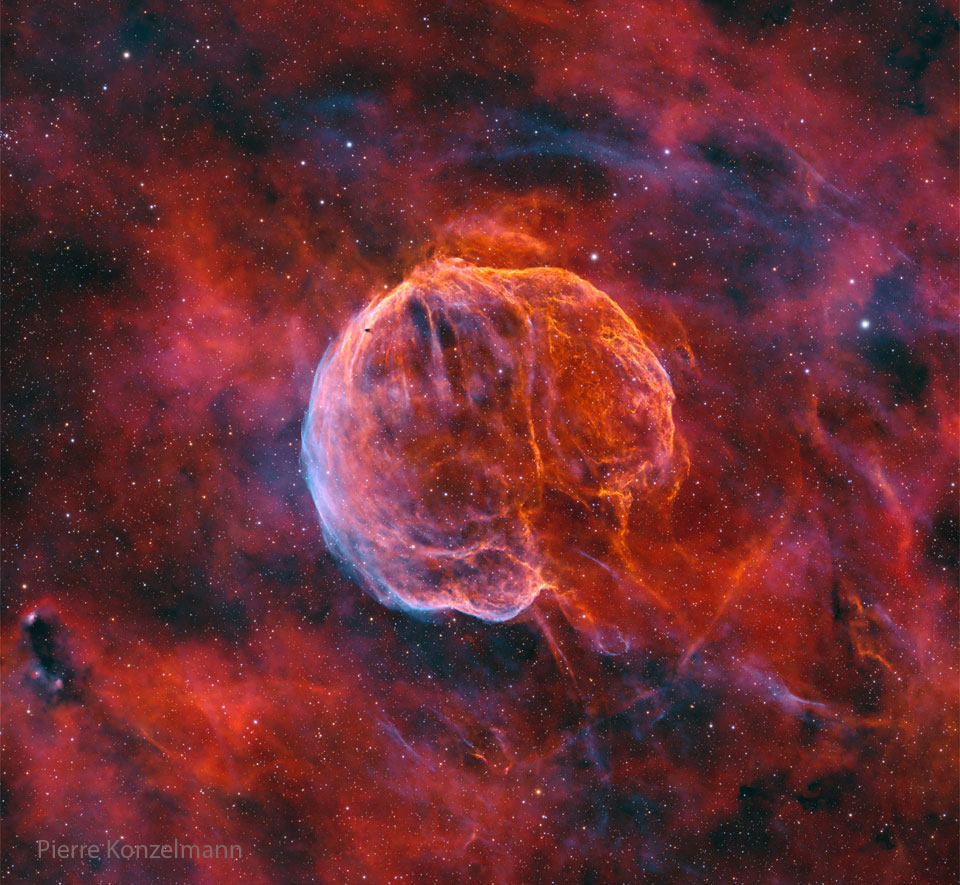
If the universe ever needed a brain teaser, CTB 1 would be it.
This expanding gas shell, left behind when a mighty star in the Cassiopeia region blew itself apart about 10,000 years ago, wears a kinship with brains so well that astronomers nicknamed it the Medulla Nebula. It’s brain-shaped in the most celestial way, a 3D puzzle painted in gas and light, still flickering in the night like a memory that refuses to fade 💫.
What Powers This Unusual Nebula? 🌟
Picture a star that burned through its own fuel faster than a rumor travels through the cosmos. As the star ran out of elements near its core that could sustain stabilizing nuclear fusion, it detonated in a spectacular supernova. The blast cast off a shell of gas that began to drift outward—an expanding, glowing remnant that would outlast most of its stellar siblings by tens of thousands of years.
In visible light, the Medulla Nebula glows because of heat generated by the collision of its gas with surrounding interstellar matter. Think of a cosmic car crash that never truly ends—shock waves heating the gas as the shell plows through space 🚗💥. The result is a soft, brainy glow that you could almost imagine as a faint portrait of the star’s last act.
The X-Ray Mystery 🔍⚡
But the plot thickens in X-ray light, and that’s where things get deliciously mysterious. Scientists are still chasing the reasons behind the nebula’s X-ray glow. One leading idea is that the star’s death didn’t take all the fireworks with it. A pulsar—a highly magnetized, rapidly spinning neutron star born from the supernova—could be powering the nebula with a fierce, fast wind of particles.
If that’s true, CTB 1 is not just a relic of a stellar explosion; it’s a laboratory where the life after death is keeping the nebula lit in ways visible and invisible to us. Much like how Phobos orbits Mars at breakneck speeds, this pulsar is performing its own cosmic dance 🌌.
The Pulsar Evidence 📡
The pulsar hypothesis gains traction with a compelling clue from radio observations: a pulsar has been detected that appears to have been expelled by the explosion at speeds over 1,000 kilometers per second 🚀. That’s a cosmic getaway car, revved and rolling away from the blast site, leaving behind clues in both radio waves and high-energy photons. It’s the kind of evidence that turns a good story into a plausible one: the brain-like shell remains, the pulsar drives a wind, and the nebula glows across different wavelengths thanks to their ongoing interaction.
Scale and Observation Challenges 🔭
And then there’s the sheer scale and the quiet, almost secretive nature of the Medulla Nebula. It may look as large as a full moon in our sky, but it hides in the faint, patient glow of distant gas. To capture its image in all its delicate detail, astronomers needed 84 hours of exposure with a small telescope in Texas. That’s right—a long, steady gaze with a modest instrument, turning a whisper of light into a photograph that lets us peer into a violent, beautiful afterlife of a star.
Understanding such complex astronomical phenomena requires patience and dedication, much like any learning process that benefits from spaced repetition 📚.
What This Tells Us About the Universe 🌠
So what does all of this say about the universe—and about the way we tell its stories? The Medulla Nebula reminds us that stellar death isn’t a one-note goodbye. It’s a complex, evolving tale of energy, heat, shock, and magnetic wind that outlives the explosion itself. The brain-like shape invites metaphor, yes, but the physics behind it is the real star: remnants stirring the interstellar medium, a pulsar pushing wind through the void, and X-ray photons tracing the afterimage of a spectacular cosmic finale.
If you’re tempted to imagine CTB 1 as a celestial postcard, you’re not too far off 📮. It’s a message in a bottle from a star that ran out of fuel but didn’t run out of influence. The Medulla Nebula sits in Cassiopeia like a quiet, radiant brain pulsing in the dark, its questions about X-rays and pulsar winds inviting us to look closer, listen more carefully, and accept that some answers require patience—and a lot of time spent watching the sky.
The Cosmic Takeaway 💭✨
And perhaps that’s the best takeaway: the cosmos loves a good mystery, and it doesn’t rush. The Medulla Nebula shows that even after a star’s dramatic exit, the story isn’t over. The light continues to glow, the wind continues to blow, and the universe continues to keep us watching, year after year, hour after hour, faint as a whisper, brilliant as a revelation when the data finally align 🌟.
For more fascinating insights into space phenomena and cosmic wonders, explore our collection of astronomy articles that bring the universe closer to home 🏠🔭.
Related Topics:Supernova Remnants | Pulsar Wind Nebulae | Cassiopeia Constellation
Image via NASA https://ift.tt/UTvW8iN