Ways4eu WordPress.com Blog
SPA View of ways4eu.wordpress.com
Abell 7: The Universe’s Most Understated Planetary Nebula | Complete Guide
By JohnTheWordWhirlwind
on Fri Jan 23 2026
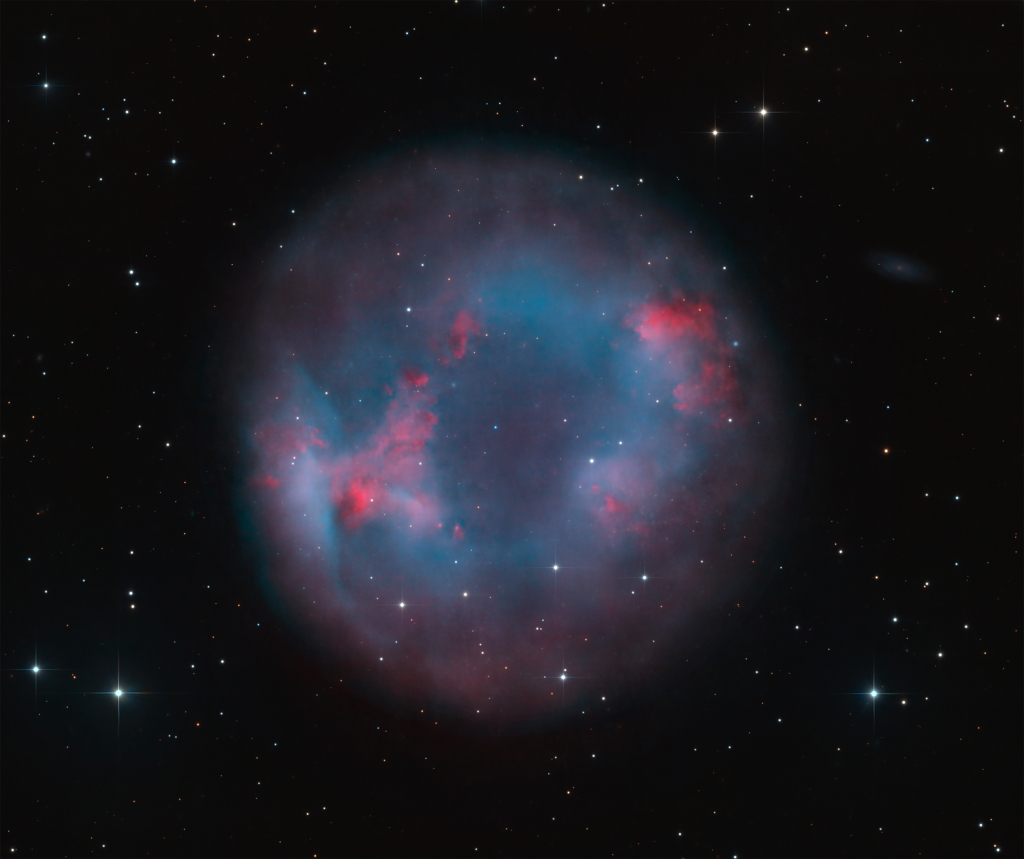
If the sky had a subtle way of wink-winking at us, Abell 7 would be its most understated flirty glance 😉. This faint planetary nebula sits about 1,800 light-years away, and yet it still manages to steal a moment in the mind’s eye when the night is clear and the imagination runs a little wild.
It’s tucked just south of Orion, threading its way toward Lepus—the Hare—for a celestial cameo that would look modest if not for the sheer scale of the cosmos that cradles it.
The Quiet Beauty of Abell 7 🌌
In the grand scheme of skywatching, Abell 7 is not a spectacle that shouts. It prefers a quiet, thoughtful glow. In a deep image, and with the help of patient telescopes and careful filters, its shape emerges as an elegant sphere about eight light-years across. It’s a simple silhouette against the Milky Way’s scatter of stars, yet inside the bubble you’ll find a surprisingly intricate tapestry.
The beauty comes from what you see when you crank up the exposure and tune the colors: emission from hydrogen and oxygen atoms that paint the nebula in hues the eye alone would miss. Without those long exposures and narrowband filters, Abell 7 would be entirely too faint to appreciate, even by the most optimistic of stargazers.
What Is a Planetary Nebula? 🌟
So what is Abell 7, really? It’s a planetary nebula—a very brief curtain call in the life of a star that used to shine like the Sun. When stars like ours run out of fuel, they puff off their outer layers and reveal a shrinking, radiant core. The expelled gas drifts outward in a ghostly, glowing cloak, while the central star—what remains of the once-sun-like sun—dims into a fading white dwarf. It’s a poignant, almost ceremonial finale: a star saying goodbye to its own planetary neighborhood as the rest of the universe looks on.
The Clockwork Behind the Scenes ⏰
And Abell 7 has its own quiet clockwork behind the scenes. The nebula itself is estimated to be about 20,000 years old—a blink of an eye on cosmic timescales, yet enough time for the gas to settle into a recognizable shape and for the central star to settle into its white-dwarf glow. The central star, seen in the image as that fading beacon at the heart of the mist, is far older—about 10 billion years old. It spent most of its life as a middle-aged, stable sun, then decided to spice things up by shedding its outer layers and letting the curtain fall on this chapter with a brilliant, shifting glow.
Stellar Evolution: A Star’s Final Act 💫
If you’re thinking about generations and ages here, you’re not far off. A planetary nebula is a brief stage—a final act in a star’s life where the stellar showbook has almost run dry. Our own Sun is slated to perform this same farewell in roughly five billion years. It’s a reminder that stellar evolution is less like a smooth arc and more like a dramatic, time-lapse bloom: a star ages, changes color, and finally releases its outer layers to drift away in a cloud that will eventually disperse into the galaxy’s memory. Abell 7 is one of those eloquent postcards from a star’s late-life chapter, captured long after the music has faded.
How We Glimpse the Invisible 🔭
What makes Abell 7 so compelling isn’t just its existence, but how we glimpse it. The cosmos does not volunteer its secrets in one bright wink; it asks us to lean in, to stack images, to filter for the right wavelengths, and to let the telescope do the talking. The emission lines of hydrogen and doubly ionized oxygen (the [O III] lines) are the telltale signatures that light up the nebula’s interior, revealing filaments and structures that would be nearly invisible otherwise.
Long exposures gather enough photons to transform a whisper into a conversation, and the narrowband filters tune out the background noise so the nebula’s voice can be heard clearly—soft, patient, and absolutely worth listening to 🎶.
A Cosmic Conversation Spanning Millennia 🌠
In the end, Abell 7 isn’t just a pretty picture for a planet Earthly night out; it’s a reminder of two universes in one frame: the vast, unchanging tapestry of the Milky Way and the intimate, transient life of a star that once burned as brightly as a sun, then gently handed its legacy to the cosmos. It’s also a cue for humility—the realization that the sky’s most delicate features demand time, patience, and a good chunk of dark, quiet night.
Observing Abell 7: Location and Tips 📍
If you ever find yourself staring toward Lepus, the Hare, and you coax your telescope to peek a bit deeper, you’re not just looking at space—you’re watching a centuries-long conversation between a star and the surrounding gas, a dialogue that will outlive the star itself by thousands of generations. Abell 7 is a humble messenger from that conversation: a spherical, eight-light-year-wide reminder that even in a universe that feels endless, there are small, precise, radiant moments worth pausing for, listening to, and letting your curiosity chase a little further.
The Final Bow: A Star’s Legacy ⭐
So, the next time you point your optics toward this quiet corner of the sky, imagine the central star as a patient conductor and the nebula as a shimmering chorus of leftovers—the final, gleaming bow of a star that once held a solar-sized universe in its light. Abell 7 won’t shout. It will simply glow, and in its glow you’ll hear the faint, stubborn note of cosmic endurance.
The universe never ceases to tease us with beauty, but it does so with exquisite restraint—one faint, brilliant ember at a time 🔥.
Related Articles:
– Explore the Iris Nebula
– Discover the Medulla Nebula
– The Whirlpool Galaxy Guide
Learn More:
– Understanding Planetary Nebulae
– Astrophotography Techniques
– Lepus Constellation Guide
Image via NASA https://ift.tt/ukmhfO4