Ways4eu WordPress.com Blog
SPA View of ways4eu.wordpress.com
Phobos and Deimos: Mars’ Doomed Moons Facing a Spectacular Cosmic Fate
By JohnTheWordWhirlwind
on Sun Jan 25 2026
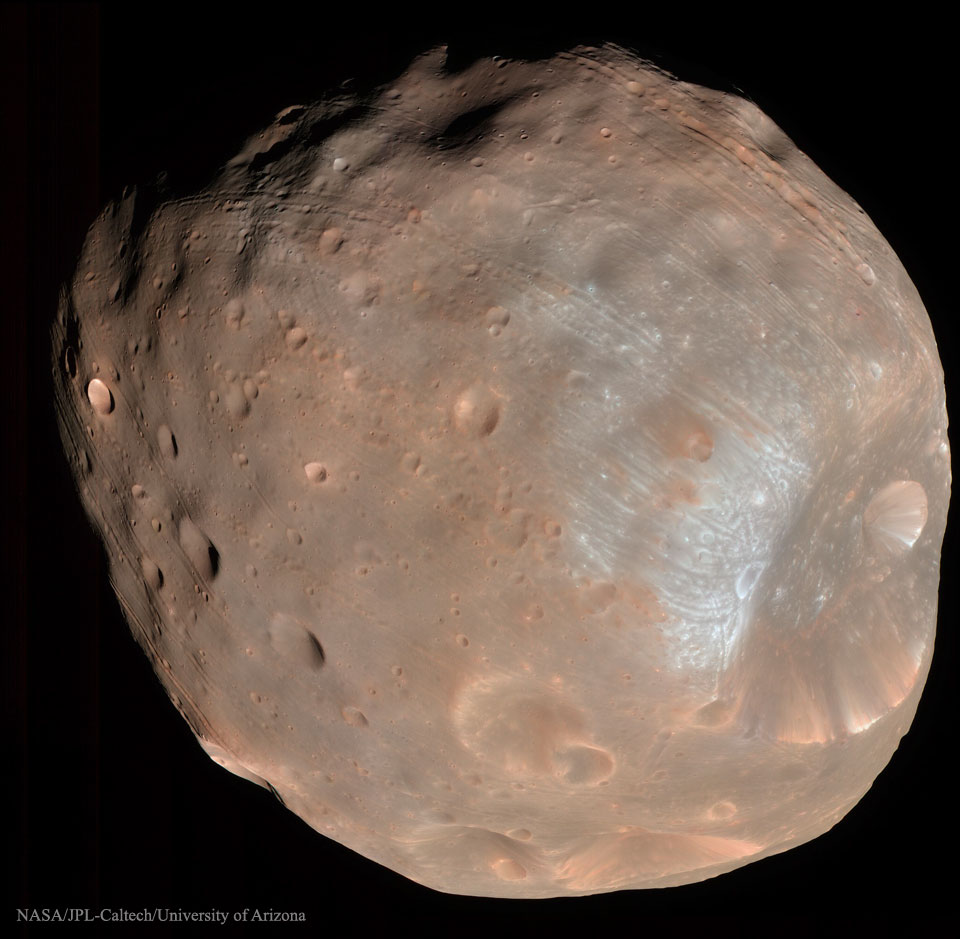
Mars, the red planet named for the Roman god of war, has two pint-sized moons that moonlight as cosmic pranksters: Phobos and Deimos 🌑✨.
Their names come from the Greek for Fear and Panic, which is a fitting soundtrack for a duo so close to a planetary battlefield you could practically hear the tidal whispers. These Martian moonlets may be captured asteroids that wandered in from the main belt between Mars and Jupiter—or perhaps they hail from even more distant corners of our Solar System, brought here by gravitational gossip and a little cosmic luck 🎲.
Phobos: A Cosmic Chicken Nugget with Attitude
Phobos, the larger of the two, isn’t just a rock with attitude. It’s a cratered, asteroid-like chicken nugget of a moon that could double as a spacecraft’s worst nightmare—except it’s the kind of nightmare you’d invite to a science fair 🔬. A stunning color image from the Mars Reconnaissance Orbiter shows Phobos in crisp, crater-pocked detail, a reminder that this isn’t a smooth orb but a battlefield-scarred relic. And yes, the Mars Reconnaissance Orbiter can image objects as small as 10 meters, which makes Phobos look like a stubborn granule of pepper flung across the Martian plains.
The Death Spiral of Phobos
But Phobos isn’t content to just bob around Mars in cosmic irritation 😤. It orbits so close to the planet that it shimmies through the Martian gravitational field at roughly 5,800 kilometers above the surface—a hair’s breadth in space terms, given that our Moon sits about 400,000 kilometers away. The result is tidal forces that are literally tugging at Phobos’ sleeve, pulling harder with every orbit 💫.
The long, slow dance is twisting its fate: a spiral inward that scientists expect will culminate, in perhaps fifty million years, in Phobos meeting a dramatic end. Not a fiery crash, but a grizzled, graceful disintegration into a ring of debris, a celestial encore that Mars might wear for a while as a shimmering reminder of borrowed or captured wanderers 💍.
Deimos: The Quiet Sibling
Deimos, the smaller sibling, watches all this with the wry detachment of a planetesimal who knows that the bigger show will always be about Phobos 😏. Deimos isn’t as close to the fight as Phobos is, and its own future isn’t pinned to a dramatic ring-forming reckoning—yet. It’s a quieter companion, slowly drifting through Mars’ gravity well, more likely to outlive its loud-mouthed cousin while offering a steadier, if less spectacular, view of the Red Planet.
The Mystery of Their Origin
The origin question is part of the charm (and the mystery) of this Martian duo 🕵️. If Phobos and Deimos aren’t born from Mars itself, they’re at least kin to other wanderers—captured asteroids from the main belt, or perhaps icy travelers that found a home in Mars’ gravity for a spell. Their Greek-named monikers are a gentle wink to the drama they bring: fear and panic, fear and dread, orbiting a world that has inspired more imagination than most of the stars put together ⭐.
A Cosmic Survivor’s Story
And what a show Mars puts on! The MRO’s color imagery doesn’t just reveal a rock; it reveals a history of impacts, a record of the Solar System’s messy adolescence, and a reminder that not everything in the cosmos wears a smooth, friendly face 🪨. Phobos isn’t out there as a polished moon with a halo; it’s a rough-edged chunk that survived wreckage, collisions, and whatever else the solar neighborhood threw its way. It’s a cosmic survivor, even as its timing belt tightens around its own future.
The Inevitable Cosmic Rearrangement
If you want a headline with punch, you’ve got one: This moon is doomed 💥. Not today, not tomorrow, but in a cosmic blink—tens of millions of years from now, the tug-of-war between Phobos and Mars will end with a spectacular, if not entirely friendly, rearrangement of the system. The ring that Phobos’ remnants could form would be a glowing reminder that even moons aren’t immune to the gravitational gossip of the universe.
The Martian Theater
So here’s the takeaway with a wink 😉: Mars may look serene from a distance, a dusty red postcard from a simpler time, but up-close it’s a dynamic theater where tiny moons flirt with doom, where ancient rock meets gravitational choreography, and where science imagines futures both breathtaking and a little bit melancholic. Phobos’ ringlet of debris could someday glitter in the Martian twilight, a celestial necklace for a world that has long been used to being red and restless 🔴✨.
Until then, Deimos will keep its quiet watch, and we’ll keep watching the skies, wondering what borrowed wanderers will grace our solar stories next 🌌.
Image via NASA https://ift.tt/6TmCuoV