Ways4eu WordPress.com Blog
SPA View of ways4eu.wordpress.com
Running Man Nebula (Sharpless 279): Star Formation in Orion’s Sword
By JohnTheWordWhirlwind
on Mon Feb 02 2026
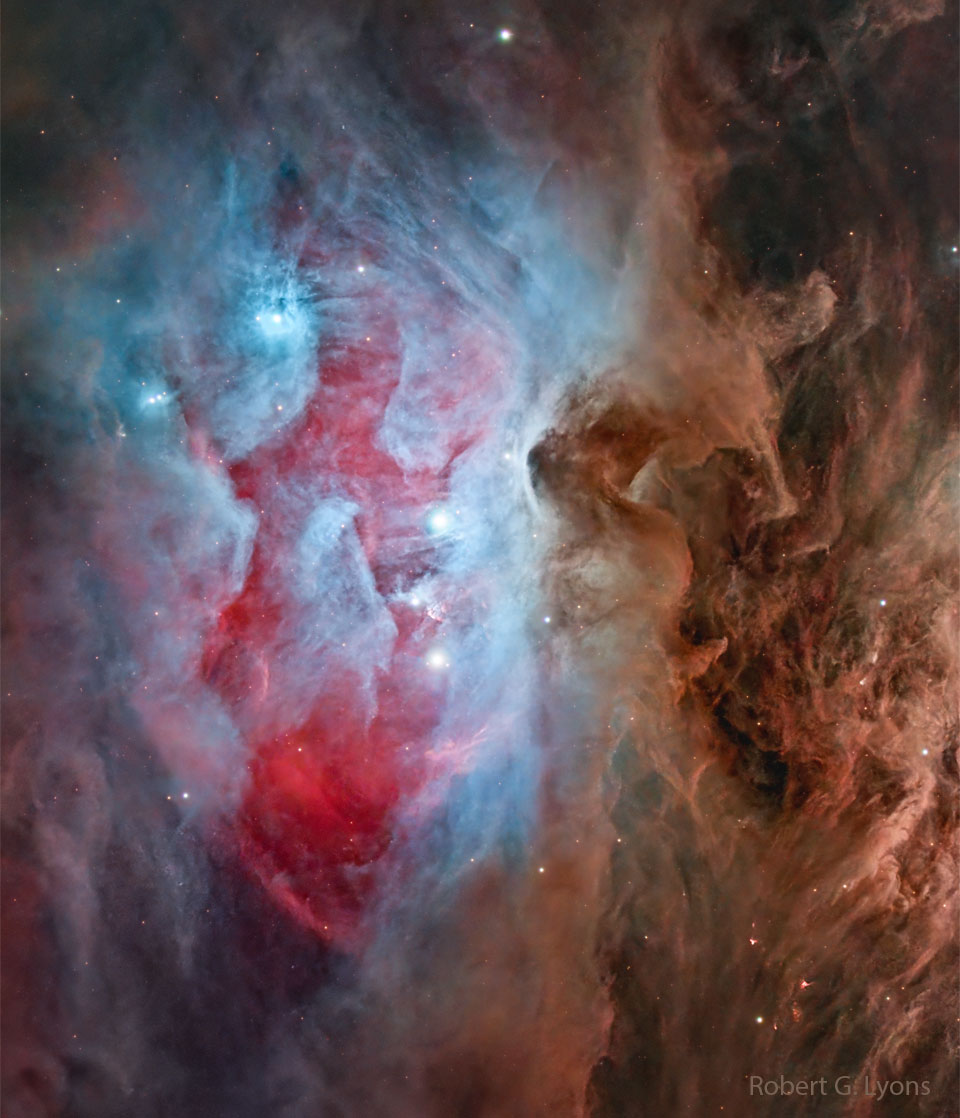
Running Through Orion’s Sword: The Running Man Nebula and Its Dusty Dash ✨
Just north of the famous Orion Nebula, in the slice of sky that forms Orion’s Sword, a picturesque star-forming region offers a different kind of cosmic spectacle: a tangle of intricate dust bathed in starlight 🌟. This is the Running Man Nebula, also known by its catalog name Sharpless 279. Looked at from the right angle, the brownish dust seems to morph into running legs 🏃, giving this celestial cloud its memorable nickname.
What Makes It Glow: Reflection Nebula Secrets 💫
What you’re seeing is a reflection nebula. The dust itself isn’t glowing on its own; instead, it’s lighting up because it’s catching and reflecting the light from nearby young stars. A splash of blue tint shines through in places because reflection preferentially scatters the blue light more than the red—think of it as interstellar sunlight bouncing off a cosmic dust-filter. Similar to other nebulae in the Orion region, the Running Man showcases the beautiful interplay between starlight and cosmic dust.
Location and Stellar Nursery Dynamics 🔭
The Running Man sits squarely in Orion’s Sword, part of the larger Orion molecular cloud complex. This isn’t just a pretty dust cloud; it’s a bustling cradle of star formation ⭐. The region’s bright stars—among them 42 Orionis, the luminous beacon closest to the image’s center—send out powerful radiation that interacts with the surrounding dust. Over time, that radiation slowly sculpts and erodes the cloud, reshaping its dusty limbs. In the grand timescale of the cosmos, the dust won’t last forever—the material here is slowly being swept away, and researchers estimate it may be completely gone in about 10 million years ⏳.
Scale and Cosmic Context 🌌
Stretching about 15 light-years across and sitting roughly 1,500 light-years from Earth, the Running Man is a sizable feature in the sky, but its true drama unfolds on scales of light-years and millions of years. The nebula isn’t isolated; it’s part of the broader Orion molecular cloud complex, a fertile region where gas and dust mingle and swirl under the influence of starlight and gravity. It’s a snapshot of a dynamic process—the way stars form, light pollution from newborn suns, and the slow erosion of the very scaffolding that birthed them.
If you tilt your head and squint at the right angle, you’ll notice the Running Man’s “legs” forged in brown dust, with the blue-reflected pockets acting like accents that hint at the stars embedded within 👀. That juxtaposition—dusty silhouettes against a glow of reflected starlight—gives this region its character: a dusty race track where cosmic winds and radiation are the pace cars 🏁.
Why Astronomers Study Star-Forming Regions 🔬
Why should we care? Because the Running Man Nebula offers a tangible reminder that star formation is not a still-life portrait. It’s a dynamic, evolving scene, constantly reshaped by the light of newborn stars 💡. By studying regions like Sharpless 279, astronomers glean clues about how radiation impacts dusty environments, how quickly dust can be dispersed, and how the cradle of stars evolves over millions of years. Just as scientists study other fascinating nebulae like the Boogeyman Nebula near Orion or distant planetary nebulae, the Running Man provides crucial insights into cosmic evolution.
A Living Cosmic Laboratory 🌠
So, next time you read about star-forming regions, picture the Running Man along Orion’s Sword: a 15-light-year-wide ribbon of blue-tinted reflections and brown dust, quietly sprinting through a cosmic atmosphere shaped by its own light ✨. A simple, dazzling postcard from a universe that’s always in motion, where even the dust gets a running start—and, eventually, a finish line that’s millions of years away 🎯.
Whether you’re interested in deep space exploration or simply marveling at the night sky, the Running Man Nebula reminds us that the cosmos is a living, moving laboratory 🔭. Each photograph captures not just beauty, but the ongoing story of stellar birth and cosmic transformation that has been unfolding for millions of years—and will continue long after we’re gone.
Related Topics:Orion Constellation | Reflection Nebulae | Astrophotography Tips
Image via NASA https://ift.tt/GOg9eID