Ways4eu WordPress.com Blog
SPA View of ways4eu.wordpress.com
NGC 1333: The Cosmic Star Nursery in Perseus | Space Photography & Astronomy
By JohnTheWordWhirlwind
on Tue Feb 03 2026
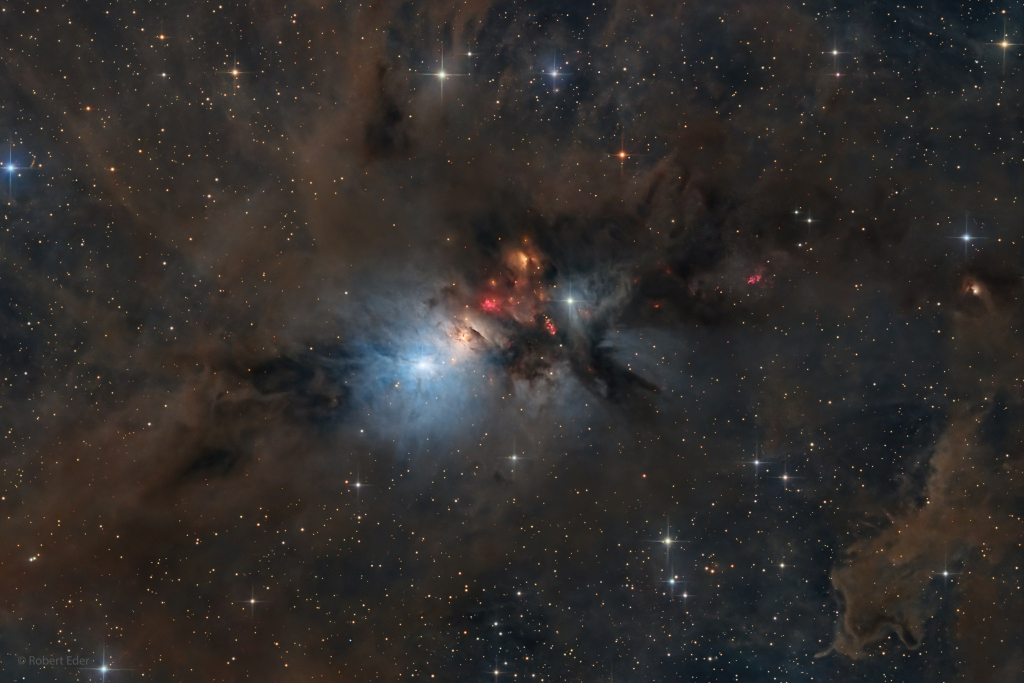
The Bustling Star Nursery on Perseus Street ✨
If the universe had a neighborhood watch, NGC 1333 would be the bustling star nursery on the corner of Perseus Street. In visible light, this blue-tinged jewel reads as a reflection nebula—starlight shining on interstellar dust, with blue hues doing their best impression of a cosmic glow stick 💙. The dust doesn’t glow on its own; it simply reflects the light of nearby stars, scattering it like sunlight bouncing off a sea of sapphire grains. The result is a canvas that looks almost painterly, as if someone took a brush to the cosmos and decided to emphasize the cool blues of starlight hitting dust.
A Modest Distance in Cosmic Terms 🌌
The distance is delightfully modest by cosmic standards: about 1,000 light-years away. Not exactly next door, but close enough that a well-placed telescope can tease apart the drama without needing a starship’s fuel reserve 🚀. It sits at the edge of a colossal, star-forming molecular cloud—a giant, cold cloud of gas and dust that’s basically a cosmic construction zone. Here, gravity has a habit of grabbing messy piles of material and turning them into baby suns. It’s the kind of environment that makes you wonder if the universe’s own version of a day care center has a “no attendance” sign for foggy mornings and a “please, no jumping” policy for infant stars 👶⭐.
The Scale of Star Formation
If you focus the view a bit, you’ll notice that the telescope’s field of view spans a little more than two full moons across the sky 🌕🌕. At the estimated distance of NGC 1333, that translates to a patch just over 15 light-years across. In human terms: a sizable chunk of space, but still a tiny corner of the Milky Way’s vast metropolis. It’s big enough to host hundreds of nascent stars, yet intimate enough that the drama of their births can be followed by the patient gaze of an observer with a good eye and a steady hand.
The Cosmic Theater of Star Birth 🎭
Within this dusty theater, there are details that catch the eye and the imagination. The region reveals the dusty niches where material clumps and threads toward future suns. And then there are the telltale signs of activity—contrasty red glows that indicate the presence of Herbig-Haro objects. These are the jets and shocks produced by newborn stars as they gulp down their surroundings and hurl material outward at high speeds ⚡. When those supersonic jets slam into the surrounding gas, they heat it and ionize it, lighting it up with a glow that looks, in images, like red sparkles scattered across the cloud ✨. It’s a visual reminder that star formation isn’t a peaceful process but a roiling, dynamic dance of inflows, outflows, and pretty dramatic lighting effects.
Hundreds of Stellar Youngsters 🌟
And speaking of newborns, NGC 1333 is something of a celestial cradle for hundreds of stars. Most of these stellar youngsters are less than a million years old—a blink of an eye in cosmic time, yet enough to have left their earliest stages shrouded in the pervasive stardust that fills their birth cloud 🌠. In optical views, many remain hidden behind the dusty curtains, but infrared eyes and spectrographs can peer through that veil long enough to tell us that a baby boisterously exists inside each cocoon. It’s a reminder that what we see with our naked eye is only a fraction of the story; a lot of the real action is taking place just out of reach of visible light, where the dust’s opacity is a sly, persistent antagonist 🔭.
Echoes of Our Solar System’s Birth 🌍
All this activity is more than just a pretty panorama. It echoes a possible chapter from our own solar system’s origin story. The chaotic environment in NGC 1333—the flurries of gas, the gravitational push-pull, the energetic jets—may be strikingly similar to the conditions under which the Sun and its siblings formed more than 4.5 billion years ago. It’s a cosmic reminder that our solar system’s early days probably didn’t happen in a pristine, orderly cradle, but in a bustling, boisterous neighborhood where gravity, dust, and starlight collided in spectacular fashion 💫.
A Narrative Written in Light and Dust 📖
If you like your astronomy with a side of storytelling, NGC 1333 offers a narrative with all the right plot devices: a blue reflection nebula to set the mood, a dust-filled stage to hide and reveal budding stars, dramatic red jets to punctuate the action, and a time-lapse-like window into the chaotic infancy of planetary systems. It’s a place where hundreds of tiny suns are still finding their footing, still wearing their dusty veils, still learning how to shine in a universe that loves a good ignition sequence 🔥.
So next time you hear someone sigh about the calm of the night sky, point them toward Perseus and say, “Look closer. The quiet hides a nursery.” NGC 1333 is a reminder that the cosmos is not just a backdrop of twinkling points; it’s a bustling workshop where stars are born, jets are launched, and the earliest chapters of solar systems—perhaps even our own—are being written in light, dust, and a bit of celestial swagger ✨🌌.
Image via NASA https://ift.tt/UeV9h6F