Ways4eu WordPress.com Blog
SPA View of ways4eu.wordpress.com
NGC 1512: The Three-Ring Galaxy – A Cosmic Circus of Stellar Rings ✨
By JohnTheWordWhirlwind
on Wed Feb 04 2026
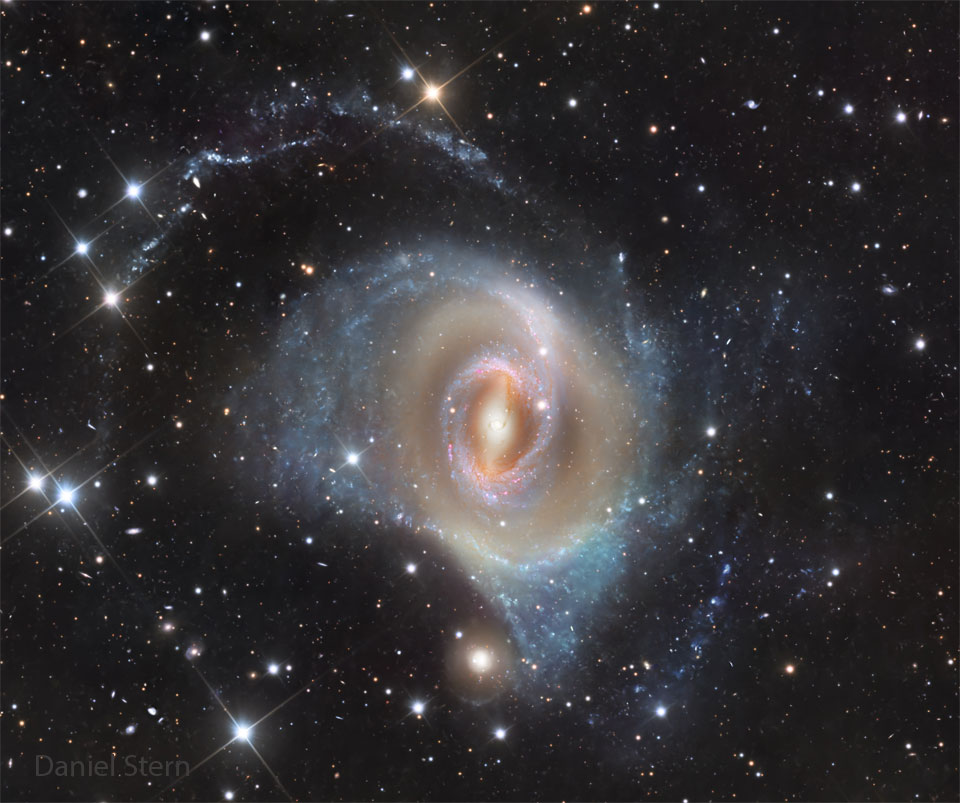
The Three-Ring Circus of NGC 1512 ✨🪐
Most galaxies don’t have rings—why does this one have three? 🤔 It’s a cosmic punchline that leaves even the most seasoned stargazer smirking. The image before you centers on NGC 1512, a barred spiral galaxy that decided to accessorize with not one, not two, but three luminous rings.
The Nuclear Ring: A Stellar Nursery 🌟
To begin, tucked near the galaxy’s heart is a nuclear ring. It’s so close to the center that it’s practically playing hide-and-seek, yet it glows brightly with newly formed stars. This stunning 2,400 light-year-wide circle of infant star clusters creates a “circumnuclear starburst ring“. If you squint at the image hard enough, you can almost sense the current starburst energy radiating from that compact loop 💫.
The Inner Ring: Cosmic Crossroads 🌌
Next outward lies a ring of stars and dust that looks both red and blue—an inner ring, counter-intuitively named for its position. This ring isn’t just a pretty belt; it serves as a cosmic crossroads, connecting the ends of a diffuse central bar of stars that runs horizontally across the galaxy. It’s as if the bar laid down a chalk line and the inner ring followed, tracing the route with stellar paint. This bar structure acts as a type of stellar nursery, channeling gas inwards through orbital resonance and fueling star birth.
The Outer Ring: Sparkly Goodbye 🎆
Farthest out in this wide-field view is a ragged structure that might be considered an outer ring. This outer ring has a spiral-like temperament, dotted with clusters of bright blue stars that pop against the galaxy’s softer glow. It’s the luminous fringe, the galaxy’s sparkly goodbye, a reminder that rings aren’t always tidy. Similar to the star-forming regions found in nebulae like the Running Man, these bright knots represent areas of intense stellar birth 🌠.
Secular Evolution: The Patient Sculptor ⏳
All these ring structures are thought to be influenced by NGC 1512’s own gravitational quirks in a drawn-out process astronomers call secular evolution. In other words, the galaxy’s gravity isn’t a blunt hammer but a patient sculptor, slowly reworking stars, gas, and dust into looping patterns over cosmic timescales. This process can take billions of years, transforming the galaxy’s structure through internal dynamics rather than external collisions.
Deep Sky Chile Captures the Drama 🔭
The featured image was captured last month from a telescope at Deep Sky Chile in Chile, offering a fresh glimpse into this ringed drama. Located in the Rio Hurtado Valley at 5,590 feet above sea level, this exceptional astronomical site boasts over 320 clear nights per year and seeing conditions around 1 arcsecond. Such pristine conditions make it ideal for capturing the intricate details of cosmic wonders like NGC 1512 🏔️✨.
Cosmic Companionship 🤝
Remarkably, NGC 1512 isn’t alone in space—it’s gravitationally interacting with its smaller companion, the dwarf galaxy NGC 1510. This cosmic dance, ongoing for 400 million years, has warped NGC 1512’s outer spiral arms and likely contributed to its dramatic ring structures. The interaction demonstrates how gravitational forces shape galaxies over vast timescales, much like the tidal forces affecting Mars’ moons Phobos and Deimos.
The Cosmic Takeaway 🎪
If you ever doubted that space could come with a three-ring circus, here’s your reminder: in the cosmos, rings aren’t just jewelry—they’re history in spirals. Each ring tells a story of star formation, gravitational dynamics, and the ongoing evolution of this magnificent barred spiral galaxy located approximately 30 million light-years away in the constellation Horologium ⭐🎭.
Related Topics:
– Deep space observations and astrophotography
– Stellar formation in nebulae
– Space exploration and cosmic wonders
Image via NASA https://ift.tt/zxCy8TO