Ways4eu WordPress.com Blog
SPA View of ways4eu.wordpress.com
NGC 1275: The Magnetic Drama at the Heart of Perseus Cluster
By JohnTheWordWhirlwind
on Thu Feb 05 2026
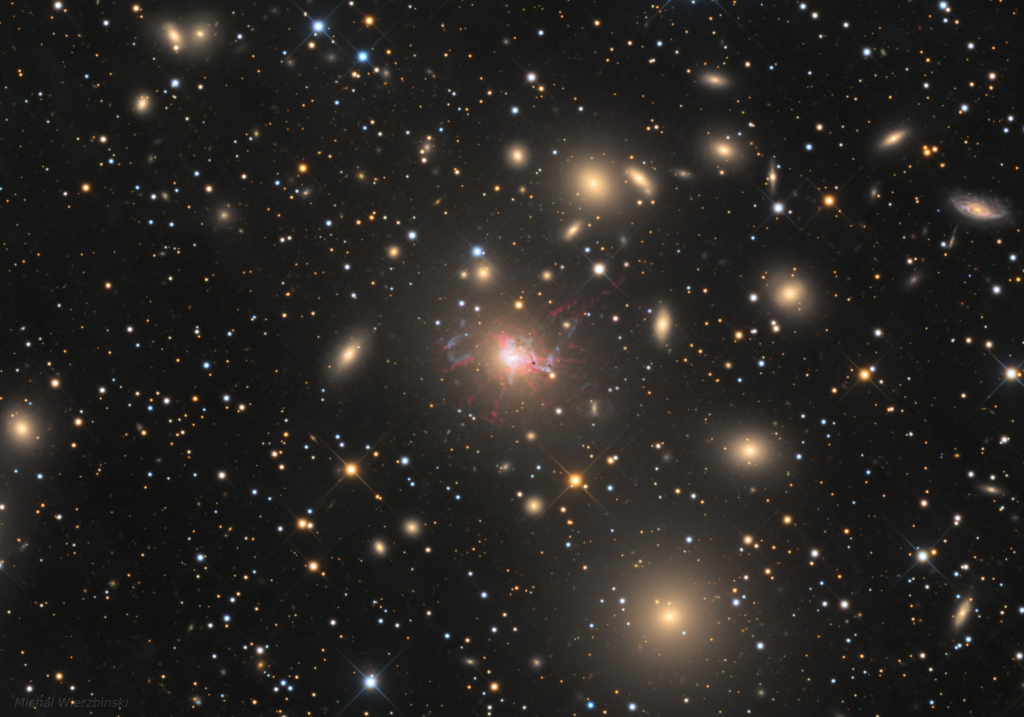
NGC 1275: The Cosmic Diva of the Perseus Cluster 🌌
If you’re hunting for a galaxy that storms the spotlight with more drama than a soap opera, meet NGC 1275—the central diva of the Perseus Cluster ✨. Also known as Perseus A, this active galaxy is the gravitational heavyweight in a nearby galactic neighborhood. It spans more than 100,000 light-years, sits roughly 230 million light-years away, and stares back at us through a mess of X-rays, radio waves, and a nebula of glowing gas that would make any nebula blush 💫.
A Visual Spectacle Across Wavelengths 🔭
In the optical realm, NGC 1275 can look wild enough to headline a sci-fi poster: a jumble of starry debris, wisps of light captured in sharp, almost architectural detail. But the real party happens in other wavelengths. The galaxy is a prodigious source of X-rays and radio emission, a telling sign that something powerful lurks at its core.
The Supermassive Black Hole at the Center ⚫
And what lurks is a supermassive black hole feasting on matter—and not just from the galaxy itself. Whole galaxies drift into the cluster’s gravitational clutches, feeding this cosmic appetite and feeding the black hole’s appetite in turn. It’s a grand cosmic buffet 🍽️, with the central galaxy as both host and conductor.
The Mysterious Filamentary Structures
Luminous Threads in the Darkness
Zoom in with the right instruments, and the scene shifts from a chaotic buffet to a more organized, almost sculptural display. Narrowband image data—think of it as color-tuned physics—highlights a cascade of galactic debris and long, luminous filaments of glowing gas. Some of these filaments stretch up to 20,000 light-years in length. They’re not tiny threads you’d ignore in a casual glance; they’re colossal, delicate tendrils that still persist long after the gravitational chaos of galactic collisions should have torn them to pieces 🌟. It’s as if the cosmos decided to keep a few spare strands of cosmic spaghetti in the pot, even after the boil.
The Magnetic Backbone 🧲
So, what gives these filaments their stamina? The quick, suspenseful answer is: magnetic fields. Observations point to a magnetic backbone that holds the strands together as they’re pushed outward from the galaxy’s center by the very activity of the black hole—the jets, the outflows, the dramatic feedback that keeps the center from turning entirely into a quiet sinkhole. In other words, while gravity and gravity’s friends are busy rearranging material on a colossal scale, magnetic fields are acting as invisible anchors, binding the filaments into something coherent rather than letting them drift into the surrounding hot gas.
A Cosmic Tug-of-War ⚡
Think of it as a cosmic tug-of-war played out on scales we can barely fathom 🤯. The black hole and its energetic outbursts push and sculpt, carving filaments out of the galactic material. The magnetic fields—woven through the plasma like an invisible lattice—hold the structure in place, resisting dispersion by the intracluster medium’s pressure and the chaotic flows of matter. The result is a striking magnetized skein that survives the ritual chaos of galactic encounters, a reminder that in the universe, sometimes the strongest glue isn’t gravity alone but magnetic finesse ✨.
A Living Laboratory for Astrophysics 🔬
NGC 1275 isn’t just a pretty multi-wavelength postcard. It’s a living laboratory for questions about how galaxies grow, how black holes regulate their environments, and how the intracluster medium trades heat and matter in a dance choreographed by magnetic fields. Perseus A—the central powerhouse of a nearby cluster—offers a rare chance to see, in a single system, how feeding black holes, galactic cannibalism, and magnetic architecture can shape structures on tens of thousands, even hundreds of thousands of light-years.
Multiwavelength Storytelling 📡
For readers who love the visual in astronomy as much as the numbers, the appeal is twofold. First, there’s the perspective: a galaxy so large that its outskirts span well beyond the visible impression it leaves in a single photograph. Second, there’s the multiwavelength storytelling. X-rays tell you where the hottest gas roams; radio reveals the jet activity and the galaxy’s non-thermal heart. Narrowband imaging stitches a map of glowing filaments, turning an active galaxy into a luminous tapestry that hints at the unseen forces threading through the cosmos.
The Scale of Cosmic Drama 🌠
And the scale? NGC 1275 is a reminder that the universe loves big stories 📖. A thousand filaments may appear delicate, but together they compose a structure spanning more than 100,000 light-years and extending into a cluster whose galaxies mingle in gravitational dances over hundreds of millions of years. The mere fact that we can observe these strands at all—20,000 light-years long in places—speaks to the extraordinary sensitivity of modern telescopes and the rich, layered narratives that the cosmos keeps ready for us to decode.
Lessons from the Perseus Powerhouse 💡
In a world where we often chase the newest telescope or the latest simulation, NGC 1275 keeps teaching the same lesson with a different accent: magnetic fields aren’t mere footnotes in astrophysics; they’re active players in shaping galaxies and their environments. They can sculpt, constrain, and preserve structures even as everything around them is in a perpetual state of upheaval. If you want to understand how a galaxy can be both a hungry devourer and a patient architect, watch the filaments—the magnetic lines are the plot device that makes the story coherent 🎭.
Looking to the Cosmos 🌌
As we gaze at Perseus A through the lens of time and distance, we’re reminded of just how much there is to learn about the choreography between black holes, gas, and magnetic fields. NGC 1275 is a testament to the beauty of cosmic complexity—a reminder that the universe’s largest dramas often hinge on the quiet, invisible threads that bind it all together 🧵.
And while we may not yet have all the answers, we do know one thing with clarity: in the heart of Perseus, magnets are doing more than holding things in place; they’re helping the universe tell its most compelling stories ⭐.
Related cosmic wonders: Explore the Whirlpool Galaxy, discover the Running Man Nebula, or learn about deep space observations 🔭✨
Image via NASA https://ift.tt/lN4iE2L