Ways4eu WordPress.com Blog
SPA View of ways4eu.wordpress.com
Cassiopeia A: The Spectacular Death of a Massive Star and Cosmic Recycling 🌟💫
By JohnTheWordWhirlwind
on Fri Feb 06 2026
The Dramatic Life and Death of Massive Stars ⭐
In the Milky Way, massive stars don’t do shy exits. They burn blazing blue-white, forge the universe’s heavy elements in their fiery cores, and, after a few million years at warp speed, go out with a bang that leaves the cosmos forever rearranged 💥. The life story of these giants is basically a blockbuster: collapse from vast clouds, ignition of nuclear furnaces, creation of heavy elements, and a dramatic finale that seeds the next generation of stars. Cassiopeia A (Cas A) is the most vivid afterparty we’ve witnessed from that sequence—a remnant that holds the bones of a star’s spectacular retirement and a reminder of how the universe recycles itself ♻️.
Cosmic Compost: How Stellar Death Seeds New Life 🌱
The star’s swan song isn’t just a flash in the pan. The enriched material blasted into interstellar space becomes the raw feedstock for future stars, planets, and all the heavy atoms that make life possible. When a star dies in such a cataclysmic fashion, its debris doesn’t vanish. It spreads out, mixes with the surrounding gas, and over millions of years can spark new star formation, like cosmic compost turning into starlight ✨. Cassiopeia A is one of the clearest, most compelling examples of this final phase of the stellar life cycle, a celestial fingerprint of a supernova that shaped its neighborhood long before we learned to look closely enough to understand it.
A 11,000-Year Journey Through Time ⏳
If you could have stood in the Earth’s sky at the moment Cas A exploded, you would have seen a brilliant flare around 350 years ago 🎆. That’s the moment the blast’s light finally reached our planet. But the light’s journey to Earth took a far longer route—the photons spent about 11,000 years wending their way through the galaxy before arriving in our atmosphere. It’s a humbling reminder that what we observe is a snapshot of a long-vanished event, viewed through the lens of time itself. The cosmos likes to keep us waiting—and then rewards the wait with a more detailed view than we could have imagined 🔭.
Webb’s Stunning View of Cas A’s Fiery Remains 🔥
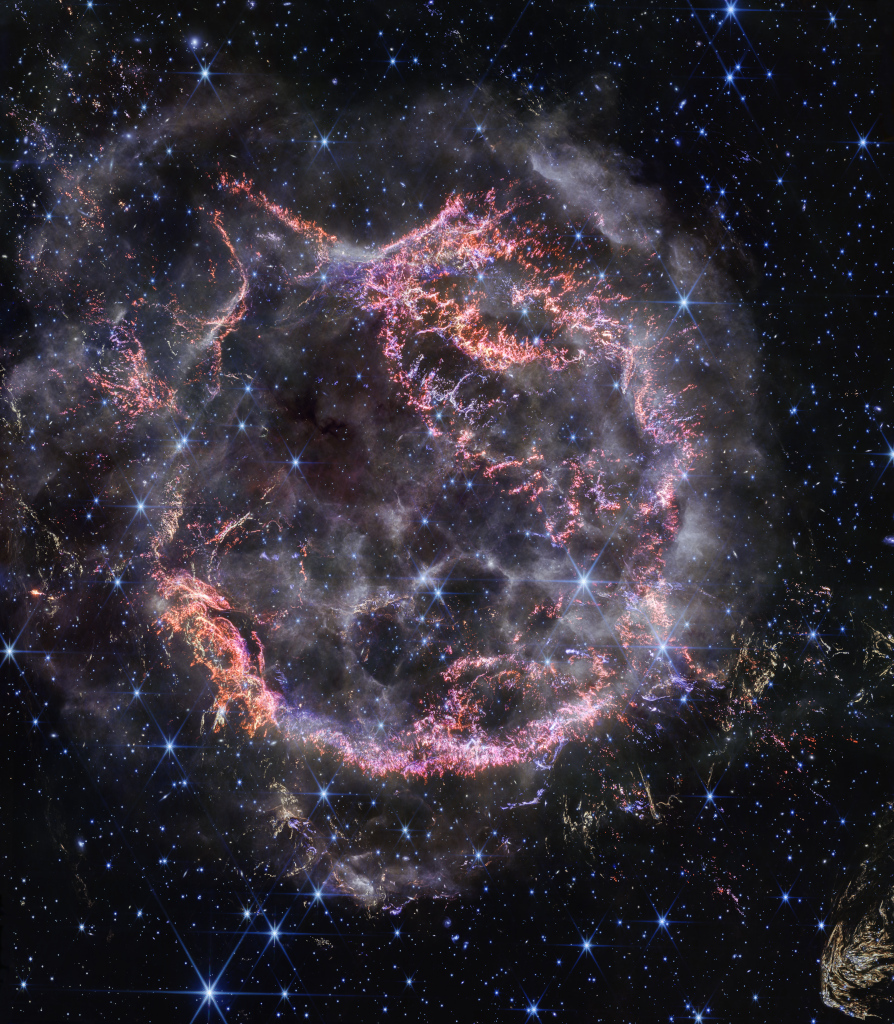
A sharp NIRCam image from the James Webb Space Telescope offers just that kind of reward. The still-hot filaments and knots within Cas A look like the ember trails of a cosmic wildfire, woven through a tangled tapestry of gas and dust 🌫️. These structures aren’t neat and tidy; they’re jagged, luminous shards left behind by a violent past, each filament a railway of cooling gas that still remembers the blast. The contrast between the brighter knots and the cooler, darker surroundings gives astronomers a direct line into the dynamics of the explosion and the subsequent expansion of the remnant. It’s a vivid demonstration of how a dying star can leave behind a complex, working-with-timework of physics that keeps teaching us new things as our instruments improve.
The Immense Scale of Destruction 📏
Speaking of scales, the outer shell of the Cas A remnant is simply enormous: the whitish, smoke-like veil of the expanding blast wave spans about 20 light-years across 🌌. If you could stand on one edge and shout across Cas A, your voice would take 20 years to reach the opposite side. Of course, you wouldn’t want to stand there shouting, but the image gives you an intuitive feel for the sheer magnitude involved when a star’s explosive finale throws trillions of tons of matter outward at thousands of kilometers per second. The shell isn’t perfectly uniform or smooth—this is ancient, chaotic debris after all—but its broad silhouette is a testament to the force unleashed when the star finally gave up its noble struggle 💪.
Light Echoes: Cosmic Time Capsules 📸
Cas A isn’t just about a single explosion. It’s also a laboratory for studying the way light travels through space and how the interstellar medium records those cataclysmic moments. Webb’s observations reveal a series of light echoes—the delayed reflections of the original explosion off dust and gas in the surrounding medium 💫. These echoes act like cosmic time capsules, letting astronomers map the three-dimensional structure of the nearby interstellar environment and reconstruct details of the supernova that would be almost impossible to glean from a single moment in time. The echoes are not merely pretty features; they’re a way to hear the past—an astronomer’s rattle of the celestial calendar, resonating across the void.
The Rosetta Stone of Stellar Death 🗿
So what does all this mean for our understanding of the universe? Cas A is more than a pretty picture 🖼️. It’s a rosetta stone for stellar death and galactic recycling. The heavy elements forged in the heart of massive stars—elements essential to planets, oceans, and life as we know it—are dispersed into space by supernovae like Cas A. That material becomes the building blocks for new stars and planetary systems, continuing a cycle that has played out countless times since the galaxy’s earliest days. Observing Cas A with JWST isn’t just about marveling at a spectacular remnant; it’s about watching a fundamental process of cosmic evolution in vivid, tangible detail 🔬.
Endings Are Just Beginnings 🌅
If you’re hunting for the moral of the story (as a reader who enjoys a good celestial plot twist), here it is: endings aren’t just endings. They’re beginnings—on a timescale that makes human patience look like a pep talk ⌛. Cas A reminds us that the universe is not a static stage but a living workshop where death refines and seeds what comes next. The 11,000-year light show that reached Earth is a reminder that we stand within a grand, slow booklet of time, one whose pages are written in X-ray filaments, infrared wisps, and the glimmering afterglow of echoes that travel across the void 📖.
A Cosmic Origin Story Written in Stardust ✨
In the end, Cas A isn’t just a remnant of a once-mighty star. It’s a cosmic origin story, a testament to how galaxies keep turning the pages, star after star, generation after generation 🌠. And if we’re lucky, our own tiny corner of the Milky Way will someday write its own chapter in the same long, brilliant, stardust-filled tradition. The remnant is here to tell us that science isn’t just about calculation and cold data; it’s about listening to the universe’s astonishing stories, one light-year at a time 🎵.
Related Topics:Stellar Evolution | James Webb Space Telescope Discoveries | Supernova Remnants | Nucleosynthesis | Cosmic Recycling
Image via NASA https://ift.tt/CaJ3Rm0