Ways4eu WordPress.com Blog
SPA View of ways4eu.wordpress.com
Miranda Moon: Uranus’s 500km Wonder with Hidden Ocean Discovery | Space Exploration
By JohnTheWordWhirlwind
on Mon Feb 09 2026
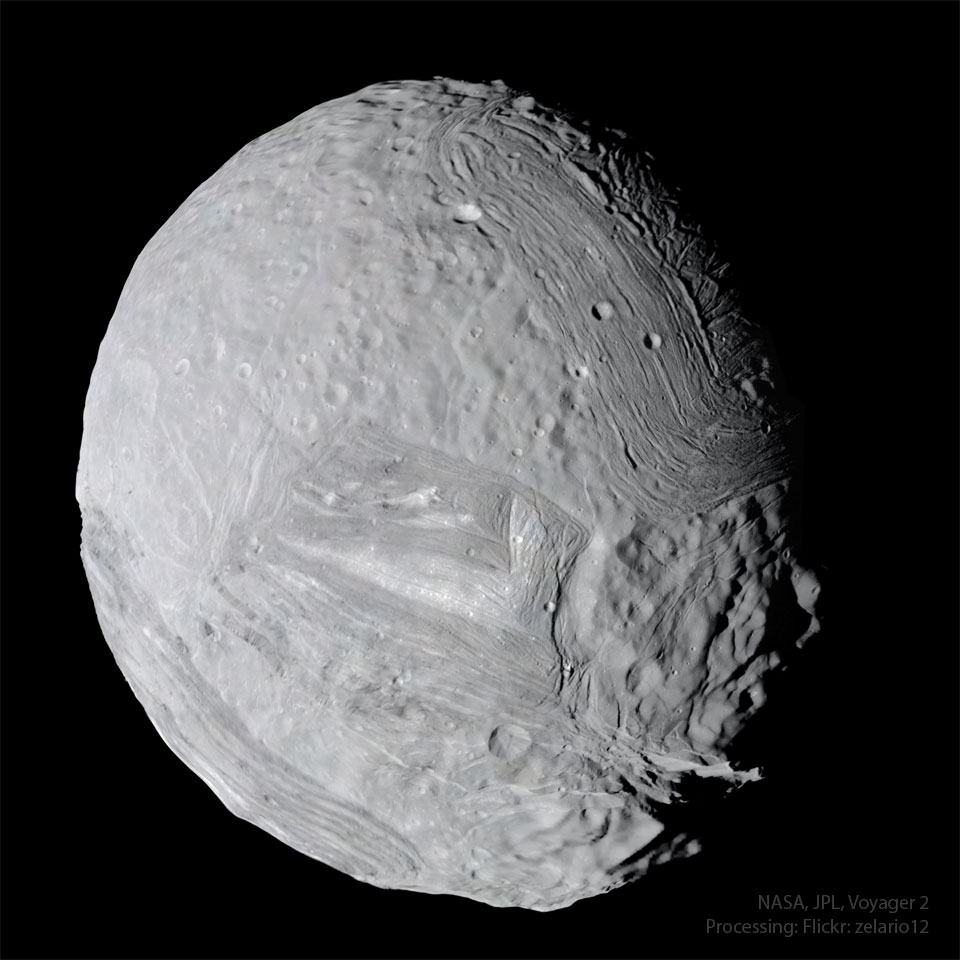
If you’ve never given Miranda a second thought, you’re not alone. Until recently, this little moon of Uranus played the wallflower at the outer-Solar-System dance. Then Voyager 2 showed up, painted a sharper picture, and suddenly Miranda wasn’t just a blot on a planetary map—it’s a drama queen with canyons, grooves, and a backstory that could rival any soap opera. 🎭
Visuals That Make the Case 📸
Thanks to a careful revival of older images from Voyager 2’s historic 1986 flyby, Miranda’s face has emerged with a clarity that would have felt revelatory even to the spacecraft’s own engineers. The images highlight a roughly 500-kilometer-wide moon orbiting with a swagger that belies its size: cratered plains, fractured terrains, and elongated grooves snaking across its surface like wrinkles earned from a lifetime of geological drama. The imagery—remastered and polished—gives us a feature image that’s as striking as it is informative. Learn more about Voyager missions and space exploration. ✨
A Name with Literary Flair 📚
Miranda’s name isn’t just a label; it’s a nod to a character from Shakespeare’s The Tempest. In the play, Miranda is the daughter who embodies innocence and wonder, a fitting moniker for a moon that’s both fragile and formidable in equal measure. The connection isn’t just poetic; it’s a reminder that our solar system’s frontiers invite stories as rich as any on Earth.
The Shakespeare Connection
All of Uranus’s 28 known moons are named after characters from works by Shakespeare and Alexander Pope, making this planetary system unique in our cosmic neighborhood. 🎭
What Voyager 2 Revealed—And What Scientists Are Still Figuring Out 🔬
When Voyager 2 swept past Uranus in January 1986, Miranda’s surface announced itself with a mix of features that were both familiar and perplexing. It’s a world of contrasts: smooth plains beside rugged, grooved ridges; large scarps that look like torn pages in a planet’s diary. The close encounter gave scientists a first, striking glimpse into a body whose geological history seemed to have been written in ice, rock, and a lot of tension.
What’s exciting now is that researchers are revisiting those old data and images with fresh eyes and better techniques. By reprocessing Voyager’s photographs and combining them with newer modeling, scientists are re-evaluating how Miranda got its distinctive topography. The consensus is not a single “aha” moment, but a provocative possibility: Miranda could have hosted a subsurface ocean beneath an icy crust at some point in its history, with tidal forces from Uranus contributing heat that kept a pocket of liquid water afloat long enough to carve those dramatic features.
A Leading Hypothesis: A Hidden Ocean That’s Slowly Freezing 🌊
The idea of a subsurface ocean beneath Miranda isn’t just science fiction; it’s a natural consequence of what we know about tidally heated, icy moons. According to a groundbreaking 2024 study published in The Planetary Science Journal, the ocean would have been at least 100 kilometers deep and hidden beneath an icy crust no more than 30 kilometers thick.
How Big Was This Ocean? 💧
Given Miranda has a radius of just 235 kilometers, this subsurface ocean would have filled almost half of the moon’s body—a stunning revelation for such a small celestial object. If Miranda once harbored a warm, liquid layer beneath its crust, gravitational flexing from Uranus could have kept pockets of water liquid long enough to drive movement in the ice, fracture the crust, and form the colossal canyons and ridges we see today.
As the interior cools, that ocean would gradually freeze, leaving behind the telltale grooves, fractured terrains, and a surface that still bears the scars of a more dynamic past. Explore more about ocean worlds in our solar system.
Tidal Heating: The Key Ingredient 🔥
Key to creating that ocean, researchers believe, were tidal forces between Miranda and nearby moons. These regular gravitational tugs can be amplified by orbital resonances—a configuration where each moon’s period around a planet is an exact integer of the others’ periods. These orbital configurations and the resulting tidal forces deform the moons like rubber balls, leading to friction and heat that keeps interiors warm.
Why Miranda Matters in the Hunt for Water—And Life 🔍
Miranda isn’t the biggest moon in Uranus’s system, yet it’s become part of a broader lineup that scientists watch for signs of water beyond Earth. Europa and Titan often steal headlines, but Miranda shows that even small, distant worlds can harbor geologic mysteries that point to habitable conditions—past or present.
If a subsurface ocean did exist on Miranda, even briefly, it adds to the growing body of evidence that icy moons are promising places to look for the chemistry of life, or at least the ingredients that could support microbial life in some form. The suggestion of an ocean inside one of the most distant moons in the solar system is remarkable, especially considering Miranda was predicted to be just a frozen ball of ice. 🧬
The Growing Family of Ocean Worlds 🪐
Our solar system’s ocean-bearing moons may collectively hold 100-fold the volume of Earth’s oceans beneath their protective icy shells. This makes them prime targets in the search for extraterrestrial life.
The Big Picture: A Window Into How Worlds Evolve 🌌
What makes Miranda compelling isn’t just the canyons or the grooved terrain; it’s the window it opens into how small, icy worlds evolve under the tug of a giant planet’s gravity. The Voyager 2 legacy—its simple, steady data—continues to spark fresh ideas as we apply modern processing and physics to old images.
Miranda reminds us that the Solar System isn’t done teaching us its secrets, even about a moon that could fit comfortably inside a national park. In fact, upcoming missions to Uranus slated for the early 2030s could further enhance our understanding of this ice giant and its mysterious moons. 🚀
What’s Next for Miranda Research? 🔭
A Uranus Orbiter and Probe mission, designated as a high-priority Flagship-class mission by NASA’s 2023-2032 Planetary Science Decadal Survey, could use radio science methods to detect subsurface oceans on Miranda and Uranus’s other major moons.
If you’re fascinated by the cold edges of our cosmic neighborhood and the long arc of discovery from Voyager to modern science, Miranda is a perfect microcosm: a compact world with a big story, a hint of oceans beneath ice, and a reminder that curiosity can turn a distant moon into a compelling chapter in the ongoing search for water and life in our Solar System. 🌠
Related Topics:
Planetary Science | Astrobiology | Space Missions
“`
Image via NASA https://ift.tt/KUmVZ8p