Ways4eu WordPress.com Blog
SPA View of ways4eu.wordpress.com
RXJ0528+2838: When Cosmic Lighthouses Turn Up the Drama ✨
By JohnTheWordWhirlwind
on Mon Feb 16 2026
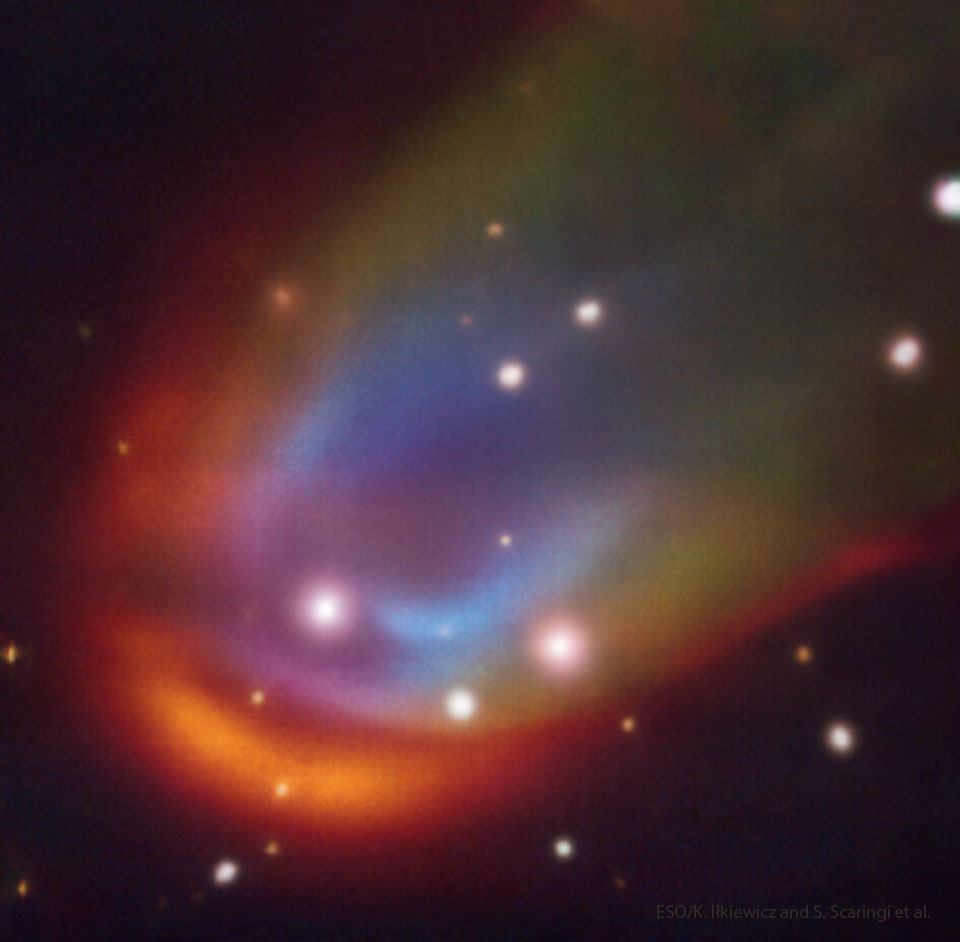
If you’ve ever wondered what happens when a cosmic lighthouse decides to crank up the drama, look no further than RXJ0528+2838. This recently spotted white dwarf—sat just to the left of the two largest, sun-baked freckles on the celestial map—has joined the universe’s most exclusive club: the Mighty But Mysterious 🎭. At a tidy 730 light-years from Earth, it’s the kind of neighbor you’d invite to a stargazing soirée, provided you don’t mind a little bow-wave bravado.
What Creates These Spectacular Shock Waves? 🌊
So, what’s with these shock waves? Imagine a speedboat skimming across a calm lake, carving a glossy arc with a white froth of spray. Now replace the boat with a stubbornly compact stellar remnant and the lake with the interstellar medium—mostly hydrogen, nitrogen, and oxygen slipping through space in quiet, invisible whispers 💫. What you get is a bow shock, the cosmic equivalent of an audience applauding a particularly dramatic reveal. The image that captures this moment was snapped with the European Southern Observatory’s Very Large Telescope, a facility famous for turning the stubborn darkness of space into something almost navigable with the naked eye of curiosity.
Understanding White Dwarfs: The Universe’s Stubborn Survivors 🔬
White dwarfs are the stubborn survivors of stellar evolution. After a star like our Sun fuses nuclei in its core, it eventually sheds its outer layers and leaves behind a dense core—the white dwarf. These stellar remnants are so dense that the only thing stopping them from collapsing is a rulebook written in quantum mechanics. In that sense, they’re the universe’s most stubbornly exquisite accountants: tiny, incredibly dense, and governed by the strange arithmetic of quantum pressure ⚛️.
Our Sun’s Stellar Destiny ☀️
The grand future? In about 5 billion years, our own Sun will join the white dwarf club. The comparison isn’t perfect—our Sun will go from a cheerful yellow beacon to a pale, cooling fossil—the kind of star that would make a chemistry professor sigh with cosmic nostalgia 😌. But for RXJ0528+2838, the story isn’t about inevitability; it’s about the present spectacle.
The Millennium-Long Light Show 🎨
The bow shocks around RXJ0528+2838 have endured for at least a millennium, a stretch of time that makes human history look like a blinking neon sign ⏳. The red, green, and blue hues in the view aren’t just pretty; they’re kilobytes of evidence: glow from hydrogen, nitrogen, and oxygen that illuminates the surrounding gas as if the star’s own shockwave dialed up the chroma. Yet the engines behind these shocks remain something of a cosmic mystery. Astronomers have the frame, the spectrum, and the timing—but not yet the full engine map 🔍. What powers these shocks? The universe isn’t rushing to reveal its secrets, and that’s part of the charm.
The Cosmic Dance of Physics and Drama 💃
Still, this much is clear: the interplay between a stubbornly compact star and its environment creates a drama. It’s not just about the star’s gravity or its faint ember of heat; it’s about how the ejected material, the surrounding gas, and the ambient magnetic fields decide to tango. The bow shock is the choreography, the glow is the lighting, and the centuries-long persistence is the standing ovation from a cosmos that never stops putting on a show 🎪.
For readers who like their astronomy with a dash of humor and a side of cosmic wonder, RXJ0528+2838 offers a reminder that the night sky isn’t a static diorama. It’s a living, sighing, bowing theatre of physics: white dwarfs whispering the rules of quantum mechanics, shocks tracing luminous arcs through the interstellar medium, and scientists piecing together clues from pictures that take lifetimes to fully interpret 🌌.
Why Stellar Afterlives Matter 🌟
So next time you hear a scientist talk about why a star’s afterlife matters, remember RXJ0528+2838: a compact stellar remnant that refuses to fade quietly, instead choosing to shock the universe with a bow wave that spans centuries—and colors the night with the glow of elemental signatures 🎆. If nothing else, it’s a delightful reminder that even in the cold, empty vastness, drama has a way of finding a spotlight.
Related Reading:
- White Dwarf Stars: NASA’s IXPE Uncovers the Cosmic Buffet
- Cassiopeia A: The Most Vivid Supernova Remnant
- The Rosette Nebula: A Cosmic Rose of Gas and Stars
Image via NASA https://ift.tt/8ENtMX4