Ways4eu WordPress.com Blog
SPA View of ways4eu.wordpress.com
🌌 Seeing in the Dark: When Gravity Plays Tricks on Light
By JohnTheWordWhirlwind
on Fri Apr 03 2026
The Masters of Vanishing
How can we see what is invisible? In the grand theater of the cosmos, black holes are the ultimate masters of vanishing acts. They don’t glow, shimmer, or wink like a distant galaxy‘s favorite supernova. They pull, tug, and twist, turning the ordinary act of light’s flight into a dramatic show of distortion.
Gravity as a Lens
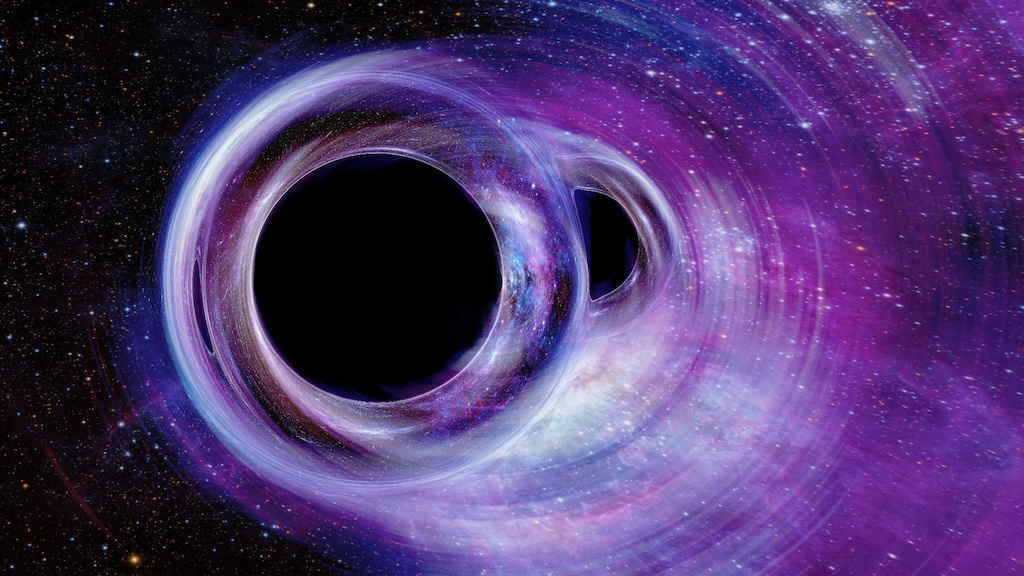
The night sky is a vast stage, and astronomers are the audience who bring the spotlight.Black holes reveal themselves not by throwing a party for photons, but by bending them. As light from background stars and nebulae crashes near one of these voracious giants, gravity warps its path.
The result is a celestial kaleidoscope: warped images, stretched arcs, and sometimes almost perfect rings—Einstein rings—where light has taken multiple routes around the black hole before reaching our eyes. These Einstein rings are named after Albert Einstein, whose general theory of relativity predicted that massive objects would bend light.
The Tarantula Nebula
A striking image in this cosmic play blends science with art. It pairs a simulation of a black hole binary system in its final, dramatic “death-dance” with the breathtaking beauty of the Tarantula Nebula in the background.
The Tarantula Nebula itself is a radiant cauldron of star formation. Nestled in the Large Magellanic Cloud—our Milky Way‘s diminutive satellite galaxy, about 160,000 light-years away—it’s a neighborhood admonition that distance does not always equal dullness.
The Detective Story of the Cosmos
So why does this matter? Because the cosmos is a detective story, and gravity is the most reliable suspect. By watching how light bends, twists, and multiplies, we infer the presence of objects that radiate no photons at all.
We deduce the mass, spin, and even the dance of orbiting partners that would otherwise stay hidden in the black. It’s a reminder that visibility isn’t simply about brightness; it’s about influence. The invisible can cast the most striking shadows, and those shadows are how we learn the rules of the universe.
A Lesson in Perspective
The image we’re drawn to isn’t just a pretty composite; it’s a lesson in perspective. It tells us that nearby or distant, bright or dark, the cosmos operates under the same laws. When light meets gravity’s lens, the universe becomes a gallery where every frame is a clue, every distortion a hint, and every Einstein ring a tiny triumph of physics over opacity.
Seeing the Invisible
As our instruments sharpen and our models grow more confident, we’ll keep spotting these gravitational signatures. The Tarantula Nebula will continue to be a luminous neighbor, while black holes will insist on proving that in the grand design, invisibility is merely a disguise for a masterpiece of gravity.
In the end, seeing the invisible isn’t magic; it’s mathematics wearing a tuxedo. And in the theater of the cosmos, that tuxedo is our best lens—allowing us to witness the elegance of gravity as it rewrites the light that finally reaches our eyes.
Image via NASA / APOD