Ways4eu WordPress.com Blog
SPA View of ways4eu.wordpress.com
🎨 The Furies, the Fire, and Francis Bacon’s First Mature Moment
By JohnTheWordWhirlwind
on Fri Apr 03 2026
A Painting That Hums
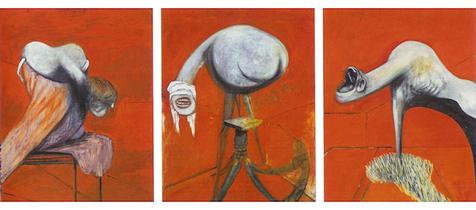
It’s not every day you stumble upon a painting so electric that it practically hums from the wall.Three Studies for Figures at the Base of a Crucifixion, Francis Bacon‘s 1944 triptych, does exactly that—except it hums in a way that sounds more like a siren from a coral reef than a lullaby from a gift shop.
The Visuals: Wringing Motion from Stasis
Let’s start with the visuals, because the eye is, if not the window, then certainly the door to Bacon’s world. The canvases are a trio of writhing anthropomorphic figures slung against a burnt orange backdrop that’s so saturated it could double as a solar flare excuse. The medium—oil paint and pastel on fiberboard—begs to outlive its fragile surface, which is fitting when you consider what Bacon is after: a raw confrontation with human vulnerability.
Source Material: The Furies Reimagined
The source material is a neat conspirator in Bacon’s plot. He leans on the Eumenides, the Furies of Aeschylus’s Oresteia, but instead of translating ancient gloom into a medieval tableau, he refracts it through a 20th-century lens. The figures aren’t idealized or heroic. They’re contorted, almost tidal in their energy, as if the very act of looking at them requires a certain bravery.
Two Weeks That Changed Art History
Two weeks, a short creative sprint by most standards, produced what many regard as Bacon’s first mature work. The urgency isn’t just in the execution but in the idea: a pivot from everything before it to something that feels unapologetically definitive. Bacon famously suppressed earlier works from the market, a move that reads as a man choosing to grow in private before any public rite of passage.
The Orange as Bat Signal
There’s a tension here that’s hard to miss. The figures are set against a flat, almost suffocating orange—color as barrier and invitation at once. It’s a bat signal for the psyche: a call to lean in, to confront whatever lurks behind human surfaces. And Bacon’s influences—Picasso‘s biomorphs, the crifixion, classical myth—aren’t decorative trifles. They’re instruments.
Art as Friction
The triptych doesn’t tell you what to think; it invites you to feel first and then marshal your thoughts. It’s a reminder that art—especially art that aspires to be a hinge rather than a wall—thrives on friction: between audience and image, between reverence and revolt, between mythic gravity and post-war self-doubt.
Craft and Material Truth
The choice of oil paint and pastel on fiberboard is more than a technical detail. The combination creates a surface that can glide from lacquered smoothness to a chalky bite, allowing Bacon to shift textures as readily as he shifts moods. In a world that constantly urges polish, Bacon’s roughness feels like an act of honesty.
The broader art-historical wink here is subtle but powerful. Bacon doesn’t pretend to reinvent myth; he reinterprets it through a lens forged in the crucible of 1940s anxieties. The result is a work that feels both relic and prophecy: a testament to art’s enduring ability to press on, even when the ground beneath feels unstable.
Image via Wikipedia