Ways4eu WordPress.com Blog
SPA View of ways4eu.wordpress.com
💫 The Antennae: When Galactic Love Letters Turn into Cosmic Fireworks
By Kinda Cool
on Fri Apr 10 2026
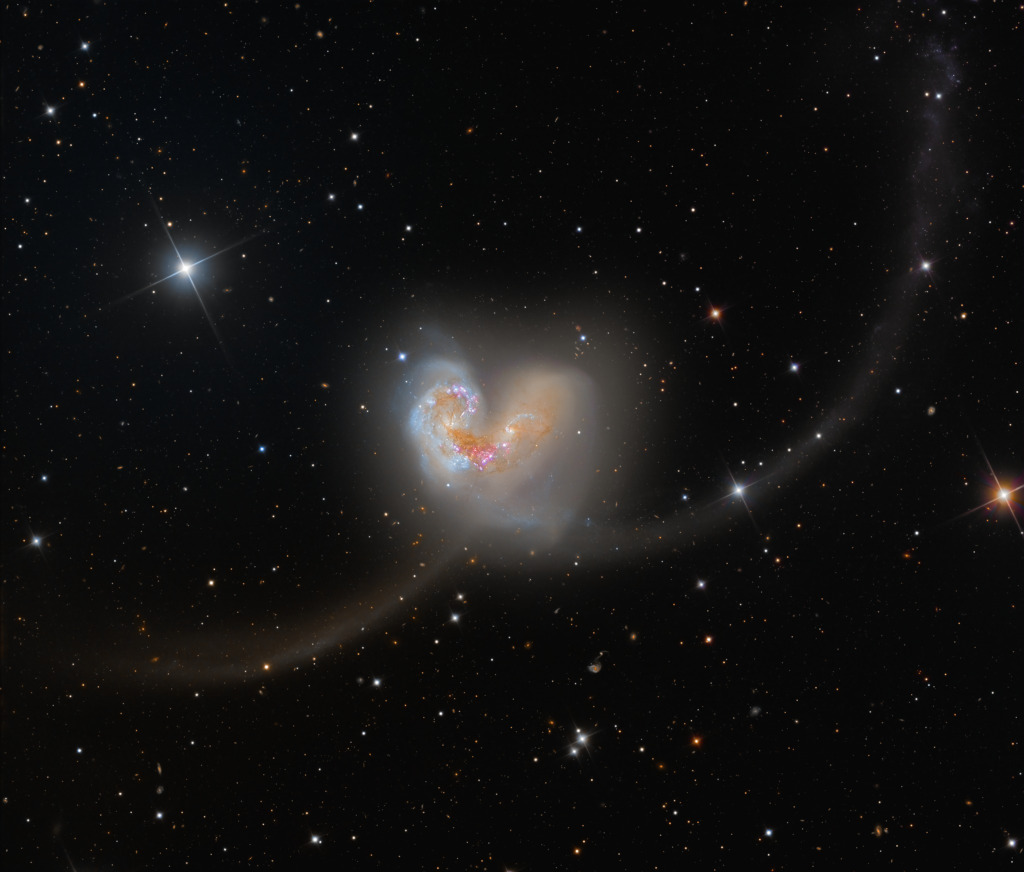
Cosmic Behemoths in an Embrace
If you peek deep into the southern skies, you’ll find two cosmic behemoths in a not-so-private embrace: a grand collision between galaxies NGC 4038 and NGC 4039, tucked away in the constellation Corvus about 60 million light-years from our doorstep. They’re not just bumping elbows; they’re exchanging gravity like a pair of celestial wrecking balls.
Where the Real Party Happens
Collisions between individual stars are exceedingly rare in these colossal encounters. The heavens are vast, and space is mostly empty. It’s the clouds of molecular gas and dust where the real party happens. As the galaxies grind against each other, these clouds compress, spark, and ignite. Star formation goes into overdrive.
Tidal Tails and Background Galaxies
The frame spans over 50 thousand light-years and offers more than pretty pinwheels of light. Newborn star clusters emerge like bright fingerprints, while matter is flung outward by the tug-of-war of gravitational tides. You can trace faint tidal tails and glimpse distant background galaxies peering through the cosmic debris.
The Antennae’s Nickname
Known to astronomers as Arp 244, the Antennae earns its nickname from the sweeping, arcing structures that resemble giant antennal cords reaching toward the void. Those “antennas” are the skeletal remains of a violent romance, a visual metaphor for gravity’s long, elegant pull on matter.
New Light from Chaos
The spectacle is a reminder that change is the only constant in the cosmos. Even when the lights go dark in one corner of the sky, new light—born from chaos—continues to spark. In the Antennae, starlight isn’t just surviving the collision; it’s thriving as new generations of stars begin their lives.
A Cosmic Forge
So next time you hear the phrase “galactic collision,” don’t picture fearsome impacts alone. Picture, instead, a cosmic forge where gravity, dust, and time collaborate to birth the next generation of stars. The Antennae aren’t just two galaxies getting cozy; they’re a celestial workshop where an encore of starlight is continually being written.
Image via NASA / APOD