Ways4eu WordPress.com Blog
SPA View of ways4eu.wordpress.com
🤗 A Hug for Home Away from Home: Christina Koch’s Orion Moment
By Kinda Cool
on Tue Apr 14 2026
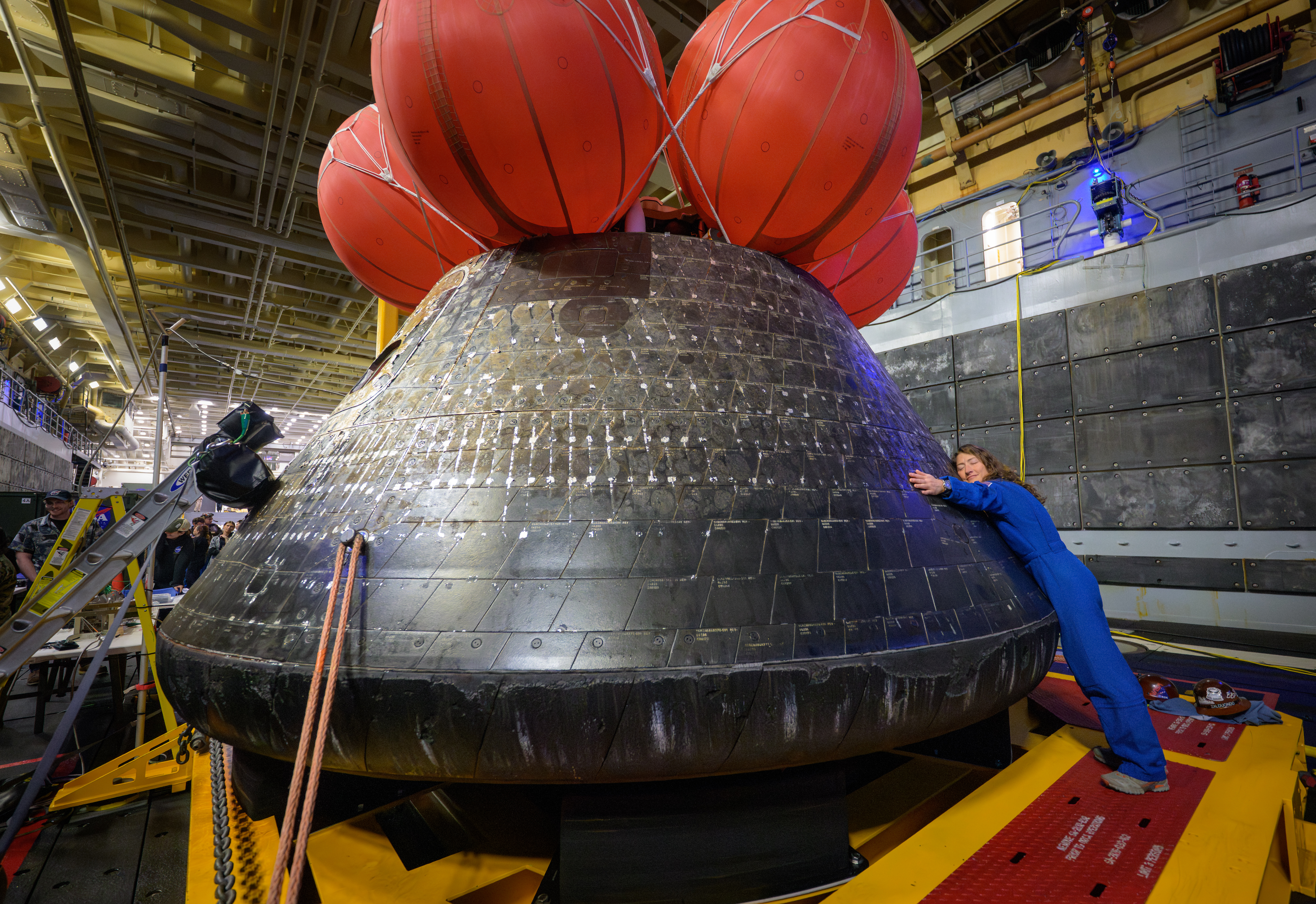
🤗 Hugging the Future — One Spacecraft at a Time
In the grand tradition of people who treat space like a long layover at a cosmic airport, NASA astronaut Christina Koch has mastered the art of hugging the future. On a sunlit Saturday that felt suspiciously like a pep rally for engineers, she wrapped her arms around something that isn’t exactly a place you’d find on a travel itinerary: the Orion spacecraft. The scene took place in the well deck of the USS John P. Murtha, a ship whose name sounds like a veteran’s story told over a well-deserved cup of coffee. And yes, this was April 11, 2026—a date that will be recorded in the annals of “good vibes per square inch” for many years to come.
🎒 A Pep Talk for Your Backpack, But Make It Galactic
If you’ve ever tried to give your backpack a pep talk after a long flight, you know how it goes: you hug it, you whisper, “We’ve got this,” and somehow the zippers feel a little less rebellious. Christina Koch’s moment with Orion was basically that, but on a galactic scale. The well deck, typically a showcase for nautical oddities and the occasional sailor who has memorized every line on a ship’s hull, became a stage for a very human gesture. It wasn’t a press conference or a ceremonial parade—though there were cameras and a chorus of approving nods from the crew—just a sincere, almost ceremonial, embrace between a traveler and their vehicle, the better to remind the universe that home isn’t just a place; it’s a feeling you carry in your chest, preferably with a bit of propulsion.
🔧 More Than IKEA Shelves
The Orion spacecraft is not exactly a set of IKEA shelves. It’s the kind of thing that makes engineers grin in a way that suggests they’ve just solved a riddle with a spoon and a whiteboard. It’s designed to carry astronauts beyond our blue marble and bring them back—the kind of mission that sounds like a sci-fi plot written in the margins of a lab notebook. And yet, in that moment, it looked like a living, breathing confidant. Christina wrapped her arms around Orion as if to seal a pact: we’ve trained for this, we’ve sweated through the simulations, we’ve logged enough physical therapy to outlast a small town, and we’re ready to navigate the mysteries of microgravity.
💍 Space Exploration’s Mood Ring
If space exploration had a mood ring, this moment would be its highest, shiniest setting: hopeful and a little buoyant, with a dash of “we’ve got this, let’s do the thing.” It’s easy to reduce space travel to numbers and trajectories, to talk in metrics and mission dates, but that hug reminds us there’s a human story threaded through every launch. It’s the same story we tell when we lace up hiking boots and step toward an unmarked trail—the impulse to connect, to reassure, to remind ourselves that we belong to something bigger than a single footprint on the ground.
⚓ The Working Stage of Progress
The well deck of the Murtha isn’t a glamorous stage; it’s a working space where logistics, teamwork, and the stubborn magic of hardware meeting humans collide. Yet in that collision, or perhaps because of it, you get a snapshot of why space programs capture imaginations: they’re a reminder that exploration is not just about reaching the stars, but about keeping our feet planted on the ground while we reach. Koch’s hug was a playful cue to the cosmos: we are here, we are excited, and we aren’t afraid to show it with a little warmth and a lot of science-backed swagger.
🫡 A Nod to the Crew
And let’s give a nod to the crew of the Murtha, those steady hands who choreograph the choreography of launch-day life: the deck teams, the engineers, the flight directors who speak in calm, precise cadences and probably dream in mission timelines. The moment of connection—astronaut to spacecraft—speaks volumes about the human side of high-stakes engineering. It’s not all dashboards and telemetry; it’s also hugs, high-fives, and the kind of handshake you reserve for the promise of new frontiers.
🚀 Taking the Work Seriously, Never Forgetting the Hug
In the end, A Hug for Home Away from Home might become more than a photo op. It could be emblematic of the culture we’re building as we push farther into the unknown: take the work seriously, and never forget to give the things you’re building a little squeeze now and then. After all, a spacecraft is not merely a metal tube with thrusters. It’s a lifeboat, a habitats-in-the-sky, a vessel that will carry us to new chapters in the human story. And if a hug can make that voyage feel even a little more like returning to a familiar, comforting room, then perhaps the universe isn’t as vast as it seems—just well enough to contain a good hug and a brave crew who know how to share the warmth.
❤️ You’re Not Alone Out There
So here’s to Christina Koch, Orion, and a deck full of sailors and dreamers who know that progress often arrives wrapped in a gesture as simple as a hug. It’s not just about reaching the stars; it’s about taking a moment to say, with arms open wide, “You’re not alone out there.” And if a well deck on a ship can become a launchpad for that sentiment, then we’re already halfway to home, wherever home happens to be.
Image via NASA
© H.J. Sablotny — All rights reserved. The text content of this post is the intellectual property of H.J. Sablotny. Images are subject to their respective copyright holders and are used for illustration purposes only.