Ways4eu WordPress.com Blog
SPA View of ways4eu.wordpress.com
🌌 A Starry Spin from Brazil to the Southern Cross
By Kinda Cool
on Thu Apr 16 2026
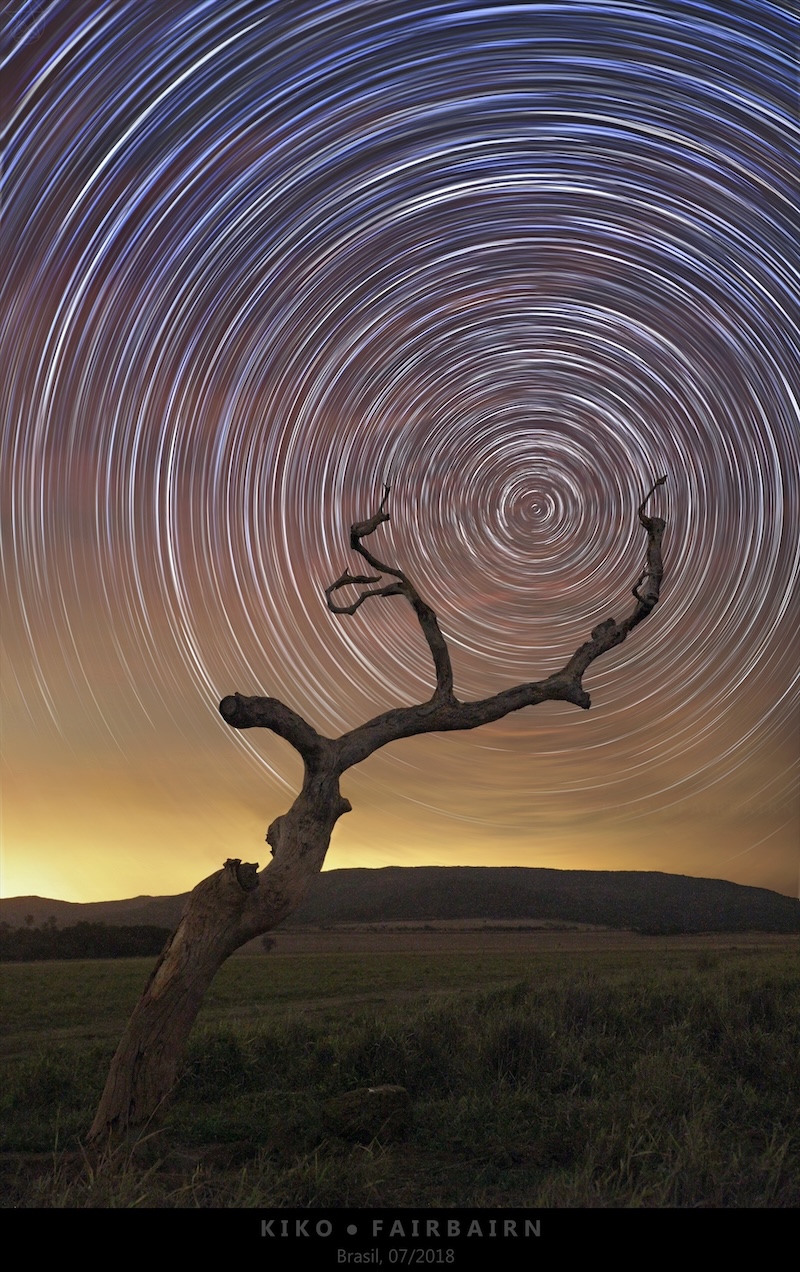
🌟 North vs. South: A Tale of Two Poles
If you live in the northern hemisphere, you’ve probably learned the simple trick of finding north by locating Polaris, the North Star. It sits near the northern celestial pole like a steadfast beacon. Now flip the globe to the southern half of the planet, and the map gets a little more playful: there isn’t a bright, easy-to-spot pole-star down there, but the Southern Cross still gets the job done. Navigation by starlight has always been a little improvisational, a dance with geometry and patience, and a good sense of wonder.
🇧🇷 Padre Bernardo, Brazil — A Celestial Metronome
The image that accompanies this post was captured in Padre Bernardo, a town in Goiás, Brazil. It’s a scene that invites you to lean in and watch the sky do some of its own housekeeping: two hours of star trails around what appears to be an empty southern celestial pole. The stars aren’t spinning because they’re mischievous; they’re simply following the Earth’s rotation. If you watched longer, the arcs would become complete circles, as sure as a clock hand chasing itself around a dial.
🔄 The Science of the Spin
A quick note on the science, for the curious: each star makes a full circle around the celestial pole roughly once every 24 hours. That’s not because the stars themselves are looping the pole; it’s because the Earth is turning on its axis. From any fixed point on the planet, the stars appear to travel in circles around the poles, with Polaris providing a reliable cue in the north. In the southern hemisphere, there isn’t a singular, bright star marking the southern pole, but the Southern Cross serves as a practical guide to finding south.
🌿 The Cerrado’s Living Mosaic
Padre Bernardo sits in the heartland’s Cerrado, a vast tropical savanna that covers much of central Brazil. The Cerrado is a living mosaic: rich biodiversity, seasonal rhythms, and a landscape that can look almost sculptural when the dry season peels back leaves and reveals the bones of the trees. The image’s “sky wheel” is anchored, visually speaking, by a barren branch—an ordinary sight during the dry season, which gives the scene a stark, almost architectural silhouette.
⏳ A Quiet, Gravitationally Governed Performance
What you’re seeing is less a dramatic planetary event than a quiet, gravitationally governed performance: the night sky turning over two hours, the pole staying quietly in place, and the stars moonwalking around it. It’s the kind of image that invites a long, unhurried look, a reminder that astronomy doesn’t always demand dramatic epiphanies; sometimes it rewards patience with a small, luminous circle of time.
🧭 Tips for Reading Your Own Sky
If you’ve ever wondered how to read a sky like this on your own, here are a couple of takeaways: In the northern hemisphere, locate Polaris to orient yourself toward true north. In the southern hemisphere, look for the Southern Cross to orient yourself toward south. For a little star-trail joy, set up a camera for a long exposure—over the course of hours, you’ll see the stars trace arcs around the pole.
🎬 The Cosmos as a Moving Postcard
The Padre Bernardo scene is a charming, concrete example of how the heavens interact with a particular place and season. It captures not just the stars, but the intersection of climate, landscape, and human curiosity. And if you’re ever in the Cerrado during the dry season, you’ll know exactly what that barren branch is doing there: it’s doing what all good props do in a great photograph—holding steady while the world spins.
Image via NASA / APOD
© H.J. Sablotny — All rights reserved. The text content of this post is the intellectual property of H.J. Sablotny. Images are subject to their respective copyright holders and are used for illustration purposes only.