Ways4eu WordPress.com Blog
SPA View of ways4eu.wordpress.com
🗺️ This Is a Map of the Universe: DESI’s Earth-Centered Tour Through 11 Billion Years
By Kinda Cool
on Thu Apr 23 2026
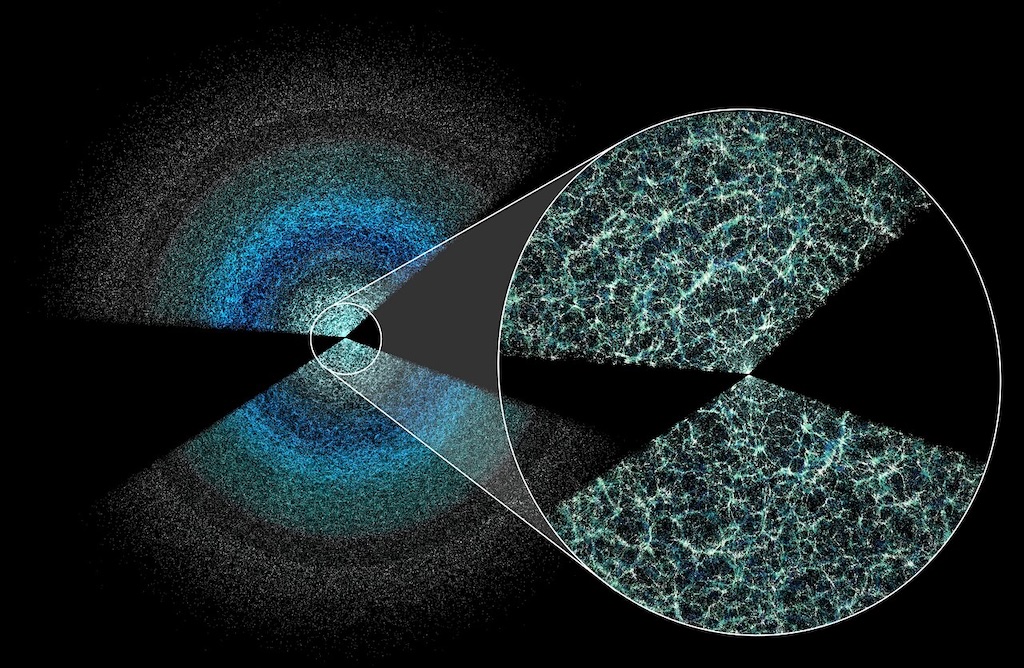
🗺️ DESI’s Five-Year Survey Is Complete
The Dark Energy Spectroscopic Instrument (DESI) at Kitt Peak National Observatory in Arizona has finished its five-year survey, and what a ride it’s been. Over those years DESI cataloged more than 47 million galaxies and quasars, stitching together a 3D map that is surprisingly Earth-centric—centered, in a practical sense, on us.
🕳️ Black Gaps and Cosmic Shade
Today’s featured image is a slim slice of that grand dataset. The black gaps aren’t mistakes; they’re the Milky Way throwing a bit of shade. Our own galaxy, with its dust and stars, foils the view just enough to leave holes in the map where distant objects hide behind the glow. But peering into the inset, you can see a feathery web—the large-scale structure of the universe—like a cosmic lacework woven over 11 billion years of light paths.
🕰️ 11 Billion Years of Light
That light comes from galaxies at staggering distances. The most distant galaxies captured in this slice have been busy traveling toward Earth for roughly 11 billion years. If you could jump into a time machine and ride along their photons, you’d arrive long before the age of our planet, watching a universe in the throes of structure formation.
🌌 Galaxies Don’t Sit Still
Galaxies don’t sit still. They cluster and branch across cosmic history, tugged by gravity and nudged by something else that sounds almost like a cosmic insurance policy: dark energy. It’s the mysterious force—or field, or property of spacetime—that drives the accelerated expansion of the cosmos. Gravity pulls, dark energy pushes, and the result is a universe that keeps stretching out its fabric faster and faster.
🔬 Dark Energy: Not So Constant?
Early DESI results perked up the science crowd, hinting that dark energy—the thing Einstein famously described as a cosmological constant—might not be constant after all. If that’s true, the implications are profound: the fate of cosmic expansion could hinge on how this mysterious energy evolves over time. But we’re not there yet. We have to wait for the full analysis of DESI’s now-complete dataset to see what the cosmos truly has to say.
🔮 The Biggest Mystery in Cosmology
For now, the best way to describe the moment is this: dark energy remains the biggest mystery in cosmology, a force that scrambles our intuition about the fate of everything we observe. DESI has given us a richer, more detailed map to study that mystery, and the universe is watching us as closely as we watch it. The next chapters—answers, more questions, new models—are being written in this 3D atlas built right here, with Earth at the center and photons long since set on their interstellar journey.
⏳ The Map Is Complete, the Science Isn’t
So stay tuned. The map is complete in form, but the science unfolding from it is far from finished. The nature of dark energy? Still the headline mystery of cosmology—and one heck of a cliffhanger for the next decade of discovery.
Image via NASA https://ift.tt/eq9nxi1
© H.J. Sablotny — All rights reserved. The text content of this post is the intellectual property of H.J. Sablotny. Images are subject to their respective copyright holders and are used for illustration purposes only.