Ways4eu WordPress.com Blog
SPA View of ways4eu.wordpress.com
A Moon–Venus–Pleiades Parade in Southern Sicily
By JohnTheWordWhirlwind
on Wed Apr 29 2026
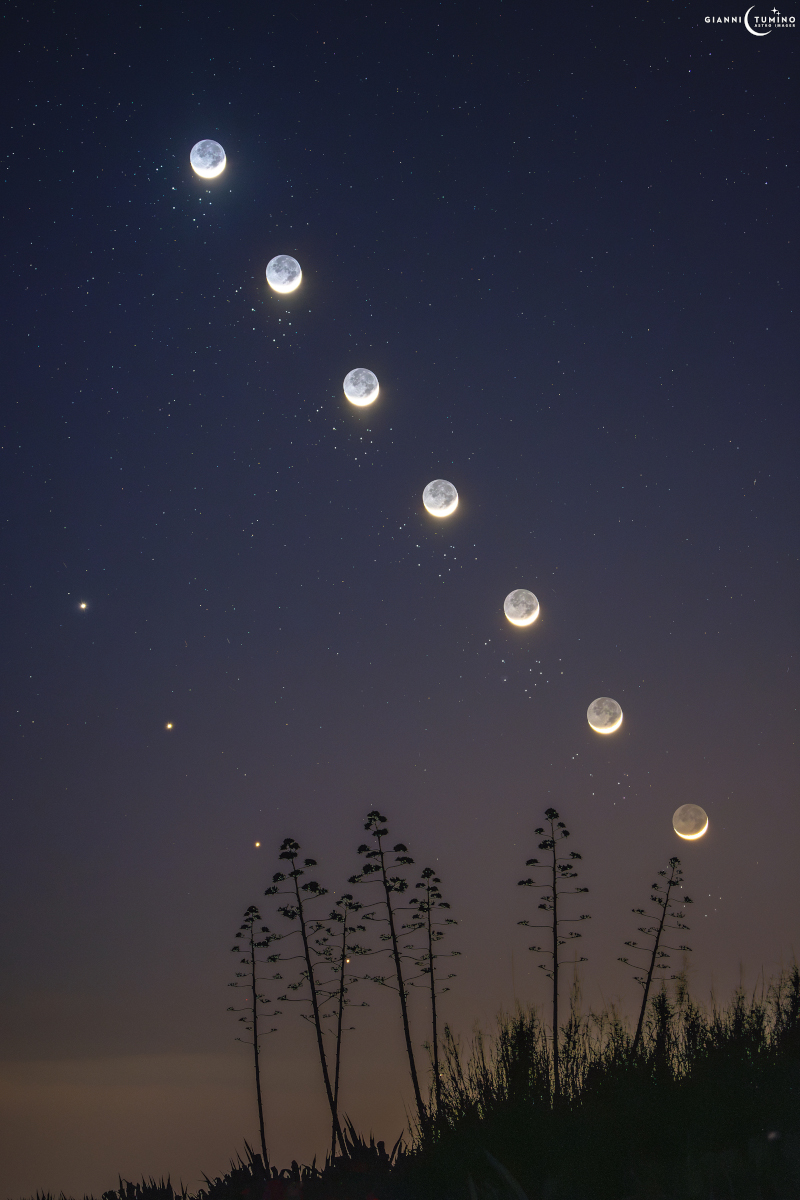
🌌 Celestial Party Over Sicily
If you glanced up at the sky lately and mistook the month for a kid’s birthday party with too many candles, you’re not alone. The sky has a knack for looking busier than a coffee shop during finals week, especially when APOD (Astronomy Picture of the Day) rolls out a multi-paneled portrait of the Moon, Venus, and the Pleiades sashaying across a southern Sicilian twilight. No, Earth did not suddenly acquire six new moons. What you’re seeing is a carefully choreographed celestial dance, captured in composite images that make the planet’s natural satellites look a little like enthusiastic guests at a cosmic soirée.
🌙 The Lineup
Here’s the snapshot you’re likely staring at: the Moon leading the procession, with Venus strutting nearby, and the Pleiades—that iconic cluster in the Taurus constellation—tagging along, all framed by a twilight-to-evening transition over a sun-drenched Sicilian landscape. The date? April 19. The mood? Silly, spectacular, and scientifically sound.
🔄 Monthly Visits 2023–2029
From 2023 to 2029, the Moon and the Pleiades have been “visiting” each other with a monthly cadence. Why? Because the Pleiades sits near the ecliptic plane—the same celestial highway that guides the Sun, Moon, and wandering planets across our sky. It’s not that six new moons popped into existence; it’s that geometry and timing conspired to give us recurring, picturesque alignments. In April 2026, the performance reached a notable cameo: the Moon, Pleiades, and Venus aligned in a single celestial frame, a reminder that the night sky isn’t a static mural but a living, moving display of relationships.
👁️ What’s Visible With the Naked Eye?
If you’re curious about what’s visible with the unaided eye, the Pleiades cluster (Messier 45) offers around six stars that most of us can pick out under good conditions. The cluster’s reputation isn’t just about pretty starlight; it’s a cultural crossroads. Because the Pleiades has been visible from nearly every corner of the world, it has inspired a treasure trove of myths and legends across cultures. Take the Haudenosaunee, or Iroquois, of North America: they tell of seven boys dancing so exuberantly that they leapt into the sky. It’s a poetic reminder that our sky-gazing habits are deeply human—shaped by wonder, storytelling, and a dash of myth-making.
🔭 New Discoveries Keep Coming
And there’s another, more grounded reason for the ongoing fascination: astronomers keep discovering more stars. Recent surveys have identified thousands of additional members of the Pleiades cluster. In other words, after thousands of years of gazing up, we’re still learning new things about this familiar neighborhood in the night. The cluster continues to be a living laboratory—an invitation to refine our models of stellar evolution, cluster dynamics, and the history of star formation in our galaxy.
✨ Final Thought
So no, there aren’t six new moons crowding the sky. There’s a carefully composed performance of familiar celestial actors—Moon, Venus, and the Pleiades—that happens to align with our vantage point from Earth. It’s a reminder that the cosmos isn’t just vast; it’s also wonderfully, poetically interconnected. The next time you see a composite image of this trio parading across a Sicilian twilight, give a wink to the science and the storytelling alike: a reminder that the heavens are both accurate and artistically engaging, even when they pull a little theatrical magic.
© 2026 ways4eu.wordpress.com H.J.Sablotny — All rights reserved. The text content of this post is the intellectual property of H.J.Sablotny. Images are subject to their respective copyright holders and are used for illustration purposes only.