Ways4eu WordPress.com Blog
SPA View of ways4eu.wordpress.com
Titan in Infrared: A Clearer Portrait of Saturn’s Enigmatic Moon
By JohnTheWordWhirlwind
on Sat May 02 2026
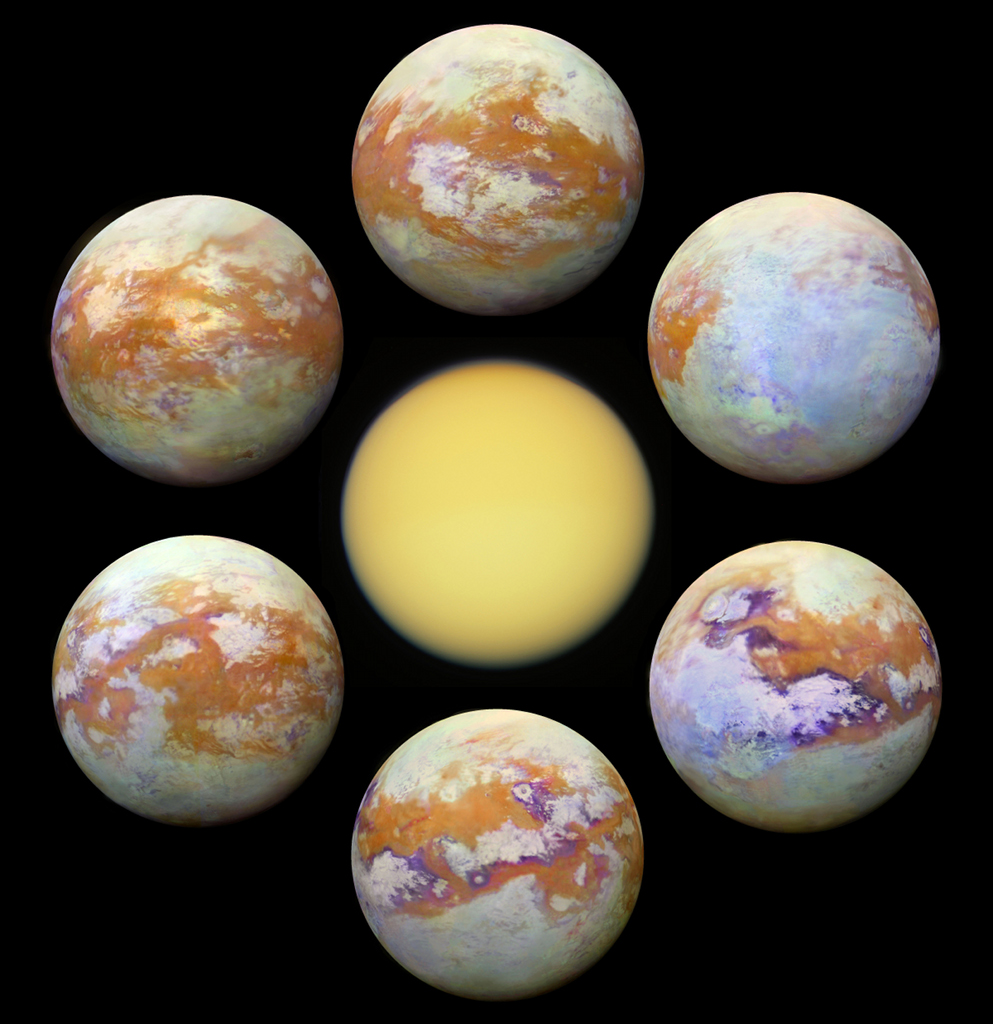
🪐 Titan in Infrared: A Clearer Portrait of Saturn’s Enigmatic Moon
Shrouded in a thick atmosphere, the surface of Saturn‘s largest moon, Titan, is really hard to see. Small particles suspended in Titan’s upper atmosphere cause an almost impenetrable haze, strongly scattering light at visible wavelengths and hiding surface features from prying eyes. It’s the cosmic version of trying to peek through a frosted window during a swampy afternoon—fun to imagine, mostly opaque in practice.
🔭 Why Infrared Observations Matter
Yet Titan’s mystique loosens its grip when the light shifts to longer wavelengths. In infrared, the scattering relaxes and the atmosphere becomes a gentler filter, revealing hints of lakes, dunes, and perhaps riverbeds that the naked eye misses. The result is a surface portrait that’s surprisingly accessible compared to what we can coax from visible light alone. When you switch to infrared, Titan’s secrets start to come into sharper focus, like a noir detective finally catching a break in a foggy alley.
Surrounding the center image, a ring of infrared views unfolds, each panel offering a different piece of the same planetary puzzle. These are some of the clearest global infrared views of Titan produced to date, a curated chorus of signals that tells a more complete story than any single image could. False color annotations, edge-enhanced contours, and careful tonal balancing come together to produce a six-panel panorama that is as informative as it is aesthetically striking.
🌫️ Atmosphere, Surface Clues, and Composition
What makes these infrared images so compelling is the consistent processing that underpins them. Spanning 13 years of data gathered by the Visual and Infrared Mapping Spectrometer (VIMS) aboard the Cassini spacecraft, which orbited Saturn from 2004 to 2017, the set demonstrates how far our eye—and our instruments—have come in translating Titan’s ethereal glare into meaningful detail. The six panels aren’t a random collage; they’re a deliberate, methodical alignment that lets you compare temporal changes, compositional hints, and regional features with confidence. The result is a stunning, almost cinematic contrast to Cassini’s traditional visible-light view, inviting us to see Titan through a different kind of lens—one where light behaves differently, and our understanding grows brighter as a consequence.
This infrared-tinted portrait isn’t just a technical curiosity. It’s a reminder of how layered and dynamic Titan is: a world where haze can obscure, but careful wavelength choices can clarify; where a spacecraft’s lasting legacy continues to illuminate even after its long mission has ended. The VIMS data, accumulated over a dozen years, continues to inform models of Titan’s surface processes, from aeolian activity to potential hydrocarbon landscapes, and fuels ongoing curiosity about what lies beneath those subtle infrared signatures.
And for the science fiction dreamer in all of us, there’s a forward-looking spark to this image set as well. NASA’s revolutionary rotorcraft mission to Titan’s surface is due to launch no earlier than July, 2028. If the name Cassini gave us a baseline for remote sensing and reconnaissance, this new chapter promises to bring a flying companion down to the moon’s enigmatic plains—an airborne observer that could translate infrared hints into ground truth and perhaps rewrite our expectations of Titan’s geology, climate, and potential habitability.
So next time you’re tempted to think Titan’s mysteries are out of reach, remember that the sky isn’t the limit—it’s the filter. Move to infrared, and the veil thins, telling a sharper, braver story about a world that’s equal parts familiar and fantastical. The six-panel infrared suite turns the night into a map, the haze into a hypothesis, and Titan into a place you can almost reach with your curiosity, even before a rotorcraft touches down.
Image via NASA https://ift.tt/DZHlRSP
© 2026 ways4eu.wordpress.com H.J.Sablotny — All rights reserved. The text content of this post is the intellectual property of H.J.Sablotny. Images are subject to their respective copyright holders and are used for illustration purposes only.