Ways4eu WordPress.com Blog
SPA View of ways4eu.wordpress.com
Old Comets, New Nebulae, and a Blue Ballad to the Skies
By JohnTheWordWhirlwind
on Tue May 12 2026
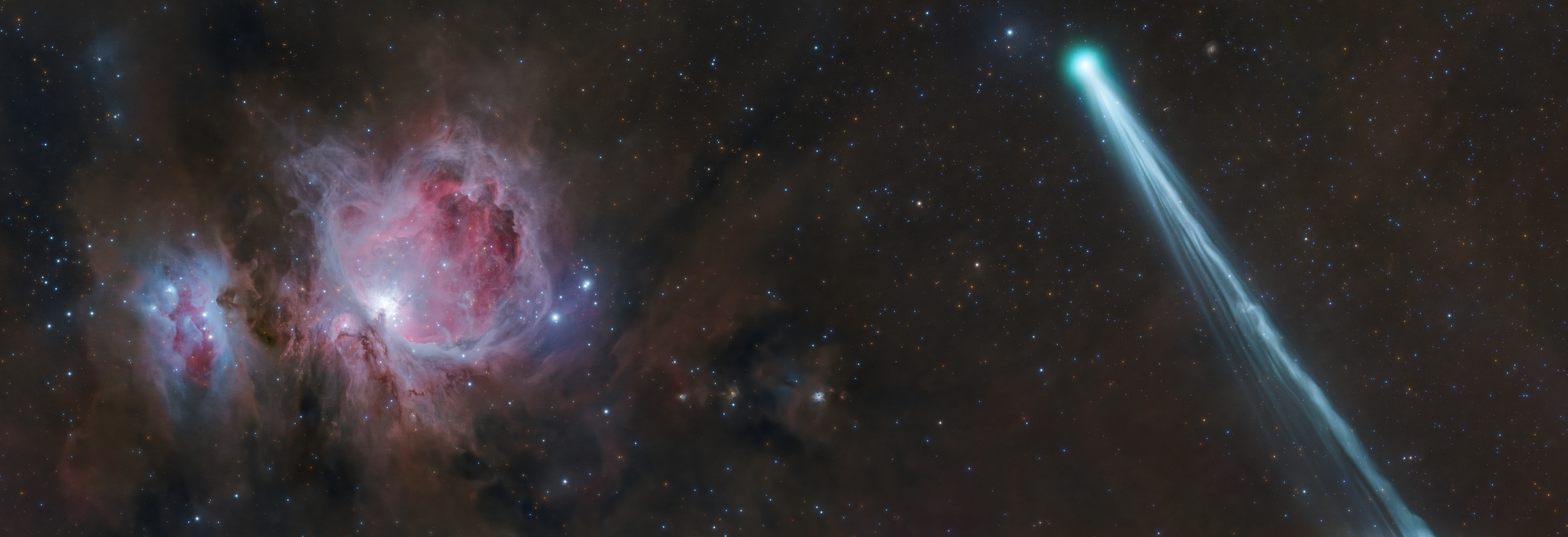
☄️ Old, New, Borrowed, and Blue
Today’s composite image features something old, something new, something borrowed, and something blue! Streaking across the right side of the frame, Comet R3 PanSTARRS looks like a cosmic postcard from a time long before our current era—likely hailing from the Oort Cloud, an ancient reservoir of icy wanderers far beyond Neptune. In other words, a bona fide old Solar System relic that has decided to drop in for a very public stroll.
💙 Why the Tail Glows Blue
What makes this comet glow with that unmistakable blue kiss? Its bright, extended ion tail shines sapphire-bright as the gas escaping the comet’s core is swept into sunlight and ionized. It’s a visual reminder that even the most serene celestial seen can pack a chemical punch: sunlight energizes the tail, the tail then glows, and we get a striking, color-true line against the starry backdrop. It’s a scene that makes the cosmos feel both delicate and dynamical at the same time.
🔬 Why Comets Matter to Science
Astronomers are fascinated by comets for all sorts of reasons. Comet compositions are untouched time capsules, offering a direct peek at the building blocks that eventually coalesced into the planets. Some scientists speculate comets delivered a portion of Earth’s water, helping to hydrate our young world. And the way a tail forms and behaves under the solar wind and radiation helps researchers test models of plasma physics, solar activity, and the interplanetary medium. In short: comets are messy, beautiful, and scientifically irreplaceable messengers from the dawn of the Solar System.
🌌 Orion Nebula as the Newborn Backdrop
The background mosaic in this image features the Orion Nebula (M42), a nearby stellar nursery brimming with newborn suns and swirling gas. That nebula was captured over two nights of observation, with the comet itself making its cameo on the third night. The Orion Nebula is, in a sense, our cosmic incubator—an ongoing reminder that stars, planets, and the complex chemistry of life have a well-documented origin story written in light-years and hydrogen.
✨ What “New” Looks Like in Space
If you’ve ever wondered what “new” looks like in space, the Orion Nebula supplies it with youthful spark and radiant color. At about 2 million years old, it’s our relatively new neighbor in the fixed tapestry of the Milky Way, where starlight paints the scene and the universe keeps its older-than-us secrets tucked away in plain sight.
👋 Farewell to a Borrowed Traveler
As the field softly fades into black, we look outward and wave goodbye to the borrowed traveler, Comet R3 PanSTARRS, as it continues its slow drift toward the outer edges of the Solar System. At roughly 127.5 million kilometers (a generous journey, even by cosmic standards) from Earth, this visitor’s time with us is a brief, brilliant cameo—the kind of moment that makes us look up and remember that the sky is not only a map of what is, but a doorway to what once was and what might still be. Until next time, dear comet: thank you for the wonder, the blue glow, and the old-news-you-are-new-again moment you’ve gifted us with tonight.
📡 Image Source
Image via NASA
🔗 Comet R3 updates | Ion vs dust tail explained | M42 imaging context
© 2026 ways4eu.wordpress.com H.J.Sablotny — All rights reserved. The text content of this post is the intellectual property of H.J.Sablotny. Images are subject to their respective copyright holders and are used for illustration purposes only.