Ways4eu WordPress.com Blog
SPA View of ways4eu.wordpress.com
The New General Catalog: Not So New After All, and Still Shining in the Sky
By JohnTheWordWhirlwind
on Wed May 13 2026
📚 The “New” Catalog from 1888
If you’ve ever admired the Milky Way’s restless orchestra of stars and wondered who catalogs all the performers, you’re not alone. The New General Catalog of Nebulae and Clusters of Stars, or NGC for short, sounds like a modern marvel, a sleek database you’d expect to be refreshed every other Tuesday. But the truth is delightfully antique: it was published in 1888. J. L. E. Dreyer assembled this sprawling astronomical menagerie to consolidate the dazzling work of William, Caroline, and John Herschel, plus a constellation of other observers, into one practical, almost indecently useful catalog of discoveries and measurements. The NGC wasn’t a flash in a telescope’s pan; it was a well-timed synthesis, a cross-index that turned scattered notes into a neighborhood map of the heavens.
🔭 Why the NGC Still Matters
Dreyer’s labor of love flourished into something more than a historical artifact. Today, the NGC remains a backbone of how we refer to bright clusters, galaxies, and nebulae. If you’ve read about a star cluster or a fuzzy patch in a telescope guide and seen a familiar “NGC” prefix, you’ve got Dreyer and company to thank—or at the very least to blame for the nostalgia it helps evoke. The catalog’s endurance is a reminder that in astronomy, yesterday’s meticulous note-taking often becomes tomorrow’s essential reference.
🌟 NGC 188: A Veteran Open Cluster
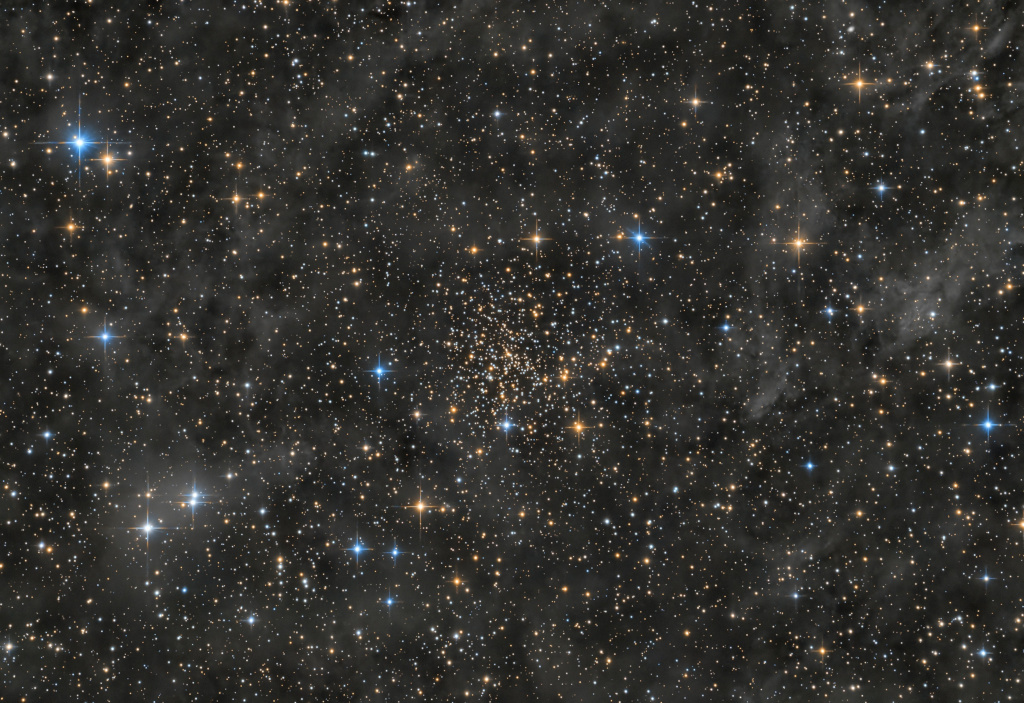
Consider one shining example: NGC 188. This object sits about 6,000 light-years away in the northern constellation Cepheus, and it’s classified as an open star cluster—though “open” hardly captures its character. At roughly 7 billion years old, NGC 188 is old for an open cluster, a veteran among stellar families. Its stars tell a story of maturity; the cluster’s red giants glow with a yellowish warmth, a color palette that makes the night sky feel almost tangible in a wide-field image or a deep-sky sketch. Despite its age, NGC 188 remains a dynamic character in the sky—an elder statesman among star clusters with more than a few tricks left to show.
🧾 NGC and Caldwell, Side by Side
NGC 188 isn’t limited to its NGC designation. In modern asterism catalogs, you’ll also find it listed as Caldwell 1, a nod to the Caldwell Catalog—a contemporary companion to the Messier legacy that aims to highlight naked-eye accessible, well-loved deep-sky objects. The dual life of NGC 188—NGC in the old guard and Caldwell in the enthusiast-friendly lineup—embodies how astronomical nomenclature evolves without losing sight of its roots.
🧭 Near the North Celestial Pole
Location, as the cosmos would have it, is part of the tale. NGC 188 sits well above the Milky Way’s busy plane, gazing toward the north celestial pole as observed from Earth. In certain circles, the cluster has earned the nickname Polarissima Cluster, a playful nod to its latitude in the sky and its almost polar solitude among the galaxy’s starry crowd. It’s not just a clever name—it hints at the cluster’s vantage point, its quiet perch above the diagonal band of the Milky Way that dominates much of our night sky.
⏳ Old Data, Living Universe
So why does the aging NGC still matter? Because it reminds us of two things at once. First, the method behind the catalog is a historical triumph: a carefully curated collection that made sense of countless individual observations, transforming scattered measurements into a usable, enduring reference. Second, the objects within the NGC aren’t relics of a bygone era; they are living windows into stellar evolution, galactic structure, and celestial history. NGC 188, with its old red giants and surprisingly long life, is a perfect illustration of how the universe doesn’t rush—from the birth of stars to their aging glow, everything unfolds on timelines that dwarf human lifetimes.
✨ A Numbered Bridge Across Centuries
If you’re hunting for a letter-perfect map of the night sky, the NGC remains a reliable compass. It might be the old catalog with the most enduring swagger in astronomy’s closet, but its content still sparkles in modern observations and amateur stargazing alike. The next time you point a telescope at NGC 188 or any other NGC-numbered object, you’re tapping into a lineage of careful observation, cross-checking, and patient study that began over a century ago and continues to guide explorers of the heavens today.
In the end, the New General Catalog isn’t quite as new as its name suggests, and that’s part of its charm. It’s a bridge between the meticulous note-takers of the 19th century and the wide-eyed dreamers of today, a shared vocabulary that keeps the stars legible, one entry at a time. And if you’re lucky, you’ll catch a glimpse of NGC 188’s yellow-tinged giants or the quiet bow of Polaris-aligned skies, and you’ll hear a faint echo of the catalog’s original mission: to bring the cosmos a little closer, one well-placed number at a time.
📡 Image Source
Image via NASA
🔗 NGC vs IC catalog | Observing NGC 188 | Deep-sky catalog history
© 2026 ways4eu.wordpress.com H.J.Sablotny — All rights reserved. The text content of this post is the intellectual property of H.J.Sablotny. Images are subject to their respective copyright holders and are used for illustration purposes only.