Ways4eu WordPress.com Blog
SPA View of ways4eu.wordpress.com
A Night-Sky Treasure Map: The Most Interesting Messier Objects You Can See with Binoculars or a Small Telescope
By JohnTheWordWhirlwind
on Fri May 15 2026
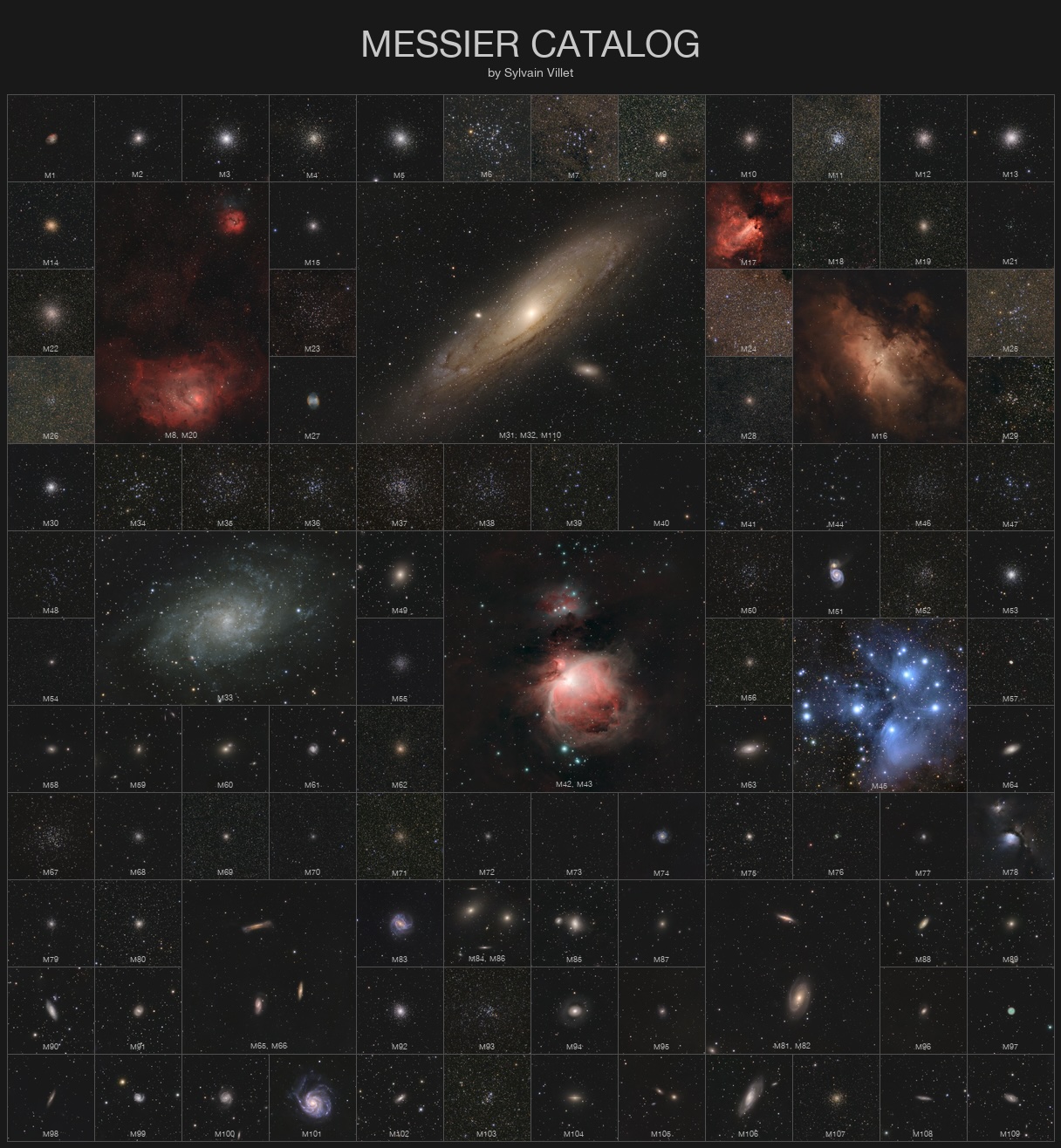
🌌 Your Messier Treasure Map Starts Here
If you’ve ever stared up at the ink-black curtain above a countryside field and wished for a guide to the glittering gems overhead, you’re in good company. With a decent pair of binoculars or a modest telescope, the Northern Hemisphere holds a veritable treasure map of astronomical wonders tucked into the Messier Catalog. And yes, most of these celestial wonders—though not all—are also visible from the southern half of the globe, so this isn’t a strictly “north only” shopping list of cosmic treats.
📚 The Catalog at a Glance
The big picture: all 110 Messier objects are gathered in one grand catalog, a kind of vintage Instagram feed of deep-sky splendor. The featured image in many guides shows these 110 objects at uniform scale—same magnification, same frame—so you can appreciate how they’d look along a night-time gallery wall. But what are these objects, really? Let’s take a stroll through the catalog’s most captivating corners.
🧭 Why Charles Messier Made the List
A quick origin story you’ll want to tell at the telescope:
Charles Messier compiled his list in the 18th century not to curate a beauty pageant of the night sky, but to help comet-hunters avoid chasing “false positives.” He was chasing comets himself and wanted a catalog of known comet-like fuzzy patches—so he wouldn’t mistake them for new comets. The result is a curated set of deep-sky objects: nebulae, star clusters, and galaxies that still spark curiosity today.
🔭 Why Messier Objects Are Perfect for Modest Gear
What makes the Messier objects so appealing to observers with modest gear:
– Accessibility: many Messier objects are bright enough to be glimpsed with simple binoculars and visible from suburban skies, given a little patience and a dark-sky site.
– Variety: the catalog isn’t a single flavor. It spans a spectrum—from star-forming nebulae to ancient galaxies, from craggy supernova remnants to glittering clusters.
– Educational punch: spotting a mix of galaxy shapes, nebulae textures, and cluster configurations makes for a satisfying night of sky-watching and ID-ing.
✨ Standout Targets You’ll Actually Remember
A few standout Messier entries you’ll likely encounter and love:
– M1 The Crab Nebula: a supernova remnant in Taurus that’s famously the aftermath of a star that exploded in 1054 AD. Through binoculars you might see a faint, wispy patch; in a small telescope, the delicate filaments come to life. It’s not just pretty—it’s a reminder that the cosmos is a filmed-in-the-future kind of place.
– M31 Andromeda Galaxy: our nearest spiral neighbor, a grand, elongated glow that rewards even a modest setup. Expect a soft oval of light with a brighter core, and, under dark skies, a sense of its vast spiral structure that stirs the imagination about our own Milky Way.
– M42 Orion Nebula: the quintessential star-forming region in the sword of Orion. Through binoculars or a small scope, you’ll see a hazy glow—plus the striking Trapezium star cluster region at the heart in higher magnification. It’s a nursery where new stars are literally taking shape.
– M45 The Pleiades: also known as the Seven Sisters, this is one of the most dazzling open clusters in the heavens. A compact bouquet of bright blue-white stars, it’s a great “wow” object that teaches you how clusters become a family of stars bound by gravity.
– M33 The Triangulum Galaxy: a face-on spiral in the northern sky’s triangle. It’s fainter than M31, but under clear skies it stretches into a delicate, extended smudge—more proof that galaxies come in all sizes and moods.
– M57 The Ring Nebula: a donut-shaped planetary nebula in Lyra. It’s a striking target because of its symmetry and contrast; a ring of gas glowing from the dying light of a central star.
– M13 The Great Globular Cluster in Hercules: a dense, ancient swarm of stars that appears as a fuzzy, round ball in mid-sized scopes. It’s like staring into a compact galaxy’s core, but closer and more accessible to amateur equipment.
– M81 and M82: a contrasting pair in Ursa Major. M81 is a bright spiral; M82 (the Cigar Galaxy) is a starburst galaxy with a more chaotic, elongated profile. Seen side by side, they offer a quick study in galactic shapes and interactions.
🛠️ Practical Night-Sky Tips
Practical tips to maximize your Messier-viewing night:
– Start with a plan: pick a handful of objects to chase per session instead of trying to “get them all” in one evening. Knowing roughly where to point your optics saves time and increases success.
– Dark adaptation wins: give your eyes 15–20 minutes away from bright lights before you start hunting. If you can, use red-light illumination for any notes or charts.
– Learn the sky map: knowing the constellations around each Messier object helps. For the northern observer, a quick orientation with Orion, Taurus, Ursa Major, Andromeda, and Cygnus often gets you to the right neighborhood quickly.
– Binocular best friend: many Messier objects appear as more rewarding targets in binoculars (large field, brighter context) than in the smallest telescopes. Then, switch to a small telescope for more detail.
– Patience is part of the experience: the best glimpses—like M51’s spiral structure or M57’s symmetry—often require a steady, cool night and a bit of magnification.
– Record your impressions: a light sketch or a short note about what you saw helps you remember and compares nights when the sky is friendlier or cloudier.
🗺️ Visibility and Seasonal Rhythm
A note on the visibility map:
– Northern Hemisphere observers will have easy access to many Messier favorites, with occasional caveats for sky brightness and weather. Many objects are visible from the southern skies as well, though your mileage may vary depending on latitude and local light pollution.
– The Messier catalog was built as a practical guide for observers, not a fixed “seasonal checklist.” Over the course of a year, you’ll cycle through a rich parade of targets as they rise, set, and cross the meridian.
🚀 Beginner Starter Pack
If you’re new to the hobby, consider this quick starter list for your first Messier night:
– Start with M45 (Pleiades) for a delightful, instantly gratifying cluster.
– Move to M31 (Andromeda) for a galaxy that behaves like a cosmic landmark in any modest telescope.
– Then try M42 (Orion Nebula) for a quintessential star-forming region that’s hard to resist.
– Finish with M13 (Great Globular Cluster) if you want a crisp, star-packed finale.
🌠 Final Takeaway
In the end, the Messier Catalog isn’t just a list of faint smudges on a night-sky map. It’s a curated tour through the universe’s variety: a nebula’s gaseous artistry, a galaxy’s sprawling architecture, and a star cluster’s communal life. With good optics, a little patience, and a sky free from the city’s glow, you’ll find that the night sky isn’t a blank ceiling but a gallery of objects waiting to be discovered, one satisfying look at a time. Happy hunting under the stars.
📡 Image Source
Image via NASA
🔗 Messier Marathon planning | Binocular buying basics | Light-pollution maps
© 2026 ways4eu.wordpress.com H.J.Sablotny — All rights reserved. The text content of this post is the intellectual property of H.J.Sablotny. Images are subject to their respective copyright holders and are used for illustration purposes only.