Ways4eu WordPress.com Blog
SPA View of ways4eu.wordpress.com
Is This a Painting or a Photograph?
By JohnTheWordWhirlwind
on Tue May 19 2026
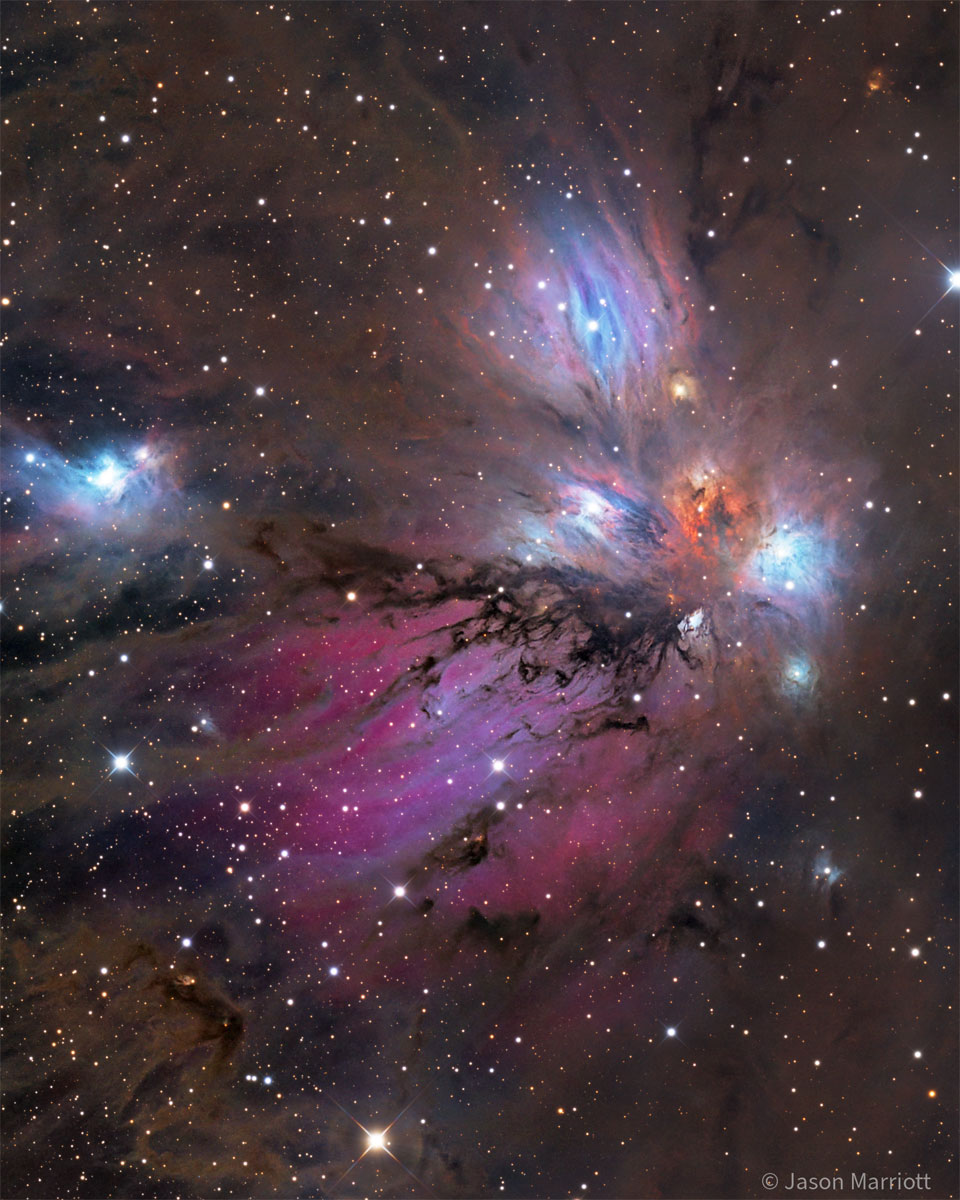
🎨 Angel Nebula: Art Meets Astronomy
In this celestial abstract art composed with a cosmic brush, dusty nebula NGC 2170, also known as the Angel Nebula, shines just above the image center. Reflecting the light of nearby hot stars, NGC 2170 is joined by bluish reflection nebulae, a red emission region, many dark absorption nebulae, and a backdrop of colorful stars. It’s the kind of scene that makes you squint at the sky and ask your inner critique, Is this a painting or a photograph?
🖌️ Painterly Yet Real
Let’s be honest: you could fool a gallery wall by swapping a frame for a telescope. The pastel halos and electric blues seem painterly, as if a brush had dabbed and dragged color across a charcoal-black canvas. Yet the stars—those pinpricks of patient geology and ancient flame—harden the case for astronomy’s version of realism. This is not youthfully reckless poster paint, but a carefully composed mosaic of light that travels across vast gulfs of time to land on our retinas with the stubborn insistence of truth.
🌫️ Many Hats, One Frame
What we’re looking at is a setting that loves to wear many hats at once. The clouds of gas and dust—cosmic studios where stars are born—hang in the same frame as the bright, hot suns that sculpt them. The bluish reflection nebulae mirror starlight, as if they borrowed the sun’s personality for a moment to showcase their own icy blues. A red emission region glows with ionized hydrogen, a color that says, “I glow, I glow, I glow,” in the most celestial of ways. Then there are the dark absorption nebulae, silhouettes on a cosmic stage, where dust blocks the light like a noir mystery framed against a glittering backdrop of newborn stars.
🦄 Monoceros: The Unicorn Studio
As with many abstract painters’ favorite motifs, these clouds of gas and dust aren’t oddities but ordinary residents of a grand landscape: a young, massive star-forming molecular cloud in the constellation Monoceros—the Unicorn. The universe knows a good studio when it sees one. And if you’re tempted to call this a still-life, well, you’re not entirely wrong. The arrangement is so deliberate that it could have been staged with a palette knife, a steady hand, and a lot of patience. But the stars aren’t posing for a portrait; they’re forging their future within the cloud, sculpting the nebulae with radiation and gravity into shapes that resemble brushstrokes only until you remember the distance—the astronomical kind, measured in light-years rather than inches.
📏 Scale and Distance
Speaking of distance, this scene sits cheerfully and almost theatrically close in cosmic terms. The giant molecular cloud Mon R2 is estimated to be roughly 2,400 light-years away. Imagine: the canvas you’re contemplating is over 60 light-years across at that distance. That scale—beyond any gallery’s widest imagination—puts into perspective the intimacy of the cosmic brushstrokes and the audacity of their reach. If a painter could make a canvas that large with a single sweep, it would still pale in the face of the real thing, where light has traveled across time to arrive at your eye with a message from a universe that was already old when your grandparents were just a rumor.
📸 Painting or Photograph?
So is it a painting or a photograph? The clever answer is: yes. It’s a photograph that looks like a painting and a painting that feels like a photograph. It is a snapshot of light sculpted by physics, captured with instruments that translate photons into data and then into color, texture, and emotion. It’s the rare moment where technique and awe overlap—where the discipline of imaging and the impulse of art collide, producing something that can be hung in any gallery of wonder and still be scientifically precise enough to teach us something about how stars are born.
💡 The Universal Palette
If you’re searching for a takeaway beyond the shimmer, here it is: the universe loves to borrow from the vocabulary of art. It uses color to tell stories—the blue in reflection nebulae speaking of icy grains reflecting starlight, the red glow of ionized gas narrating the energy of newborn stars, the dark silhouettes as stagehands hiding secrets of the cloud’s interior. And just as a painter might sign a finished piece, the cosmos leaves its mark in the arrangement of light itself—an autograph across the void that says, in a language older than civilization: wonder belongs to all of us, and the sky is our largest canvas.
🔭 Final Reflection
In the end, whether you call it a painting, a photograph, or that delightful hybrid between the two, the image invites us to pause, blink, and imagine the countless hands—the stars, the dust, the gas—that took part in making this celestial still-life. Then it nudges us to step back and consider our own place within a universe that paints with light on a scale that makes earthly art look almost quaint in its simplicity. If that isn’t a reason to look up and smile, I’m not sure what is.
📡 Image Source
Image via NASA
🔗 Reflection vs emission nebulae | Monoceros deep sky | Star formation process
© 2026 ways4eu.wordpress.com H.J.Sablotny — All rights reserved. The text content of this post is the intellectual property of H.J.Sablotny. Images are subject to their respective copyright holders and are used for illustration purposes only.