Ways4eu WordPress.com Blog
SPA View of ways4eu.wordpress.com
A Cosmic Spiral in X-ray Light: Abell 2029’s Winding Tale
By JohnTheWordWhirlwind
on Thu May 21 2026
🌀 First Look at Abell 2029
📡 X-ray Vision and What It Reveals
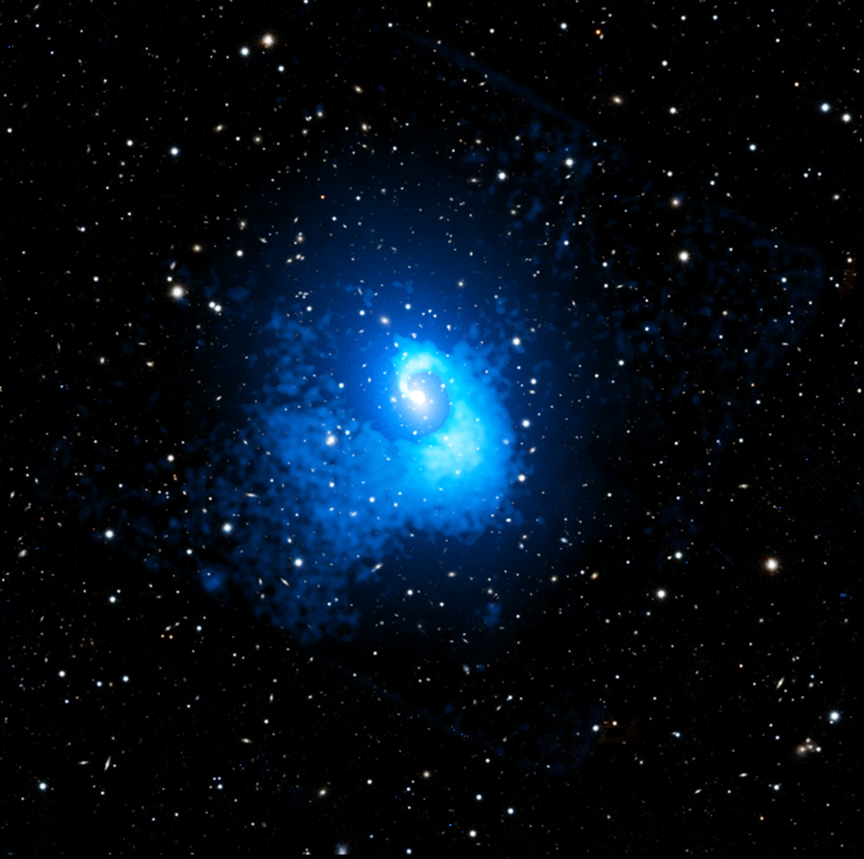
This big beautiful spiral shines in X-ray light. It is about 20 times larger than our Galaxy. It belongs to Abell 2029, a galaxy cluster one billion light-years away. (To see only the galaxies, hover your cursor over the image, or follow this link.)
🌌 The Cluster Environment
Galaxy clusters are the largest structures in the universe that are supported by gravity. Abell 2029 is formed by thousands of galaxies, surrounded by a gigantic cloud of hot gas and the equivalent of hundreds of trillions of solar masses in dark matter. It’s a gravitational metropolis where ordinary stars are the minority guests, and mystery wears a halo of unseen mass.
🧲 Gravity, Gas, and Motion
The spiral you see is not a new kind of galaxy, but a shape born from the simmering soup that fills the cluster. This gas, mostly hydrogen and helium, is no cooler than tens of millions of degrees. At those temperatures, the gas glows in X-ray light, revealing a structure that optical telescopes would miss entirely. The spiral’s glow is a beacon of the intracluster medium—the vast, whispering ocean between galaxies—that tells us how the cluster lives, breathes, and sometimes collides with itself.
🔭 Why Spiral Features Matter
Astonishingly, this spiral bears the signature of a cosmic dance with history. In a recent study using data from NASA’s Chandra X-ray Observatory, scientists traced a dramatic past event: Abell 2029 collided with a smaller cluster about four billion years ago. The collision didn’t just rearrange galaxies; it tugged on the cluster’s gravitational field and stirred the intracluster gas like wine swirling in a glass. The result is a sloshing, spiraling motion that carved this luminous arc in the X-ray sky.
📏 Scale and Distance Perspective
Imagine the scene: gravity shaping a vast, invisible pinwheel as hot gas whips around the cluster’s heart. The spiral you see is a snapshot of that motion, a fossil record of gravity’s choreography over eons. It’s a reminder that even on the largest scales—the cosmic city blocks built from galaxies and gas—motion begets structure, and chemistry (of a sort) writes the fingerprints we discover with X-ray eyes.
🧪 Scientific Interpretation
If you’re curious to delve deeper, scientists piece together this story by comparing the X-ray glow with data across the electromagnetic spectrum, simulating how gas behaves when colossal masses collide, and watching for telltale ripples that reveal the cluster’s innermost dynamics. The result is a more vivid portrait of Abell 2029: a sprawling, hot, X-ray-brilliant ecosystem where gravity, gas, and dark matter choreograph a dance billions of years in the making.
🛰️ Instrumentation and Data Context
Next time you glimpse an image of Abell 2029’s spiral, pause for a moment. It’s more than a pretty swirl of light. It’s a pale blueprinted map of a violent, elegant past—proof that in the universe, even the biggest things can stir with a gentle, spiraling grace.
Image via NASA https://ift.tt/0TQ9Eem
🔗 Abell 2029 dynamics | Cool-core clusters in X-ray | Spiral gas patterns in clusters
© 2026 ways4eu.wordpress.com H.J.Sablotny — All rights reserved. The text content of this post is the intellectual property of H.J.Sablotny. Images are subject to their respective copyright holders and are used for illustration purposes only.