Ways4eu WordPress.com Blog
SPA View of ways4eu.wordpress.com
A Cosmic Ring Grows in Cygnus: WR 134’s Wind-Tossed Arcs and the Quiet Drama of a 6,000-Light-Year Curtain Call
By JohnTheWordWhirlwind
on Mon May 25 2026
🌌 Opening View of Wolf-Rayet star WR 134
🌀 Ring Structures in Cygnus
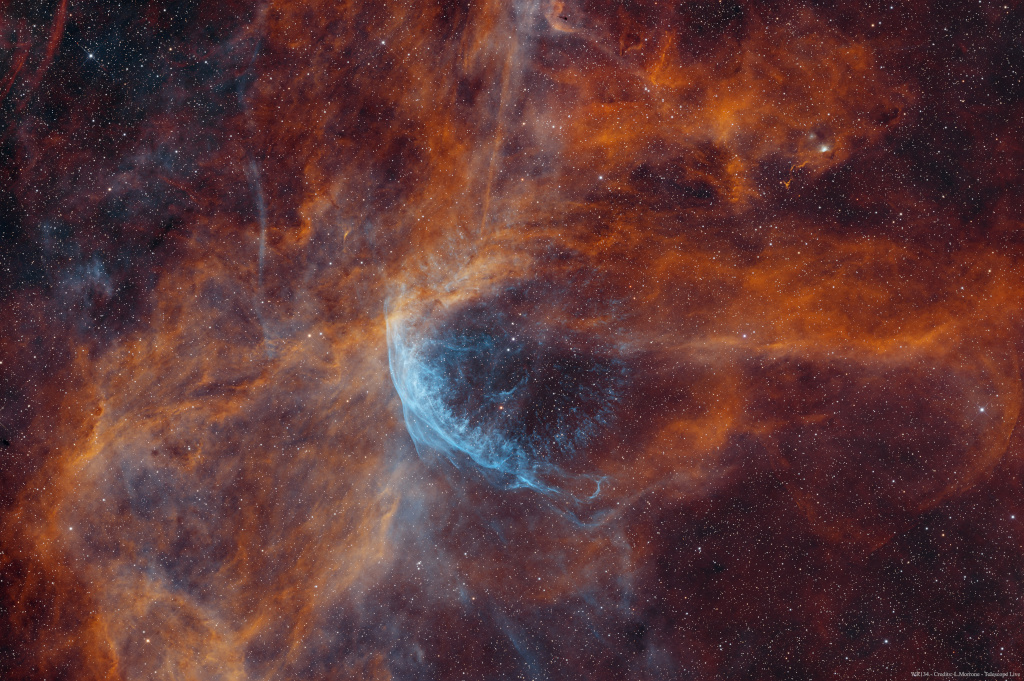
In the sky above the restless river of Cygnus, a field of view stretches wider than the full Moon’s shy halo, offering a backstage pass to a nebulae’s subtle theater. This is not a single spotlight moment but a wide-angle snapshot captured with narrowband filters that tease out the quiet drama of hydrogen and oxygen glow. The result is a bright edge of a ring-like nebula, its outline traced in electric greens and deep reds by the ionized gas that threads through interstellar space.
💨 Stellar Winds and Shock Fronts
The scene is layered, almost like a cosmic fingerprint. Embedded in a tapestry of drifting interstellar clouds, you can follow the complex, glowing arcs that cut across the frame. They aren’t random scribbles on a chalkboard; they are shell-like structures—remnants of material swept up and shaped by the wind from a singular, brilliant protagonist: Wolf-Rayet star WR 134, the brightest beacon near the image’s quiet center. If you lean in, you can almost hear the wind howling through the star’s outer layers as it propels the surrounding gas outward in a dramatic, time-lapsed ballet.
📏 Scale and Distance Context
Distance gives this image its sense of scale. WR 134 sits about 6,000 light-years from us, a reminder that the glow you’re seeing is already ancient by the time it reaches our eyes. The telescopic frame, momentarily collapsing the vastness of space into a single frame, spans more than 100 light-years across. It’s a reminder that in astronomy, breadth and distance are your two most faithful storytellers: you can see how the wind sculpts, and you can almost feel the history etched into every arc of the nebula.
🔬 Why Wolf-Rayet Stars Matter
This is the kind of scene that invites a moment of awe and a touch of curiosity about how massive stars end their lives. Wolf-Rayet stars are the heavy lifters of the stellar world, shedding their outer envelopes at a prodigious rate as they burn through nuclear fuel with enviable intensity. When the final act arrives—the spectacular supernova—their winds and explosive finale enrich the surrounding interstellar medium with heavy elements. The cosmic stew created in those moments becomes the raw material for the next generations of stars, planets, and perhaps life itself.
📡 Observational Methods
The image is a vivid reminder that galaxies aren’t just grand sweeps of light; they are laboratories where the physics of wind, shock, and ionization play out over tens of thousands of years, often in slow motion from our vantage point. Narrowband filtering is the quiet narrator here, isolating the glow of hydrogen and oxygen to reveal the clean lines of the ring and the delicate filaments that braid through the cloudscape. It’s a technique that turns a crowded celestial neighborhood into a map of active processes: where the gas has been energized, where the wind has carved a path, and where the next generation of stars might one day take root.
🧪 Scientific Implications
As you scan the frame, consider the clock behind the scenes. The light you’re seeing embarked on its journey long before humanity began to chart the stars in earnest. And yet, in this moment, we glimpse not only the aftermath of a massive star’s wind-spiral and its terminal blast, but also the ongoing cycle of cosmic recycling. The heavy elements born in WR 134’s fiery breath will mingle with future nebulae, birthing stars, planets, and maybe the ingredients for life in ways we’re only beginning to comprehend.
🧠 Reading the Cosmic Pattern
So here’s to the quiet grandeur of a ring-like nebula’s edge, to WR 134’s stellar wind, and to the patient, sometimes cosmic, sometimes human, curiosity that asks us to look up, notice the arcs, and wonder about the stories those glowing threads are trying to tell. The universe isn’t rushing its endings; it’s composing them, one wind-blown filament at a time. And in that slow, luminous unfolding, there’s plenty of drama for the imagination to savor.
Image via NASA https://ift.tt/Pk23DXH
🔗 WR 134 research | Wolf-Rayet nebulae | Massive-star wind interaction
© 2026 ways4eu.wordpress.com H.J.Sablotny — All rights reserved. The text content of this post is the intellectual property of H.J.Sablotny. Images are subject to their respective copyright holders and are used for illustration purposes only.