Ways4eu WordPress.com Blog
SPA View of ways4eu.wordpress.com
Cosmic Butter in the Pan: The Curious Case of IC 2944’s Dark Globules
By JohnTheWordWhirlwind
on Tue May 26 2026
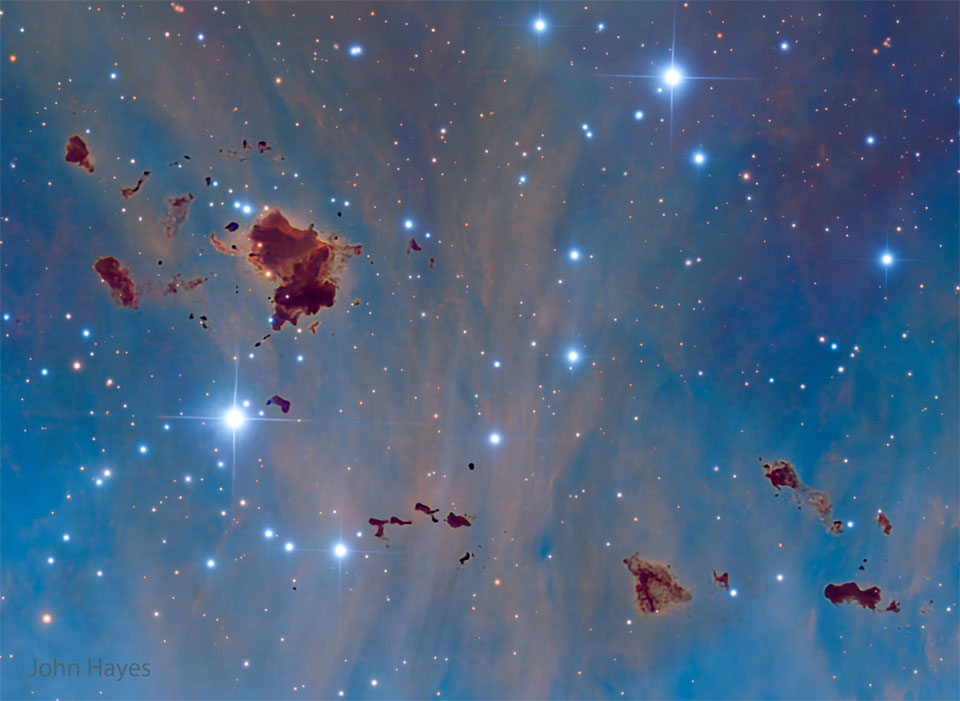
🧈 First Look at IC 2944
What are these strange space globs? If you tune your telescope to the shimmering swathes of star-forming glory, you’ll catch sight of something more enigmatic than a glittering nebula: opaque, shadowy clouds drifting in a field of radiant hydrogen. These are dark globules—pockets of interstellar dust and gas so dense that they block the glow of their fiery surroundings. They’re not just empty space snacks, either; these behemoths are so vast that they could, in theory, cradle their own miniature stellar nursery inside. In other words, they’re the kind of cosmic lumps that make you wonder if the universe is hosting a bake-off and forgot to reset the oven.
🌑 Dark Globules in a Bright Nebula
Where are these space globs? They make their home in IC 2944, a bright stellar nursery about 7,600 light-years away in the direction of the Centaurus constellation. IC 2944 is a bustling region where newborn stars light up the gas around them, casting a celestial glow that would look less like a postcard and more like a star-friendly furnace.
🔭 Observational Context in the Sky
The star of our show—the largest dark globule in this region—was first brought to light by A. D. Thackeray in 1950, using a telescope in South Africa. This particular globule is likely two separate, overlapping clouds, each more than a light-year across. That’s a lot of space to cover with a tiny umbrella, but then, these clouds are anything but tiny on a cosmic scale.
🧲 Star Formation and Dense Clumps
What makes Thackeray’s globules and their kin so fascinating isn’t just their size. They sit in a bustling neighborhood of young, hot stars whose ultraviolet radiation is busy energizing and heating the bright emission nebula around them. A recent image, captured with a careful blend of hues—what astronomers call a Hubble palette—from the El Sauce Observatory in Chile, reveals that these globules aren’t silent. They’re fractured and churning, as if the UV starlight is whisking them into a quantum smoothie. The result is a galaxy-scale dust sculpture showing signs of internal motion and weather—the cosmic equivalent of churned butter left too long on the stove.
📏 Distance and Physical Scale
And what happens to these globules in the long run? Many of them, along with their siblings in other star-forming regions, face a harsh future. The same ultraviolet assault that lights up their surroundings slowly gnaws away at their edges. In the grand, fiery kitchen of the cosmos, these dark globules can dissipate—evaporated by radiation and winds from their fiercely radiant neighbors. It’s a vivid reminder that star formation isn’t just a gentle cradle-to-graduation process; it’s more like a high-stakes bake-off, where the contestants are clouds of dust, and the judges are ultraviolet photons.
🧪 Scientific Interpretation
So why should we care about these cosmic butter blocks? They offer a window into the early stages of star formation. Studying their structure, motion, and interactions with nearby stars helps astronomers piece together how stars, planetary systems, and the broader galactic ecosystem come to be. The dark globules are like fossilized fingerprints of the conditions that prevailed in stellar nurseries, offering clues about how matter clumps, how radiation sculpts, and how the dance of gravity and heat choreographs the birth of stars.
📡 Imaging and Data Perspective
In short, these enigmatic globs are not just curiosities; they’re key players in the story of how the universe crafts new suns. They remind us that star formation is a messy, dynamic process—less a calm tea ceremony and more a boil-and-bloom saga, where dense pockets of dust and gas flirt with the heat and light of nearby young stars. And if you ever find yourself gazing at IC 2944, imagine the scene as a galactic kitchen in full swing: a field of glowing gas, a clutch of shadowy loaves, and a roiling, ultraviolet-powered bake that might someday yield a new generation of stars—and perhaps, in their wake, a few planetary systems to orbit them.
Image via NASA https://ift.tt/LoqcEWe
🔗 IC 2944 research | Bok globule evolution | Nebular dust and starbirth
© 2026 ways4eu.wordpress.com H.J.Sablotny — All rights reserved. The text content of this post is the intellectual property of H.J.Sablotny. Images are subject to their respective copyright holders and are used for illustration purposes only.