Ways4eu WordPress.com Blog
SPA View of ways4eu.wordpress.com
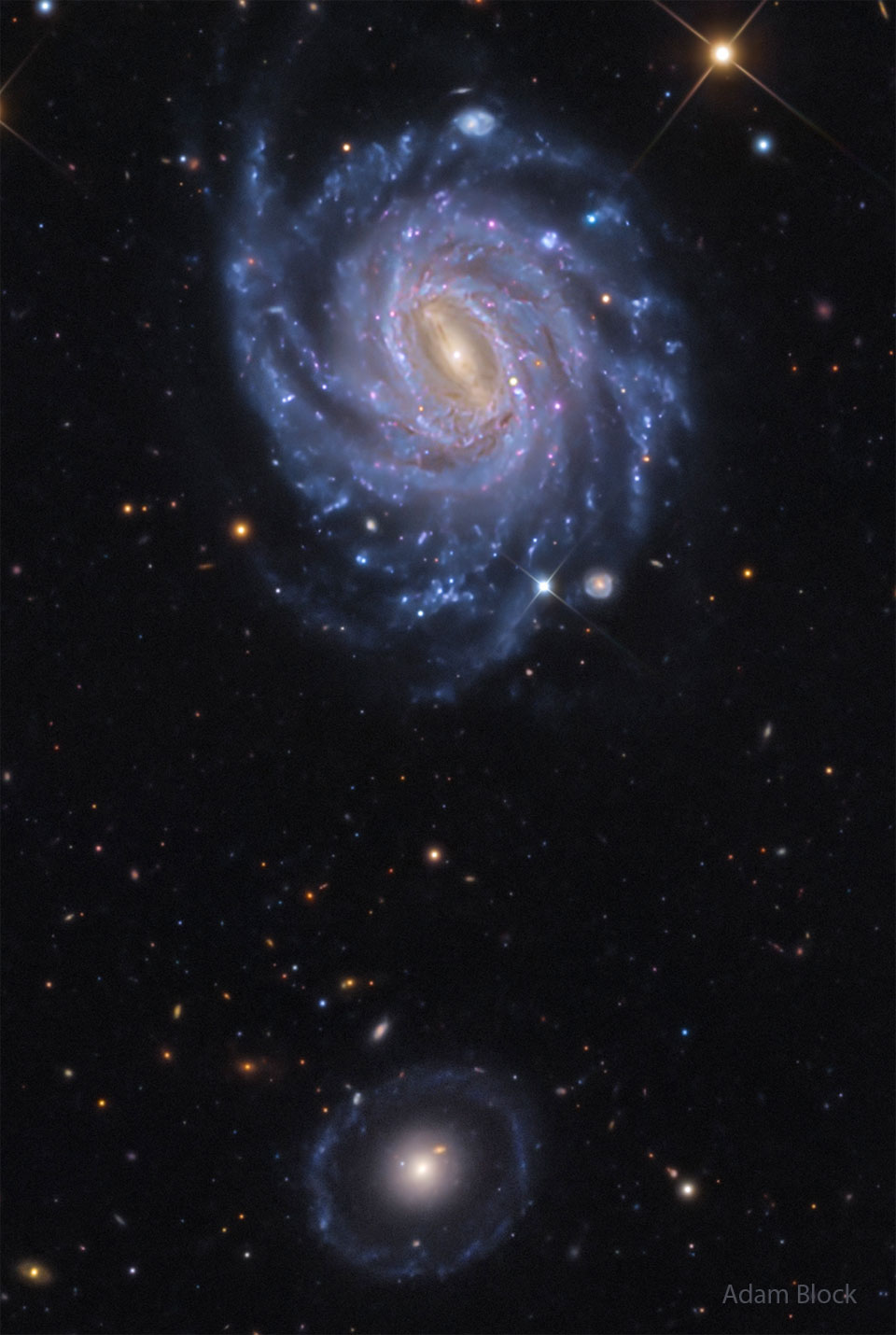
The Upper Galaxy Might Be More Photogenic, But the Lower Galaxy Is More Unusual
By JohnTheWordWhirlwind
on Wed May 27 2026
🌌 First View: Two Galactic Halves
When you look up at the night sky with a telescope and a photographer’s eye, the universe tends to reward you with drama. The upper galaxy in our look-not-so-sky-closet scene is NGC 3660, a spiral cousin to our Milky Way that knows how to pose. It wears bright blue spiral arms like ribbons of neon and sports a central bar of stars, dust, and gas that gives the core region a kind of busy elegance. It’s the kind of galaxy that photographs well on a crisp winter night: luminous arms curling around a sturdy, bar-shaped heart. And if you’re lucky, the cosmic dice roll can land you a spectacular cameo—a supernova named SN 2026cff, spotted just to the right of that central bar. It’s one of those serendipitous moments that makes deep-sky imaging feel more like a treasure hunt than a static postcard.
🔭 Why the Lower Galaxy Looks Unusual
But if you tilt your gaze a touch farther into the frame, your eye lands on the lower galaxy, informally nicknamed Burçin’s galaxy and formally cataloged as LEDA 1000714. This one isn’t about photographic glamour; it’s about puzzles and possibilities. At first glance, the center presents as an old elliptical blob—quiet, ancient, and perceptibly settled. Yet wrap that quiet center with two rings of stars, one after the other, and you’ve got a cosmic riddle in a galactic disguise. Two rings orbiting an aging core? That’s not the standard fare you’d expect from a simple spiral-to-elliptical transition. It’s a stamp of discontinuity in a galaxy’s life story, the visible record of past events that left the structure in a state of elegant confusion.
🧱 Structure, Dust, and Star Formation
What could have created Burçin’s galaxy remains a live topic of research, with teams peering into the past—literally—by tracing stellar motions, chemical compositions, and faint tidal remnants. The most persuasive theories point to accretion events: the gradual or episodic consumption of one or more smaller galaxies that dared to tango a little too close to a more massive host. Each morsel swallowed by the galaxy could stitch a ring or two into the outer reaches, leaving behind a halo of stars that aren’t “where they should be” if you were to draw a clean, textbook spiral. It’s a reminder that cosmic evolution is rarely tidy or abrupt; it’s more like a long, patient conversation between galaxies over billions of years, with each new interaction scribbling a new sentence into their shared history.
📏 Scale and Orientation Context
In contrast, NGC 3660 is a reminder that beauty and drama can be found in the same page of the cosmic notebook. Its blue arms glow with the light of hot, young stars—the kind that signpost recent star formation—and the central bar is a gravitational highway, funneling gas inward and lighting up areas where stars are born in clusters that glow with a cool, bluish fire. It’s a galaxy that looks ready for a postcard shoot or a documentary voiceover about spiral structure and barred galaxies. And then there’s SN 2026cff, a supernova that suddenly steps into the frame as if the cosmos itself wanted to remind us that star life—and death—happen on timescales far beyond human memory but within human curiosity. It’s a fleeting, luminous moment that adds a sense of scale and drama to an otherwise static image.
🧪 What Astronomers Can Infer
If you’re chasing “the more photogenic” label, the upper galaxy wins hands down. It’s a visual banquet: the contrast of bright blue arms against the darker interarm regions, the crisp outline of the central bar, and the spark of a supernova that adds a cosmic exclamation point. But if you’re chasing “the more unusual,” the lower galaxy clinches it. Burçin’s galaxy is a study in structural complexity: an old core that looks unassuming until you notice the rings, a configuration that doesn’t fit the most common evolutionary narratives, and the tantalizing possibility that it grew by devouring smaller companions, leaving behind a layered fingerprint of interactions.
📸 Imaging Notes and Visual Interpretation
The universe loves to keep us guessing, and the image pairing of these two galaxies turns that love into something almost tactile. You get the immediate, almost postcard charm of NGC 3660 with its star-forming exuberance and its accidental witness—SN 2026cff—while also getting a deeper, more investigative thrill from Burçin’s galaxy, where rings tell a story of celestial marriages and mergers that didn’t end with a neat, quiet settledness but with a gravitationally stirred, still-unfolding history.
🧠 Broader Astrophysical Relevance
So which galaxy should steal the spotlight? It depends on what you’re after. If you crave glow and a snapshot that could live on a wall, the upper galaxy is your star. If you hunger for mystery and a hint of cosmic detective work, the lower galaxy pays dividends in curiosity and ongoing research. Together, they offer a balanced view of the universe: beauty that stuns the eye and complexity that invites the mind to linger, question, and imagine.
✅ Final Reflection
As we continue to peer deeper into the night sky, images like these remind us that the cosmos isn’t a single grand finale but a gallery of stories—some photogenic, some enigmatic, all worth a closer look.
Image via NASA https://ift.tt/ogyzx79
🔗 Galaxy morphology types | Peculiar galaxy catalogues | How to interpret galaxy images
© 2026 ways4eu.wordpress.com H.J.Sablotny — All rights reserved. The text content of this post is the intellectual property of H.J.Sablotny. Images are subject to their respective copyright holders and are used for illustration purposes only.