Ways4eu WordPress.com Blog
SPA View of ways4eu.wordpress.com
What Do You See in This Crystal Ball?
By JohnTheWordWhirlwind
on Fri May 29 2026
🔮 First Look: The Crystal Ball Illusion
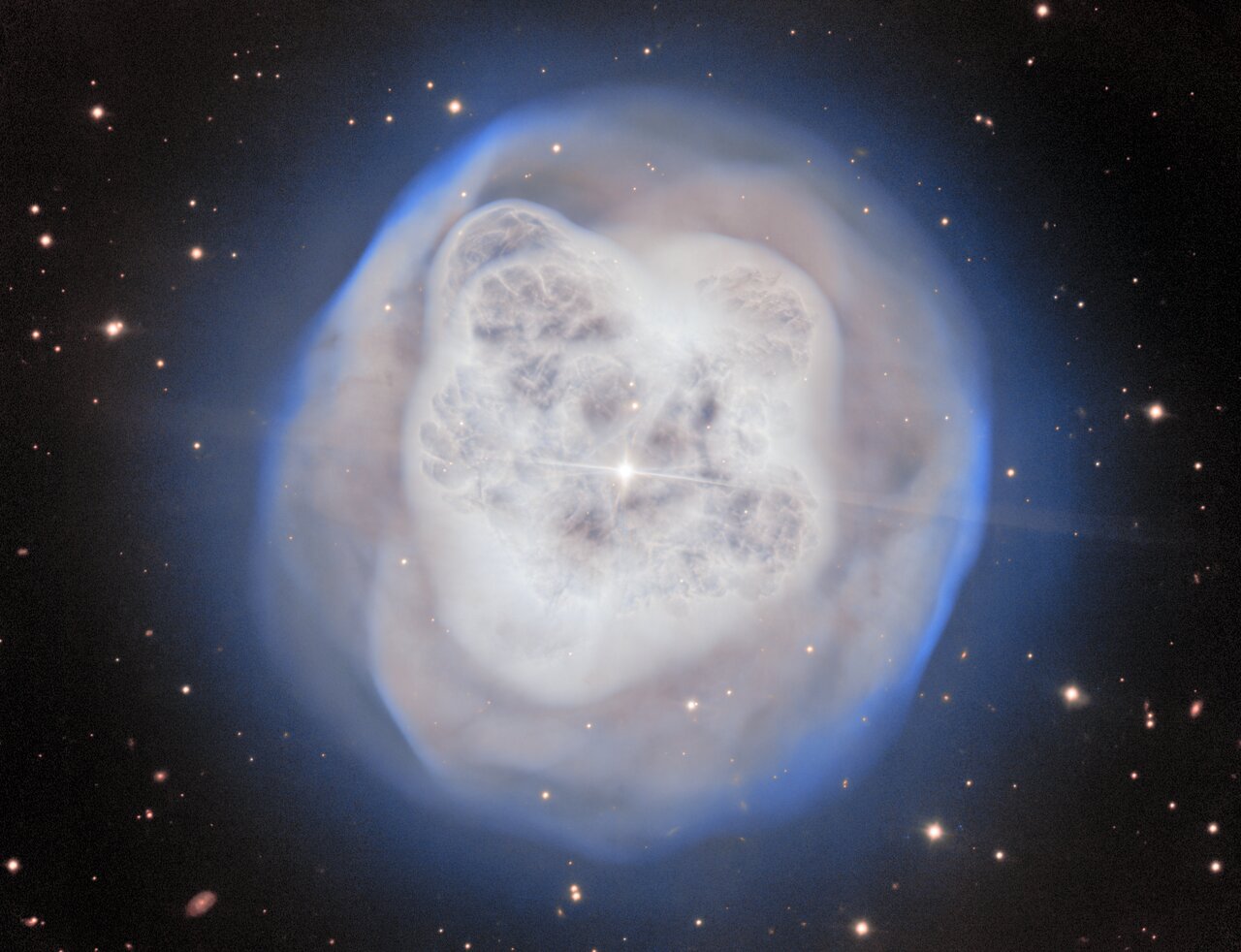
The featured image shows NGC 1514, known as the Crystal Ball Nebula, observed by the Gemini North telescope on Maunakea, in Hawai’i. This is not your grandmother’s glass orb—but it might as well be, because it looks back at us with a twinkle of cosmic mystery.
👁️ Visual Ambiguity and Pattern Perception
NGC 1514 sits about 1,500 light-years away, a distance so vast you could drive a galaxy for a year and still not reach it. It was first spotted by William Herschel in 1790, a time when astronomy was more about rummaging through the night with curiosity than about pixel-perfect precision. Yet here we are, centuries later, zooming in with state-of-the-art instruments and still getting goosebumps from its glow.
🌈 Light, Reflection, and Refraction
So what exactly is this luminous ball of gas? It’s a planetary nebula, which sounds like a contradiction—planetary? It’s a misnomer from a bygone era when telescopes were as poetic as they were new. In truth, a planetary nebula is the final, dazzling act of a sun-like star. When such a star exhausts its nuclear fuel, it swells into a red giant and sheds its outer layers into the surrounding space. The core of the star, now compact and fiercely hot, floods the ejected gas with high-energy photons. Those photons jolt the gas atoms into a state of glow, and suddenly you’ve got a nebula that shines with a beauty that can outshine pretty much every holiday light display you’ve ever admired.
📸 Composition and Photographic Timing
The Crystal Ball itself isn’t perfectly round—though it’s close enough to make you want to whisper “hocus pocus” and expect a wish to come true. The slight asymmetry is the astrophysical version of a telltale blush. At the center sits a bright star, and the real secret is that this star has a companion. Two stars, dancing around each other in a roughly nine-year orbital cadence, sculpt the gas in their surroundings. Their gravitational waltz carves shape into the ejected envelope, giving us that subtle irregularity we see in the halo of gas. It’s a celestial duet that reminds us: even in space, relationships matter.
🧠 Why We Project Meaning into Shapes
If you stand back and squint your eyes just enough, you can imagine the scene as a cosmic theater. The central stars—one a dense, radiant furnace, the other a quieter partner—coax the gas into spirals and arcs. The details are exquisitely delicate: fluorescence from ionized oxygen and nitrogen, the shimmer of dust, the faint frost of molecules clinging to the nebula’s interior. And while the science is rich, the image carries a human-sized wonder: the universe builds beauty through physics, time, and a touch of companionship.
🧪 Optics and Interpretation
What’s next for this stellar spectacle? In terms of cosmic housekeeping, this nebula is a temporary guest—on the order of 10,000 to 25,000 years before the winds of the stars scatter and disperse the glowing cloud into the interstellar medium. In other words, the Crystal Ball won’t be crystal forever. Its glow will fade as the gas dilutes and fades, but its story leaves a mark in the gas we’ll one day recycle into new stars and planets. The cycle continues, and our understanding expands with each passing observation.
✅ Final Reflection
If you’re wondering what to take away from this image beyond the pretty pixels, here are a few threadable ideas:
– Cosmic timing: The nine-year dance between star partners is a reminder that even vast, ancient systems operate on human-scale timescales.
– The power of discovery: A telescope in Hawai’i, a centuries-old telescope log, and modern imaging combine to reveal a narrative that was always there—waiting for the right instrument to tell it properly.
– The beauty of science and storytelling: A nebula isn’t just a cloud of gas; it’s a chronicle of life cycles, binary companionship, and the creative forces that seed the galaxy with elements for future suns, planets, and maybe life.
📰 Source and Reference
So, the next time you encounter a photo labeled “Crystal Ball Nebula,” remember the drama behind the glow: a pair of stars in a gravitational embrace, casting their light across a 1,500-light-year stage, and turning gas into a luminous fable about transformation, time, and the quiet magic of the cosmos.
Image via NASA https://ift.tt/Hflq3cL
🔗 Glass sphere photography tips | Creative optical illusions | Light behavior in curved glass
© 2026 ways4eu.wordpress.com H.J.Sablotny — All rights reserved. The text content of this post is the intellectual property of H.J.Sablotny. Images are subject to their respective copyright holders and are used for illustration purposes only.