Ways4eu WordPress.com Blog
SPA View of ways4eu.wordpress.com
The Explosion Is Over, But the Consequences Continue
By JohnTheWordWhirlwind
on Sat Jun 06 2026
Quick Links
- The Vela explosion in context
- What the supernova left behind
- Why the filaments glow
- The pulsar at the center
- Why Vela still matters
The Vela Explosion in Context
About twelve thousand years ago, a relatively normal star in the constellation Vela decided to put on the most dramatic light show in the cosmos and then vanish from sight in a puff of energy. If human eyes had been trained to notice the sky in those days, this would have appeared as a strange, momentary sparkle—an odd beacon that blazed into existence and then faded, leaving us with a memory of something extraordinary even as it slipped back into the night.
What the Supernova Left Behind
What happened? The outer layers of that star, exhausted and done with their life, crashed outward into the interstellar medium. The impact didn’t just produce a brilliant flash; it launched a shock wave that has kept plowing through space for tens of thousands of years. The remnants of that stellar explosion formed what astronomers now call the Vela Supernova Remnant, a colossal structure still lighting up the cosmos in a slow, persistent shimmer.
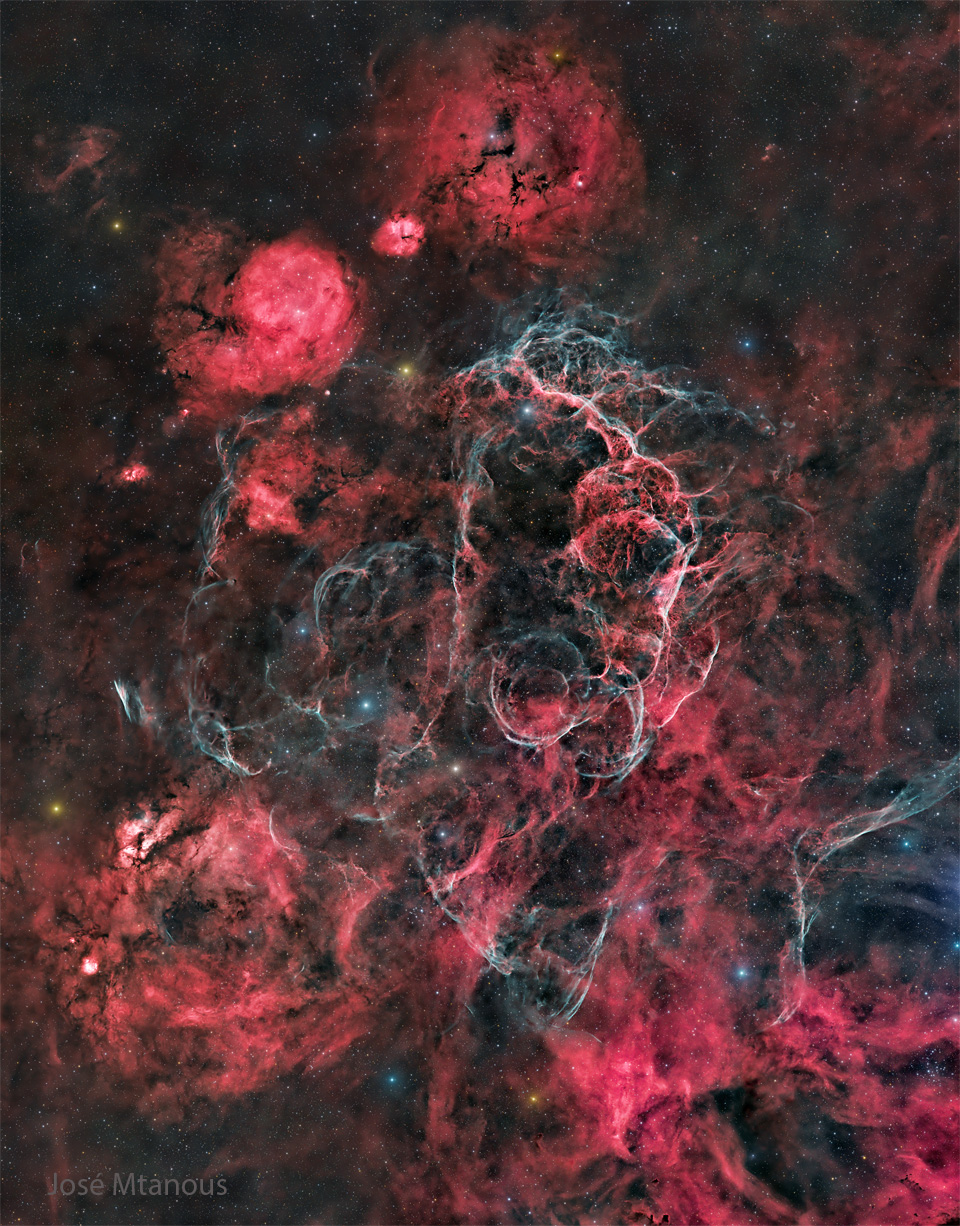
If you could peek deep into this cosmic aftermath, you’d see a landscape of filaments and luminous threads—long, delicate tendrils of gas that have been stirred and sculpted by the blast. The featured image, captured piecemeal over 60 hours from the Khomas Region of Namibia, is a striking representation of that activity. In visible light, the scene reveals a gigantic shock front winding its way through space. The details are brought into sharper relief by looking at the gas in two color channels: hydrogen glows red, while oxygen glows blue. Put together, they tell a story of energy at play across multiple temperatures and densities.
Why the Filaments Glow
As the gas continues to race away from the original detonation, it doesn’t simply disperse and fade. It encounters the interstellar medium—the sea of dust and gas that pervades galaxies—and engages in a cascade of decays and reactions. Those interactions light up in a rainbow of colors and energy bands, each shade a clue about the physical conditions at the moment of contact: temperature, ionization state, density, and magnetic influence. The Vela remnant is a cosmic laboratory, a long-running experiment in how matter cools, clumps, and glows after such a cataclysmic beginning.
The Pulsar at the Center
Centrally located within this sprawling cathedral of light sits a pulsar—a star compressed to nuclear densities that radiates energy like a lighthouse in space. It spins with remarkable speed, rotating more than ten times every second. This isn’t mere rotation for show: the pulsar’s magnetic field funnels beams of radiation as it tick-tocks, turning its centrifugal heartbeat into a steady cosmic metronome. Even though the initial explosion happened thousands of years ago, the pulsar keeps time, reminding us that the core of a stellar catastrophe can outlive the blast itself by orders of magnitude.
Why Vela Still Matters
Why does any of this matter to us, here and now? For one, the Vela remnant is a vivid reminder that the cosmos isn’t a static panorama but a dynamic, evolving tapestry. The light we see today is the afterglow of a moment long past, but it travels across incomprehensible distances to tell us a story about energy, matter, and the forces that shape galaxies. Studying these remnants helps astrophysicists understand how shock waves heat gas, how magnetic fields twist and turn, and how heavy elements get dispersed into the galaxy so that future stars—and perhaps life elsewhere—can incorporate them into their own kitchens of creation.
The colors of the Vela remnant aren’t just pretty—they are diagnostic tools. Red hydrogen and blue oxygen emissions are signposts, guiding researchers through the remnant’s complex chemistry and physics. Every filament, every knot of brightness, is a clue about when and where the gas was heated, how it cooled, and how it interacted with the surrounding medium. The image captured in Namibia is more than a pretty photograph; it’s a map of processes that unfold over timescales far longer than a human lifetime, yet intimately connected to the origins of matter that make up the stars around us.
So the message from Vela is twofold. First, explosions can end in a quiet afterlife that still crackles with energy and beauty. Second, the consequences of those explosions ripple outward, seeding the galaxy with the materials and motions that make new stars, new planets, and maybe new life possible in the far future. The explosion is over, but the consequences continue—and in the night sky, in the colors of a filament, in the steady spin of a distant pulsar, we can still watch the story unfold.
Image via NASAAPOD source
Copyright Notice: The image and referenced Reddit content remain the property of their respective creators and rights holders. They are used here solely for commentary, discussion, and informational purposes. Please visit the original source links for attribution and additional information.
© 2026 ways4eu.wordpress.com – H.J. Sablotny. All rights reserved. The text content of this article is the intellectual property of H.J. Sablotny and may not be reproduced, distributed, or republished without permission. Images remain the property of their respective copyright holders and are used for illustrative and commentary purposes only.