Ways4eu WordPress.com Blog
SPA View of ways4eu.wordpress.com
Andromeda, Then and Wow: A Nebula’s Long, Bright Life
By JohnTheWordWhirlwind
on Sun Jun 07 2026
Quick Links
- Andromeda in early astronomy
- From al-Sufi to Messier
- What the modern image shows
- Why Andromeda matters scientifically
- A galaxy of enduring questions
Andromeda in Early Astronomy
Over 1000 years ago, Persian astronomer Abd al-Rahman al-Sufi published humanity’s oldest known record of the Andromeda Galaxy in The Book of Fixed Stars (Bodleian Library MS. Marsh 144 p. 167). Yes, in a book that predates Instagram by a few centuries, Andromeda first made its cameo as more than a twinkle: a “certain nebulous image,” a faint whisper from the night sky that would, centuries later, become a central character in our cosmic soap opera.
From al-Sufi to Messier
Fast forward to 800 years after al-Sufi’s note, and Andromeda had a glow-up of galactic proportions: the 31st entry in Charles Messier’sCatalogue of Nebulae and Star Clusters. From “a small cloud” to a labeled wonder, Andromeda’s journey reads like a ledger of our growing curiosity. If you’ve ever felt nervous about progress—one day you’re sketching with a quill, the next you’re cataloging galaxies—the Andromeda arc is a solid reminder that curiosity ages surprisingly well.
What the Modern Image Shows
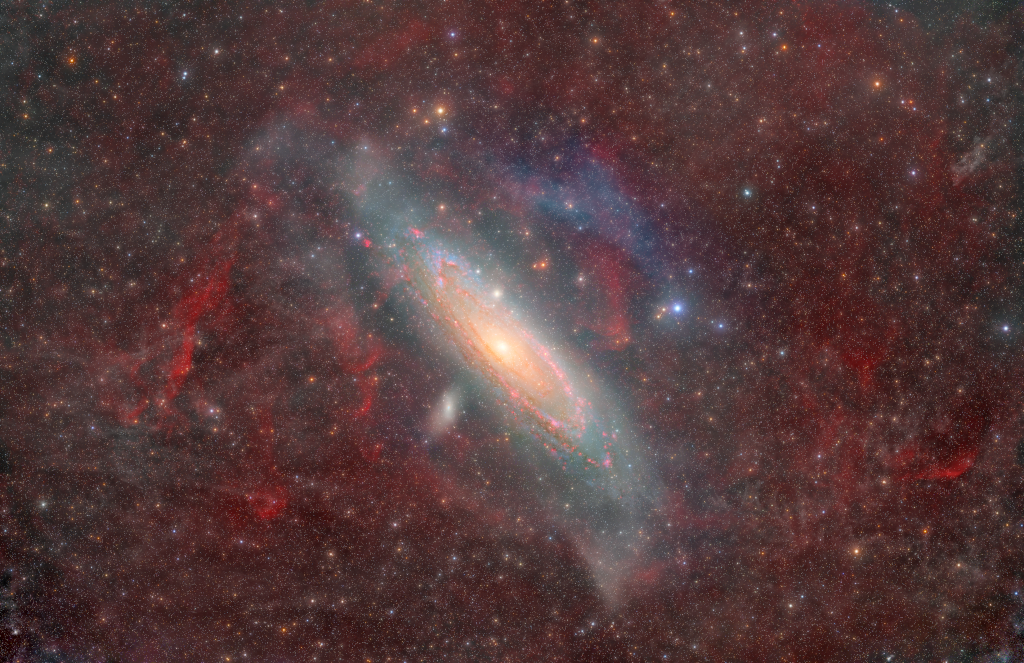
Today’s image, captured over more than 202 hours of exposure, is a neat demonstration of just how far we’ve come in observing our neighbor. The diffuse red and blue clouds you see aren’t the galaxy itself but largely foreground ionized hydrogen and oxygen residing well within our Milky Way. The pink-red swaths, on the other hand, trace hydrogen ionized by the energetic light of young stars, lighting up Andromeda’s dusty spiral arms like cosmic ribbons in a salon of starlight. And yes, you can spot M32 and M110, the satellite galaxies that are currently dancing in orbit around the larger Andromeda—the stellar version of houseguests who just never leave.
Why Andromeda Matters Scientifically
Andromeda’s long observational life is a reminder that some questions endure even as our tools grow sharper. From ancient unaided eyes peering up through the ink-black sea of the night to modern observatories that can coax faint photons from the far outskirts of the universe, Andromeda remains a fundamental object of study. What are we still chasing? How do galaxies merge and evolve across cosmic time? What is the true nature of the dark matter that underpins the scaffolding of galaxies like Andromeda? The answers will unfold slowly, the way galaxies themselves do—through collisions, accretion, and the quiet gravity of countless unseen particles.
A Galaxy of Enduring Questions
If you’re feeling the gravity of it all, you’re in good company. Andromeda has worn many crowns: a historic drawing in a medieval manuscript, a 19th-century catalog entry, and a 21st-century high-powered image that can teach us about the very fabric of matter and the fate of galactic neighbors. It’s a star-crossed history of observation and wonder, stitched together by light that has traveled across spaces we’re still learning to comprehend.
In the end, Andromeda’s story isn’t just about a nearby galaxy; it’s about humanity’s drive to see, to ask, and to imagine what’s just beyond the next bend of the night. The universe keeps offering new mysteries, and Andromeda keeps reminding us that some of the oldest questions are also the most enduring—how galaxies merge, how stars are born in dusty arms, and what dark matter really looks like when you zoom in on the cosmos with today’s telescope-power. The night sky, after all, is a long-running series, and Andromeda is one of its most faithful co-authors.
Image via NASAAPOD source
Copyright Notice: The image and referenced Reddit content remain the property of their respective creators and rights holders. They are used here solely for commentary, discussion, and informational purposes. Please visit the original source links for attribution and additional information.
© 2026 ways4eu.wordpress.com – H.J. Sablotny. All rights reserved. The text content of this article is the intellectual property of H.J. Sablotny and may not be reproduced, distributed, or republished without permission. Images remain the property of their respective copyright holders and are used for illustrative and commentary purposes only.