Ways4eu WordPress.com Blog
SPA View of ways4eu.wordpress.com
Mordor Macula and the Bold Face of Charon: A Pluto Logbook
By JohnTheWordWhirlwind
on Mon Jun 08 2026
Quick Links:APOD source | Charon | Mordor Macula | New Horizons
The Dark North of Charon
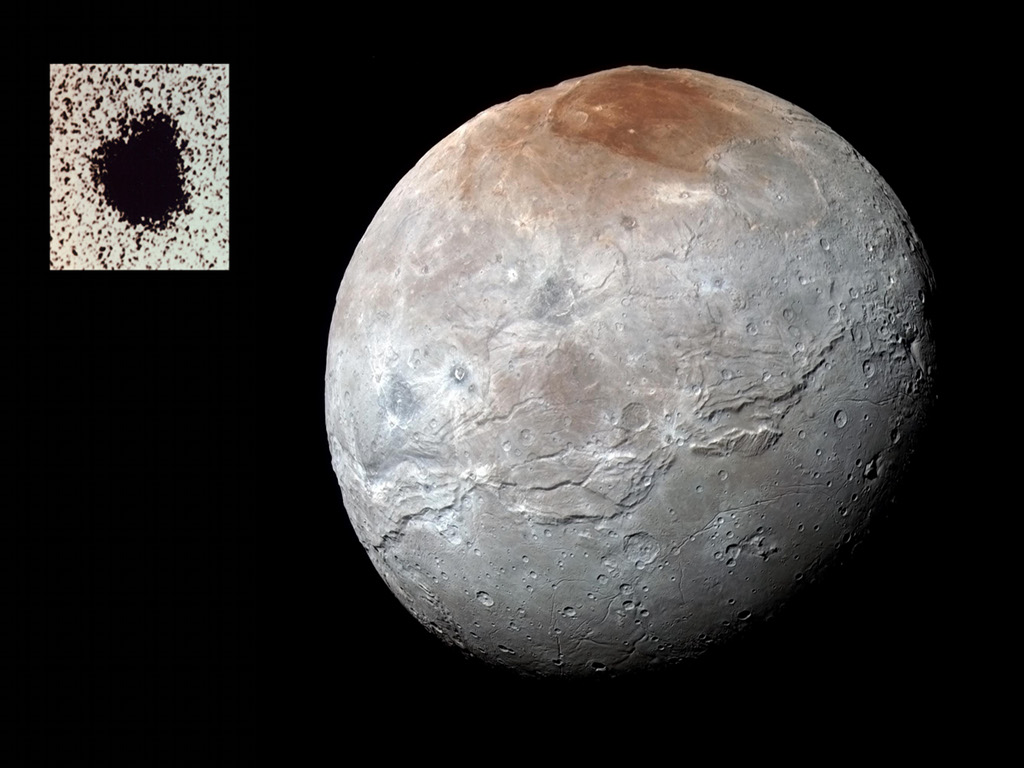
A darkened and mysterious north polar region known to some as Mordor Macula caps this premier view of Charon, Pluto‘s largest moon. If you’re hunting for the dramatic in deep space, this is the place to start. The high-resolution image was captured by the New Horizons mission near its closest approach to distant Pluto on July 14, 2015. It’s the sort of photo that makes you squint at the cosmos and say, “Well, that’s a mood.”
Color, Surface, and Geological Clues
The combined blue, red, and infrared image data was processed to enhance colors and follow variations in Charon’s surface properties with a resolution of about 2.9 kilometers (1.8 miles). In plain terms, we’re seeing a high-definition mosaic of a moon that’s over two billion miles away, yet somehow looks almost neighborly enough to touch. The color boost isn’t just pretty; it’s a map of geology in disguise. Variations in hue trace differences in surface composition, grain size, and perhaps the history of impact scars. It’s like reading the ring marks of a long, cold winter preserved in ice and rock.
A Fractured Hemisphere with Smooth Plains
Charon’s Pluto-facing hemisphere is presented in a way that makes you feel you’re peering into a frozen canyon country from a high perch on the outer rim of the Solar System. The image also features a clear view of an apparently moon-girdling belt of fractures and canyons that seems to separate smooth southern plains from varied northern terrain. It’s a celestial landscape that invites both awe and a touch of cartographer’s itch: where did that long, jagged belt come from, and what kept the southern plains so even and serene?
Scale, Discovery, and Why It Matters
Charon is 1,214 kilometers (754 miles) across. That’s about one-tenth the size of planet Earth but roughly half the diameter of Pluto itself, making it the largest satellite relative to its parent body in the Solar System. In other words, Charon is not simply a moon that tucks itself under Pluto’s wing; it’s a gravitational partner large enough to feel like a true peer.
Still, the moon appears as a small bump at about the 1 o’clock position on Pluto’s disk in the grainy, negative telescopic inset that helped James Christy and Robert Harrington at the U.S. Naval Observatory in Flagstaff discover Charon in June 1978. The story is part detective work, part cosmic lottery: a subtle hint on a starry backdrop becomes the first evidence that Pluto had a moon, opening a new chapter in our understanding of outer Solar System dynamics.
Names like Mordor Macula aren’t just whimsical touches; they reflect how planetary scientists translate color and albedo patterns into narratives about history and process. Darker patches can point to different ice mixtures, ancient surface evolution, or long episodes of space weathering. As New Horizons sailed past Pluto, the mission reminded us that the Solar System still has pages that glitter with mystery, and Charon’s bold silhouette is one of its most memorable chapters.
Copyright Notice: The image and referenced content remain the property of their respective creators and rights holders. They are used here solely for commentary, discussion, and informational purposes. Please visit the original source links for attribution and additional information.
© 2026 ways4eu.wordpress.com H.J.Sablotny – All rights reserved. The text content of this post is the intellectual property of H.J.Sablotny. Images are subject to their respective copyright holders and are used for illustration purposes only.