Ways4eu WordPress.com Blog
SPA View of ways4eu.wordpress.com
Colorful, Chaotic Jupiter: Juno and the Turbulent Art of the Gas Giant
By JohnTheWordWhirlwind
on Tue Jun 23 2026
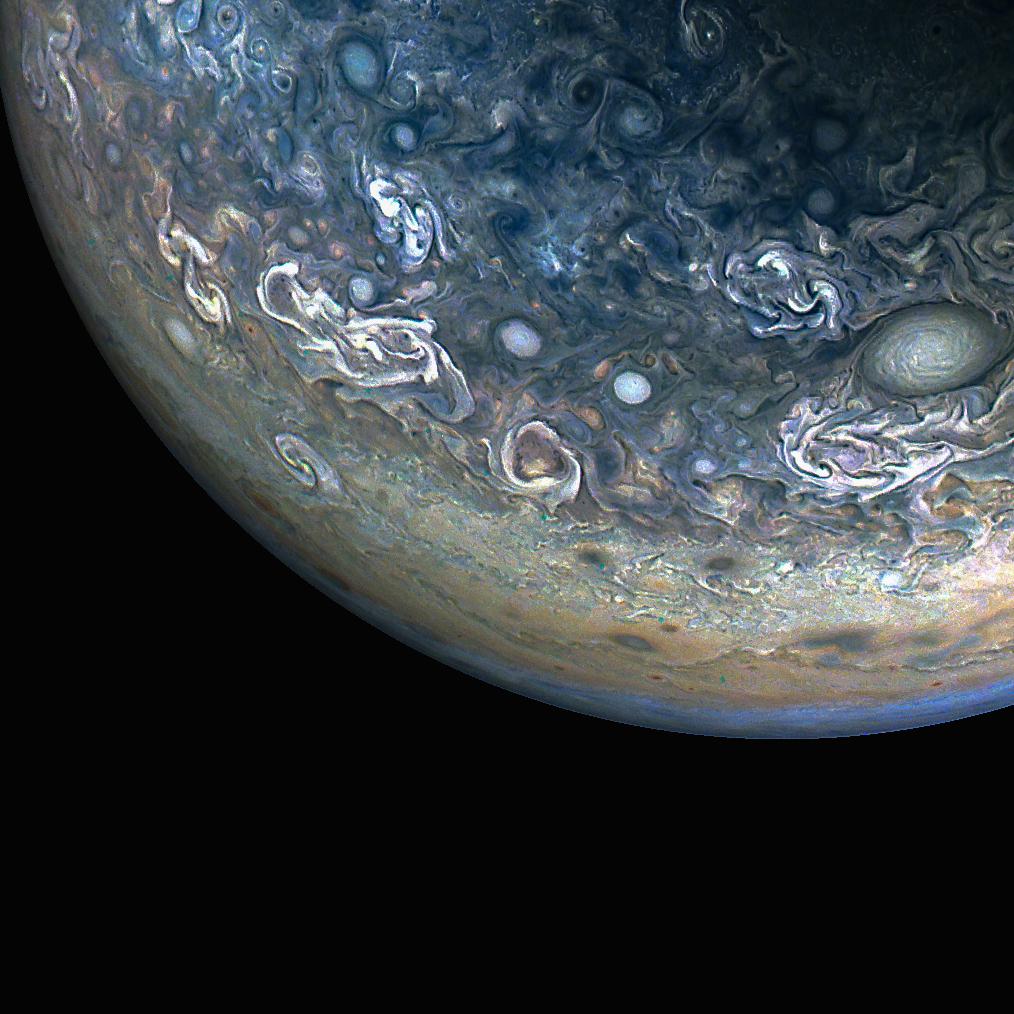
This color-enhanced view of Jupiter captures exactly why the planet remains such a compelling target for both science and visual imagination. The image, produced from data gathered by NASA’s Juno mission, turns the northern hemisphere into a study of turbulence, layered clouds, and atmospheric motion on a scale that dwarfs anything found on Earth.
Quick Links:Original NASA source | Juno mission | Jupiter storms | Gas giant atmosphere
Why the Colors Matter
The enhanced colors are not just decorative. They help highlight differences in cloud altitude, particle composition, and atmospheric structure that would be harder to separate in a flatter rendering. That makes the image useful for thinking about ammonia-rich cloud chemistry, storm boundaries, and the layered complexity of a giant planet whose visible surface is really an ever-changing weather system.
A Planet Built from Motion
Jupiter is defined by movement. Its belts, vortices, and turbulent zones reflect the interaction of internal heat, rapid rotation, and powerful jet streams. In images like this one, the northern hemisphere appears almost painterly, but the underlying processes are physical rather than artistic: convection, shear, and circulation on a planetary scale. Juno’s repeated passes help turn those visual impressions into a more coherent picture of how the atmosphere behaves over time.
What Juno Keeps Revealing
Since arriving at Jupiter, Juno has steadily improved our understanding of the planet’s gravity field, magnetosphere, polar cyclones, and cloud dynamics. Each close approach gives researchers another chance to connect imagery with instrument data, linking surface appearance to deeper questions about interior heat transport and atmospheric layering. That is why even a single vivid frame can carry scientific weight far beyond its immediate visual impact.
The Appeal of Jovian Disorder
Part of Jupiter’s fascination lies in the fact that its atmosphere never looks finished. The planet seems to be revising itself constantly through storms, braided cloud bands, and evolving color fields. This image captures that restless quality well. It shows Jupiter not as a static symbol of the solar system, but as a living example of planetary meteorology at its most dramatic.
Copyright Notice: The image and referenced content remain the property of their respective creators and rights holders. They are used here solely for commentary, discussion, and informational purposes. Please visit the original source links for attribution and additional information.
© 2026 ways4eu.wordpress.com H.J.Sablotny — All rights reserved. The text content of this post is the intellectual property of H.J.Sablotny. Images are subject to their respective copyright holders and are used for illustration purposes only.