Ways4eu WordPress.com Blog
SPA View of ways4eu.wordpress.com
Sun-Crossing Falcon 9: A Lightning-Quick Ballet Across the Sun
By Kinda Cool
on Thu Jun 25 2026
Quick Links:NASA image | Falcon 9 | Shockwaves | Cape Canaveral | Starlink
Sun-Crossing Falcon 9: A Lightning-Quick Ballet Across the Sun
A Five-Second Crossing with Perfect Timing
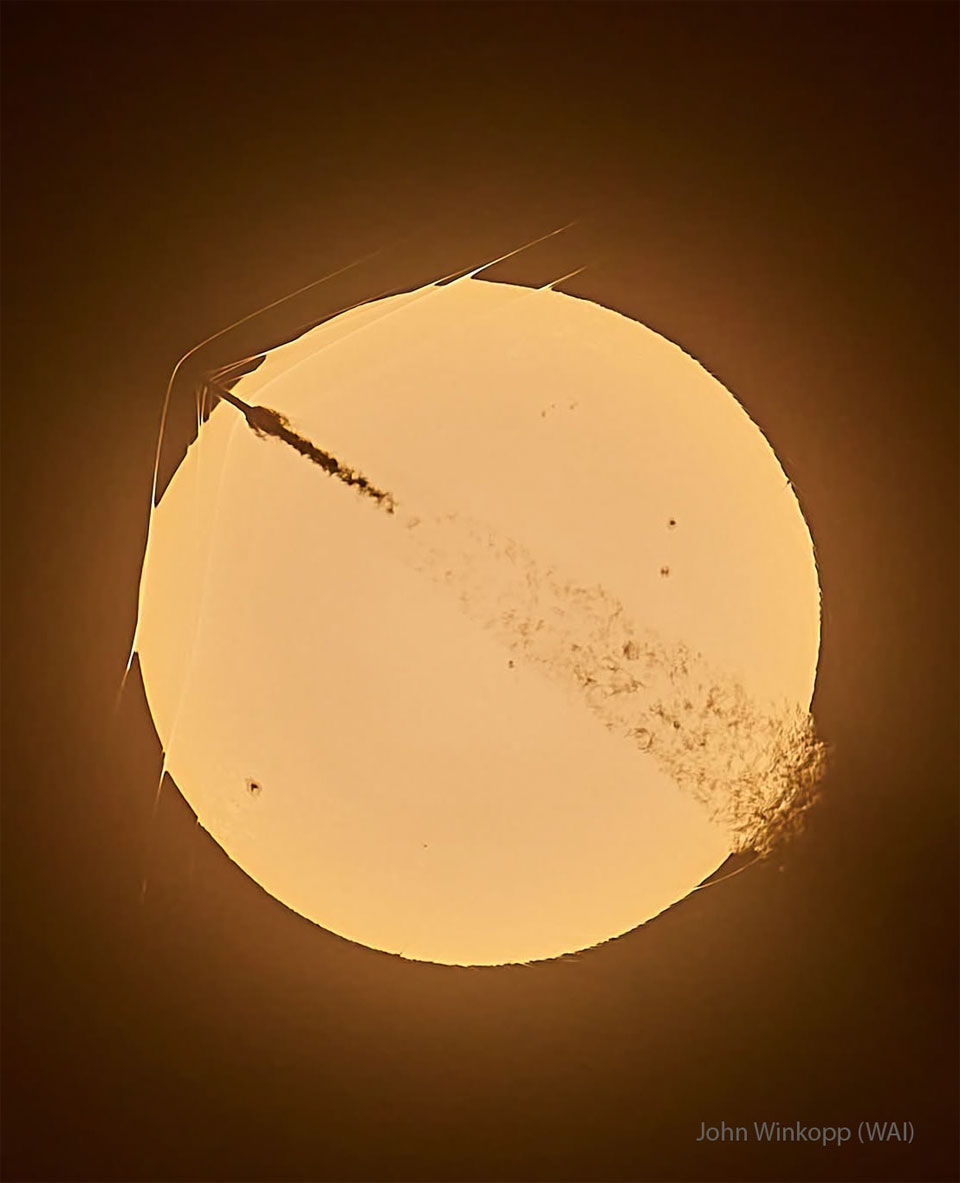
What a sight to behold. In late May, as Cape Canaveral blinked awake with the sea breeze and the whirr of distant engines, a SpaceX Falcon 9 shot skyward from Florida. The rocket rose into low Earth orbit with a hunter’s speed, and somehow, within the blink of an eye, it crossed the disk of the distant Sun from the photographer’s perfectly placed vantage point. If you enjoy celestial storytelling with a dash of engineering poetry, this image is the kind of moment you wait for—then immediately want to rewind and watch again.
Supersonic Flight and Visible Bow Shocks
Here’s what’s happening in that frame-by-frame drama. The Falcon 9 isn’t just climbing; it’s breaking the sound barrier as it streaks toward orbit. Supersonic speed isn’t merely a buzzword here. As the vehicle punches through the air, a bow-shaped wake of compressed air forms across its leading surfaces. Think of aerodynamic shockwaves as the sonic version of a drumbeat you feel rather than hear—only here, the drumming is visible, slicing through the atmosphere with precision and power.
How Sunlight Makes the Invisible Visible
In this remarkable image, at least three of those shockwaves are visible even outside the Sun’s disk. How does that happen? Sunlight refracts through the shockwaves, bending around the edges in a way that makes the invisible visible. It’s a reminder that light answers to the same rules as sound, just in a different key. When a rocket moves with such speed, the air around it does interesting visual gymnastics, and if you’re lucky enough to catch a photographer’s timing, you get an almost cinematic chorus of compression lines arcing across the frame.
The Exhaust Leaves Its Own Signature
Meanwhile, the exhaust trailing behind the rocket tells its own story. The plume dances with turbulence, its contours smeared and stirred as it tumbles toward the lower right of the image. Turbulence isn’t a sign of trouble here; it’s a signature of velocity and momentum, a visible fingerprint of a machine moving with extraordinary intent.
Starlink 10-53 and Routine Precision
All of this occurs in service of a mission that’s quietly astounding in its routine brilliance: Starlink 10-53, a robotic constellation deployment that delivered 29 communications satellites to low Earth orbit exactly as planned. Nothing dramatic in the outcome, yet everything dramatic in the spectacle. The rocket’s unshowy success—precise, predictable, dependable—serves as a backbone for a network that underpins global connectivity, even as it presents us with moments like this: a Sun-crossing silhouette where engineering meets cosmic poetry.
Sunspots Share the Spotlight
And if that isn’t enough to spark a smile, the Sun itself is doing a little jaw-dropping performance of its own. Sunspots dot the solar face, a reminder that even in the vastness of space, our star is an ever-changing ball of activity. The juxtaposition of a high-speed rocket threading the Sun’s daylight with the Sun’s own freckles creates a helmeted blend of awe: human achievement crossing the apex of natural grandeur.
Why This Image Feels So Unusual
So what’s happening to this Sun-crossing rocket? It’s a high-velocity, supersonic ascent from Cape Canaveral that demonstrates how a modern launcher can slice through the atmosphere, create a chorus of visible shockwaves, and set the stage for a network that will quietly anchor our connected world. It’s a reminder that in the age of rapid spaceflight and ubiquitous satellites, there are still moments where speed, light, and celestial geometry converge in a single, luminous frame.
A Lesson in Speed, Light, and Perspective
In the end, the image isn’t just about a rocket crossing the Sun; it’s about perspective. A well-placed photographer, a rocket on its way to low Earth orbit, sunlight refracting through the air’s dramatic choreography, and a Sun wearing spotted sunglasses at the edge of a busy sky. It’s a quick, dazzling five-second snapshot of humanity’s ongoing conversation with space—loud enough to inspire, precise enough to reassure, and witty enough to remind us that the cosmos always has a front row seat for our latest leap.
Image via NASA https://ift.tt/Pl2J6hx
Copyright Notice: The image and referenced content remain the property of their respective creators and rights holders. They are used here solely for commentary, discussion, and informational purposes. Please visit the original source links for attribution and additional information.
© 2026 ways4eu.wordpress.com – Herbert Johann Sablotny. All rights reserved. The text content of this article is the intellectual property of Herbert Johann Sablotny and may not be reproduced, distributed, or republished without permission. Images remain the property of their respective copyright holders and are used for illustrative and commentary purposes only.