Ways4eu WordPress.com Blog
SPA View of ways4eu.wordpress.com
How Did a Hamster Wheel Get Into Space?
By Kinda Cool
on Fri Jun 26 2026
Quick Links:NASA image | Hamster Wheel Nebula | Longmore 8 | Planetary nebula | El Sauce Observatory
How Did a Hamster Wheel Get Into Space?
A Strange Wheel in Deep Space
If you think your plate of spaghetti code is complex, try picturing a cosmic wheel rolling through the galaxy. The Hamster Wheel Nebula, officially cataloged as Longmore 8, sounds like a whimsical sci-fi prop, but it’s as real as your next coffee break on a clear night. Discovered by Andrew Longmore in 1976 as part of a sweeping survey of the southern sky, this celestial circuit is a reminder that the universe loves a good analogy, especially when it involves wheel-shaped gas structures and a dying star who forks over a dramatic light show.
Discovery Through Better Surveys
A survey with a high-tech boost
The discovery didn’t happen because someone happened to glance up and say, “Look at that!” No, it came about through a concerted push to see deeper into the heavens. Longmore’s survey leveraged several improvements in photographic technology for its day, including highly sensitive film capable of capturing fainter objects on the celestial plates. The result? A richer, more nuanced map of the southern sky that allowed features previously hidden in the photographic noise to reveal themselves—like a cosmic Rorschach test with a dash of astronomy.
Why the Shape Looks So Distinct
The wheel that isn’t just a wheel
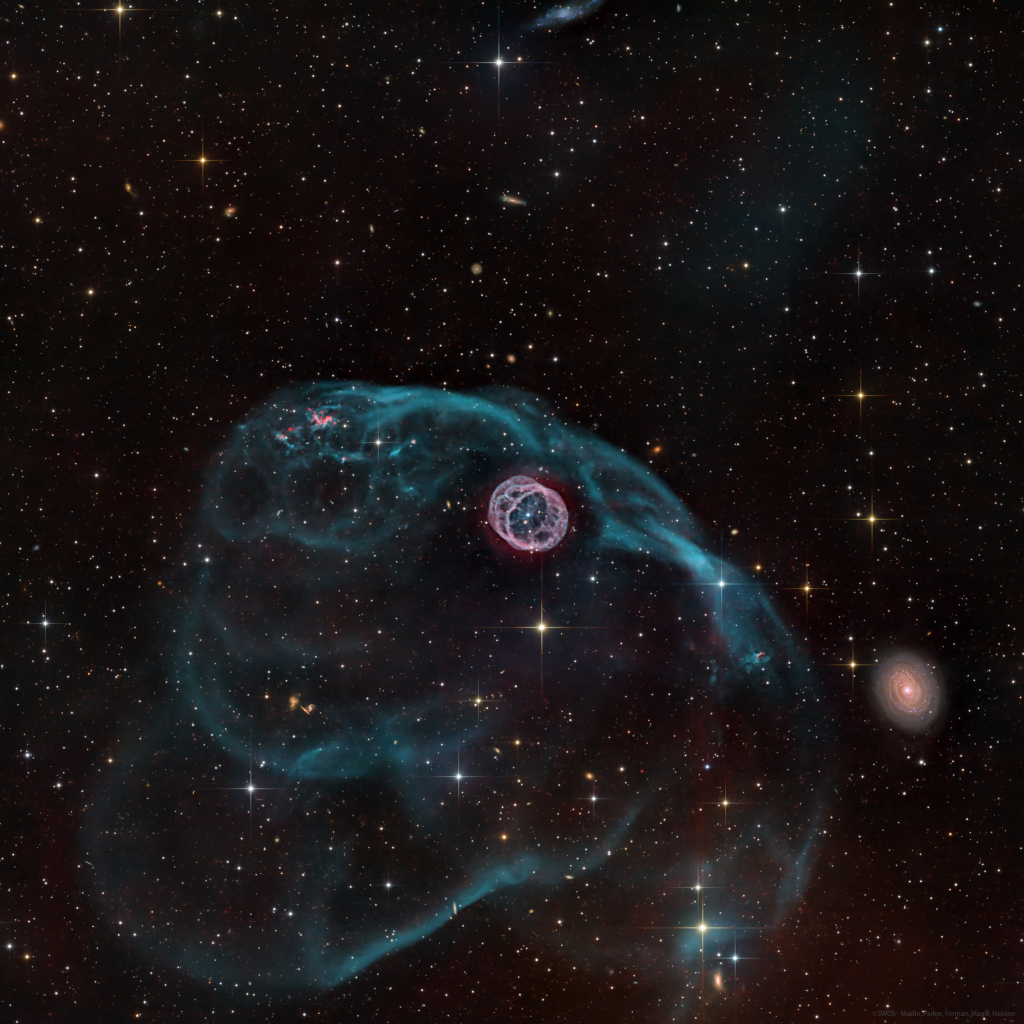
The featured image of the Hamster Wheel Nebula, taken at Observatorio El Sauce in Chile, presents a striking structure: a wheel shape knitted from glowing hydrogen. This isn’t a man-made wheel, nor a hamster’s toy tumbling through space. It’s a cosmic shell of ionized gas ejected by a dying star. The central engine is a bright white dwarf, the burned-out remnant of a once-fusing giant whose last days sent matter streaming outward, shaping the wheel as it expanded and cooled. The light we see is hydrogen gas that has been ionized, glowing in a characteristic red and blue glow that hints at the physics at play.
The White Dwarf at the Center
Why a wheel, though? In space, stellar winds and explosive events sculpt material into rings, filaments, and shells. Under the right conditions, these ejected gases can settle into symmetrical, wheel-like patterns as they interact with surrounding interstellar material and the radiation field of the central star. The Hamster Wheel Nebula is one such elegant byproduct of stellar death—an astronomical sculpture born from the final acts of a star’s life.
What Modern Cameras Reveal
The power of modern observation
That the wheel structure is so clearly visible today is a testament to the power of modern telescopes and cameras. On the original photographic plate, the wheel was barely discernible—a reminder that a lot of what we “know” in astronomy sits just beyond our threshold of perception, waiting for sharper eyes (and better cameras) to pull it into focus. Advances in detector sensitivity, image processing, and spectral analysis have turned faint whispers in the sky into vibrant, interpretable detail. When you combine high-quality instrumentation with careful observation, you don’t just see more—you understand more.
Hydrogen, Oxygen, and Color Clues
Two clumps and a hidden companion
If you scan the nebula’s glow, you’ll notice two opposing clumps of red hydrogen gas cradled within a blue veil of ionized oxygen. Those color cues aren’t merely pretty; they encode the physical conditions of the nebula: the ionization state, temperature, and composition of the gas, all of which whisper tales about the central star’s past and its present influence on the surrounding material. The red hydrogen, in particular, marks zones where energy from the central white dwarf is ionizing hydrogen atoms, while the blue of doubly ionized oxygen points to regions of higher excitation.
Could a Companion Star Be Involved?
What about a companion star? The arrangement of material and the kinematics implied by the gas clumps hint at more complexity than a lone white dwarf at the heart of the wheel. In many planetary nebulae, a secondary star can play a pivotal role in shaping the ejected envelopes, steering symmetry, and carving out structures that look suspiciously like wheels, spirals, or other geometric motifs. The possibility of a companion to the bright white dwarf at the wheel’s center adds an extra layer of intrigue to a nebula that already feels engineered by cosmic hands.
A Playful Name with Serious Science
A playful name with serious science
The “hamster wheel” label isn’t an attempt at whimsy to trivialize a serious subject. It’s a touch of public-friendly imagery that helps people connect with complex astrophysical phenomena. When we describe the wheel’s shape, we’re not dimming the science; we’re translating abstract gas dynamics into a picture that sparks curiosity. And curiosity is the first step toward understanding how stars live, die, and leave behind the spectacular light shows that become the fossil record of their final acts.
Why Longmore 8 Matters
Bottom line
The Hamster Wheel Nebula is more than a charming moniker—it’s a tangible reminder of how observational advancements unlock hidden features in the cosmos. From a 1976 survey that pushed photographic sensitivity to a wheel of glowing hydrogen sculpted by a dying star, Longmore 8 invites us to imagine the drama unfolding in the shadowed curtains of space. It’s a story of technology enabling discovery, of light revealing structure, and of cosmic cycles continuing to surprise us with their elegance.
So next time you’re tempted to overlook a faint smudge on a telescope plate, remember the wheel that rolled into space—an emblem of how far we’ve come and how much more there is to see beyond the horizon.
Image via NASA https://ift.tt/m3bdxU4
Copyright Notice: The image and referenced content remain the property of their respective creators and rights holders. They are used here solely for commentary, discussion, and informational purposes. Please visit the original source links for attribution and additional information.
© 2026 ways4eu.wordpress.com – Herbert Johann Sablotny. All rights reserved. The text content of this article is the intellectual property of Herbert Johann Sablotny and may not be reproduced, distributed, or republished without permission. Images remain the property of their respective copyright holders and are used for illustrative and commentary purposes only.