Ways4eu WordPress.com Blog
SPA View of ways4eu.wordpress.com
Celestial Tableaux: Moons, Rings, and Shadows — A Cassini Moment
By Kinda Cool
on Tue Jul 07 2026
Quick Links:NASA image | Cassini mission | Saturn rings | Mimas | Tethys
Celestial Tableaux: Moons, Rings, and Shadows — A Cassini Moment
A Postcard from Saturn
While cruising around Saturn, you learn to keep eyes peeled for the little bursts of poetry tucked into the solar system’s grand design. Picture this: a picturesque arrangement of moons, rings, and shadows that feels staged for a cosmic postcard, except it’s the real deal, captured by a ship that flew there and back with the casual confidence of a seasoned road tripper.
Mimas, Tethys, and the Ring Line
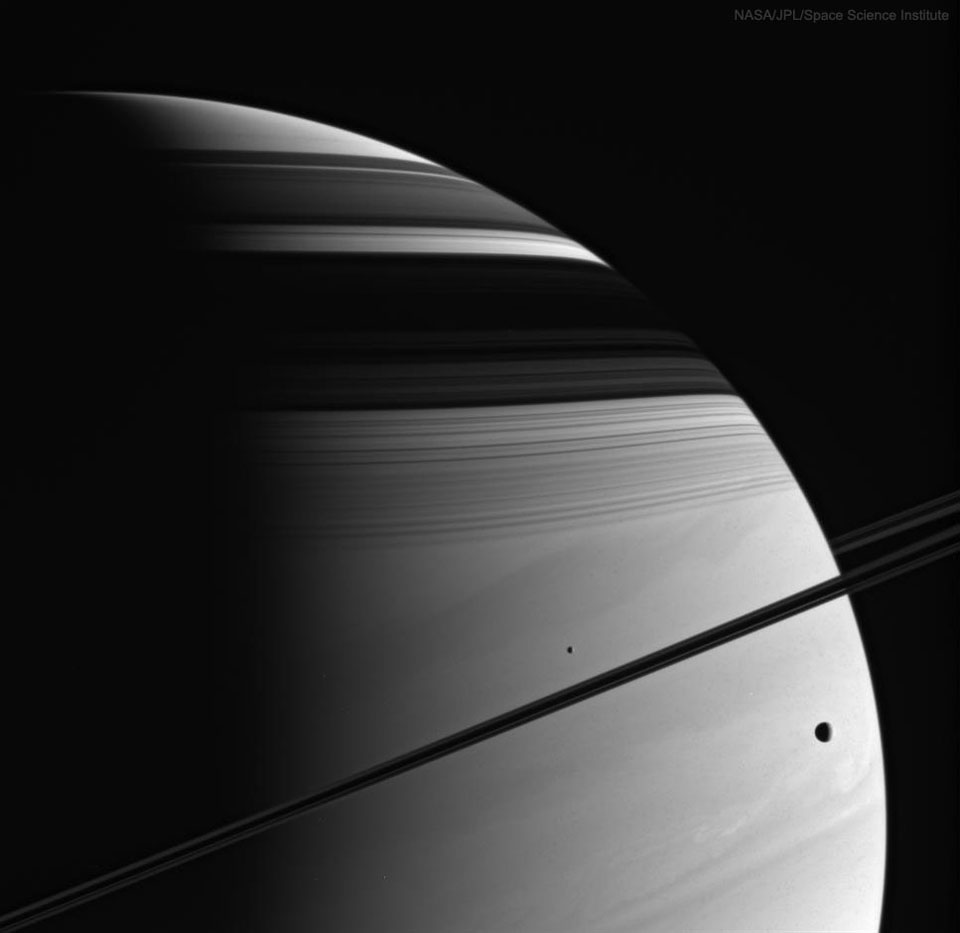
In 2005, the universe handed us one of its more charming stills, snapped by the Saturn-orbiting Cassini spacecraft. The featured image reads like a theatrical poster: two moons flanking Saturn, Mimas on the left and Tethys on the right, each one a tiny globe of its own drama. They drift on either side of Saturn’s thin rings, which are visible almost edge-on, a sight that makes the architecture of the ring system appear as a delicate, almost whisper-thin necklace around the planet.
Shadows Across the Planet
Across the top of Saturn, you can see the shadows of the wide rings — a dark, intricate lacework that hints at the rings’ sprawling structure and the way light slices through this part of the cosmos. It’s a reminder that even in something as vast as Saturn’s ring system, there are layers, lines, and silhouettes that can feel surprisingly intimate.
What Violet Light Reveals
The violet-light rendering of the scene adds another texture to the story: Saturn’s clouds gain a certain tactile quality under that spectral brush. The backdrop isn’t just a vacuum; it’s a dynamic, swirling canvas where storms and stratifications play their silent music across the planet’s upper atmosphere.
Cassini as the Patient Observer
A little orbital diary note for context: Cassini spent more than a decade orbiting Saturn, from 2004 through mid-2017. It wasn’t just a joyride; it was a carefully choreographed mission to map, observe, and understand the ringed giant from countless angles. When the time came to end the mission, the robotic voyager was directed to dive into Saturn, a final bow to the orchestration of exploration and a preventive step to avoid any chance of contaminating potentially pristine moons with Earth-made microbes.
Why These Alignments Keep Working
What makes images like this so compelling isn’t just the pretty alignment of moons and rings; it’s the reminder that the solar system is a gallery, and Cassini was our curator, turning celestial coincidences into frames we can study, share, and marvel at. Each glance offers a whisper of the processes at work: gravitational dances, orbital resonances, ring-scapes sculpted by shepherd moons, and atmospheres that churn with storms larger than Earth.
A Gallery of Rings and Resonance
If you’re hungry for more, keep an eye out for the recurring themes in Saturn’s photography: the near-edge-on rings that bend light into razor-thin silhouettes, the playful choreography of moons of varying sizes threading in and out of the scene, and the way Saturn’s weather patterns glow under different wavelengths, revealing textures that aren’t visible to the naked eye. It’s the cosmos showing off its craftsmanship, one frame at a time.
The Quiet Drama of a Giant World
In the end, those 2005 Cassini captures aren’t just images; they’re a reminder that even among the gas giant’s colossal scale, there are moments of intimate composition—a reminder to look up, tilt your head, and appreciate the quiet drama unfolding around a world thousands of times our size. The universe, it seems, has a soft spot for picture-perfect coincidences—and Cassini’s lens just happened to be in the right place at the right moment to share them with us.
Image via NASA https://ift.tt/8FbCq4s
Image via NASA https://ift.tt/8FbCq4s
Copyright Notice: The image and referenced content remain the property of their respective creators and rights holders. They are used here solely for commentary, discussion, and informational purposes. Please visit the original source links for attribution and additional information.
© 2026 ways4eu.wordpress.com – Herbert Johann Sablotny. All rights reserved. The text content of this article is the intellectual property of Herbert Johann Sablotny and may not be reproduced, distributed, or republished without permission. Images remain the property of their respective copyright holders and are used for illustrative and commentary purposes only.