Ways4eu WordPress.com Blog
SPA View of ways4eu.wordpress.com
The Blue Blob Mystery: A Supernova Survivor Near the Galactic Heart
By Kinda Cool
on Wed Jul 08 2026
Quick Links:NASA image | Sagittarius C | Chandra X-ray Observatory | XMM-Newton | Galactic Center
The Blue Blob Mystery: A Supernova Survivor Near the Galactic Heart
The Strange Blue Speck
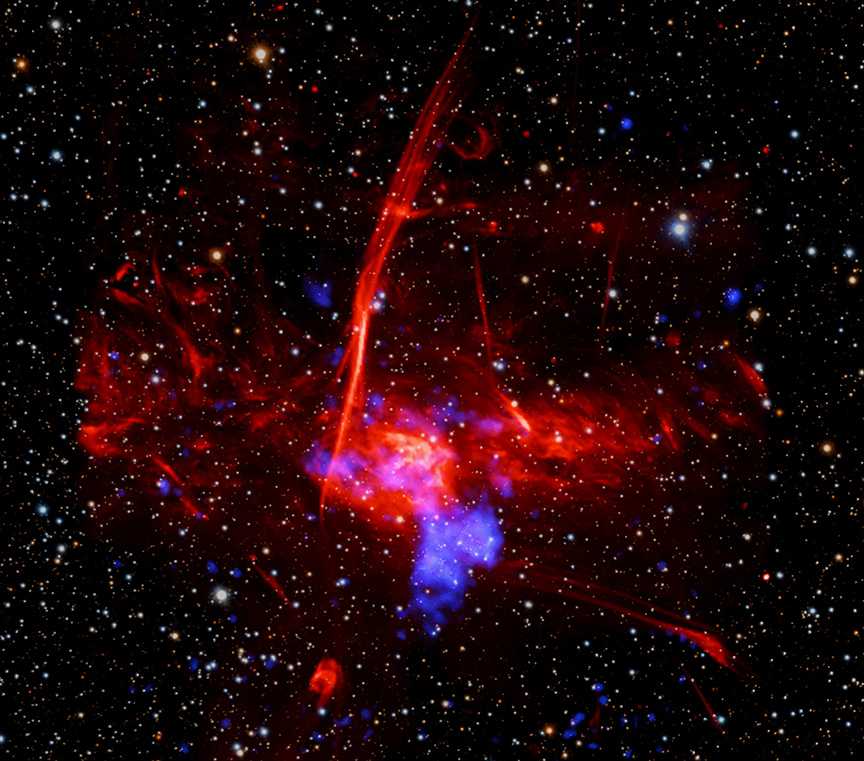
Do you see that blue blob to the lower right of the image center? If astronomers are right, that little speck is more than just a pretty pixel. It could be the ghost of a massive star that blew itself to smithereens in a supernova, its light finally arriving on Earth about 1,700 years ago. Talk about a delayed arrival—stellar fireworks that show up long after the party started.
How the Image Was Built
What makes this image so intriguing is how it’s put together like a cosmic collage. The background stars glow in red, green, and blue thanks to Pan-STARRS telescopes in Hawaii, painting a familiar optical canvas of our Milky Way. Then there’s a large red cloud stitched in from radio observations by the MeerKAT telescope in South Africa, hinting at tangled gas and magnetic fields weaving through the region. The pièce de résistance, those bright blue X-ray whispers, come from NASA’s Chandra X-ray Observatory and ESA’s XMM-Newton, revealing high-energy processes that only a superheated shockwave or a newborn remnant can conjure.
Why Sagittarius C Matters
The star-forming heart of this neighborhood is a vast expanse called Sagittarius C. Think of it as a bustling stellar nursery and a busy lab for dead-star physics all rolled into one. Sagittarius C spans roughly 50 light-years and sits about 26,000 light-years from Earth. If you were to beam a message across the galaxy, you’d be waiting a long time—about 26,000 years for a round trip. Still, we’re lucky that the light from that potential ancient supernova has finally reached us, giving us a rare, close-up glimpse into a page of galactic history.
Close to the Milky Way’s Core
One thing that makes this region especially fascinating—and, frankly, a little nerve-wracking—is proximity to the Milky Way’s central engine. The supermassive black hole at the heart of our galaxy lies just off to the left of this image, a cosmic heavyweight whose influence percolates through the surrounding gas and dust. The idea that a supernova could occur so close to such a colossal gravitational behemoth challenges and enriches our understanding of how star death and birth dance in tight, magnetized quarters.
What a Confirmed Remnant Would Mean
If the blue blob is confirmed as a supernova remnant, it would be one of the closest such remnants discovered near the Galactic Center. That proximity isn’t just a bragging-rights statistic; it would offer a rare laboratory for studying how dying stars sculpt their environment in environments shaped by intense gravity, strong magnetic fields, and dense gas. In these crowded neighborhoods, the life cycle isn’t a simple, tidy ladder. It’s a tangled web where the death of one star can seed the birth of many others, with gas flows and magnetic twists guiding the next generation of stars.
Why This Changes the Bigger Picture
So what could this mean for our broader picture of the Milky Way? It reinforces a picture of the Galactic Center as a dynamic, interconnected ecosystem. The story isn’t just about one bright afterglow in the X-ray, nor about a single cloud of gas lighting up in radio wavelengths. It’s about the chorus of physics playing out across wavelengths: stellar winds, shock fronts, magnetic reconnection, and the slow, patient accumulation of material that will someday form new stars. It’s a reminder that in the cosmos, endings aren’t quiet—they’re the opening act for something new.
The Mystery We’re Still Testing
As we keep tugging at the threads of this mystery, scientists will tighten their observations, cross-checking imaging across optical, radio, and X-ray data to confirm the blue blob’s true nature. If it passes the test, we’ll have a near-centerpiece in our galactic gallery: a supernova remnant whispering from the shadows near the heart of the Milky Way, telling us how stars die, how gas moves, and how the cosmos keeps spinning the wheel of creation. And in a universe where we measure time in millennia, 1,700 years feels almost like a blink—one more reminder that the sky is always writing back, sometimes with a blue glow that hints at a centuries-old explosion still shaping the night.
MediaLink via NASA
Copyright Notice: The image and referenced NASA image and source material remain the property of their respective creators and rights holders. They are used here solely for commentary, discussion, and informational purposes. Please visit the original source link for attribution and additional information.
© 2026 ways4eu.wordpress.com – Herbert Johann Sablotny. All rights reserved. The text content of this article is the intellectual property of Herbert Johann Sablotny. Images remain subject to their respective copyright holders and are used here for commentary, discussion, and informational purposes only.