Ways4eu WordPress.com Blog
SPA View of ways4eu.wordpress.com
The Cosmic Crib: Stages of Star Formation in Orion A (with a Side of Cosmic Chuckles)
By Kinda Cool
on Wed Jul 08 2026
Quick Links:NASA image | Orion A | James Webb Space Telescope | Star formation | Accretion disk
The Cosmic Crib: Stages of Star Formation in Orion A (with a Side of Cosmic Chuckles)
Why Orion A Makes the Perfect Classroom
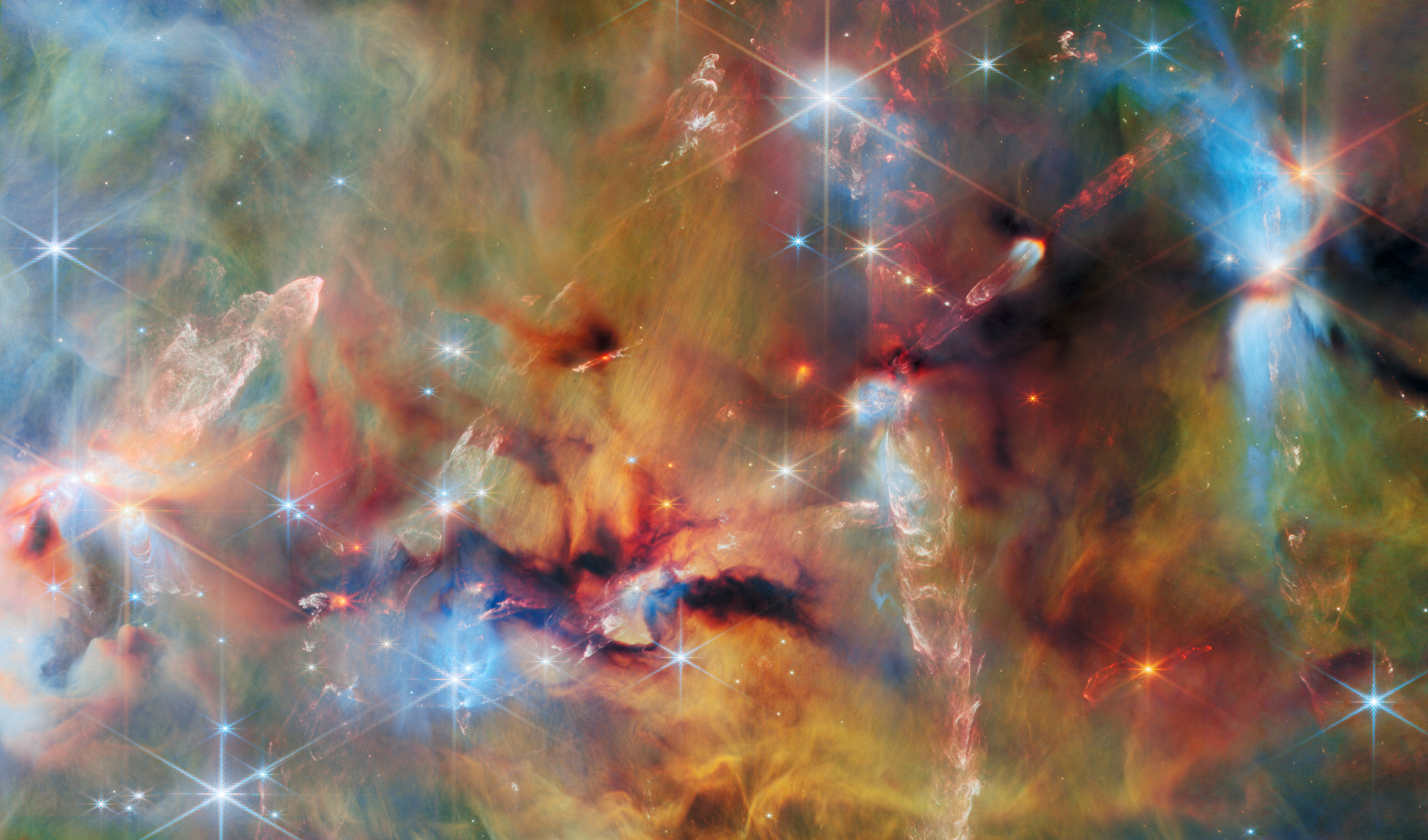
This NASA/ESA/CSA James Webb Space Telescope Picture of the Month shows the giant molecular cloud Orion A, an area of the sky replete with star-forming clouds. If you’ve ever wondered how a stubborn lump of gas and dust decided to become the glittering showboats we call stars, Orion A is the most dramatic, star-staging ground in the known universe. Think of it as the universe’s baby-obsessed theater district, with a cast that ranges from sleepy proto-stars to full-blown celestial rock stars.
Stage 1: Cold Beginnings
Stage 1: The Cold, Cloudy Start (Also Known as “Brr, It’s Cold in Here”)
Orion A starts as a vast, frigid cloud of mostly hydrogen molecules, with a sprinkle of helium and a dash of dust. It’s the kind of place where temperatures drop enough to make a snowman question his life choices, except the snow is cosmic dust and the snowman is a clump of gas. Gravity begins to nudge parts of the cloud inward, but the internal pressure and magnetic fields throw a tiny temper tantrum, slowing the collapse. It’s a slow-brewed beginnings montage, like the opening credits of a sci-fi epic where not much happens yet, but you can smell the popcorn—the stellar kind, of course.
Stage 2: Prestellar Build-Up
Stage 2: The Prestellar Haze (The Quiet Prep Week)
Before a star pokes its head above the nebulae, the cloud fragments into denser pockets. These prestellar cores are the sort of places where the universe quietly whispers, “Thing’s about to get real.” In this stage, gravity starts to win the argument, temperatures continue to fall, and the core grows denser. It’s a backstage pass to the formation of something spectacular, but you’d better bring a flashlight because the lighting is mostly dim and dramatic. The dust grains do their best impression of protective cloaks, shielding the newborn star embryos from the intense radiation of their surroundings.
Stage 3: The Protostar Appears
Stage 3: The Protostar Emerges (Introductory Scene: The Spark of Dawn)
When enough mass piles in and the core becomes unstoppable, a protostar ignites in its own baby-sized furnace. The protostar is not yet a true star—think of it as a star-in-training wearing a unruly hoodie and misplacing its solar textbooks. It shines dimly in infrared, mostly because its surface is still cocooned by gas and dust. Jets and outflows begin to pop out, like tiny cosmic garden hoses, carving channels in the surrounding cloud. It’s the moment you realize you’re witnessing a star auditioning for the lead role.
Stage 4: Disk Growth and Spin
Stage 4: Accretion and Disk Dynamics (The Accretion Disk, a.k.a. The Spin Class)
Material keeps spiraling onto the young star via an accretion disk—a radiant, rotating banquet of gas and dust. This disk is both the star’s diner and the construction site for potential planets. The protostar’s gravity pulls, the disk thins, and magnetic fields choreograph an intricate dance. If you squint hard enough, you can almost see planetesimals taking shape, like cosmic wishbones being formed for future exoplanets. Outflows continue to clear cavities, giving the newborn system its signature striped, carrot-like appearance in images.
Stage 5: Becoming a True Star
Stage 5: The Switch to a True Star (Stellar Onboarding Complete)
Once the core temperature and pressure reach certain thresholds, hydrogen fusion kicks in, and the protostar graduates to a real star. It begins to shine with a steady glow, radiating energy outward and stabilizing the surrounding disk. The once-chaotic accretion slows as the star settles into a main-sequence rhythm. Any planets that survived the proximal drama may now orbit in a more graceful, mineral-filled waltz around the newborn sun. In Orion A, many young stars are still surrounded by the remnants of their birth disks, offering a backstage pass to the early stages of planetary formation.
Stage 6: Clearing the Nursery
Stage 6: The Clearing Act (The Nebula Takes Its Bow)
With sustained energy output, young stars push away residual gas and dust, clearing the neighborhood—an astronomical version of “parents enforcing bedtime.” Jets continue to sculpt the remnants, cavities widen, and the nursery slowly empties. The remaining material may coalesce into planets, asteroids, or be flung into interstellar space by gravitational interactions. The Orion A region keeps its dramatic flair, hosting newborns at various milestones along their early lives.
Why the Whole Sequence Matters
A Quick Note on the Whole Scene
Orion A isn’t just a pretty picture with twinkly bits; it’s a bustling, multi-stage star factory. The James Webb Space Telescope’s infrared eye helps astronomers pierce the dust and reveal the hidden stages. The result is a sequence of snapshots that tell the universal story: gravity’s persistent tug, dust and gas’s dramatic interplays, and the birth of stars that will one day light up entire star-forming regions across the galaxy.
In the grand theater of the cosmos, Orion A is a backstage tour you’d actually want to attend. It’s where science meets spectacle, where the universe shows its soft side—one protostar, one accretion disk, and one nascent planetary system at a time. If you’re looking for a reminder that creation stories aren’t just myths but real, observable processes playing out in real time, Orion A hands you a front-row seat with a side of cosmic humor.
Final thought: next time you stare up at the night sky, remember that somewhere in Orion A, a baby star might be hiccuping its first fusion burps, while its planet-building siblings try on their first radial velocity shifts. It’s messy, magnificent, and absolutely worth the cosmic RSVP.
MediaLink via NASA
Copyright Notice: The image and referenced NASA image and source material remain the property of their respective creators and rights holders. They are used here solely for commentary, discussion, and informational purposes. Please visit the original source link for attribution and additional information.
© 2026 ways4eu.wordpress.com – Herbert Johann Sablotny. All rights reserved. The text content of this article is the intellectual property of Herbert Johann Sablotny. Images remain subject to their respective copyright holders and are used here for commentary, discussion, and informational purposes only.