Ways4eu WordPress.com Blog
SPA View of ways4eu.wordpress.com
A Red-Planet Flipbook: Pathfinder, Sojourner, and the Fourth of July That Went Interplanetary
By Kinda Cool
on Tue Jul 14 2026
Quick Links:NASA APOD source | Mars Pathfinder | Sojourner rover | Ares Vallis | Mars landing airbags
A Red-Planet Flipbook: Pathfinder, Sojourner, and the Fourth of July That Went Interplanetary
On July 4th, 1997, Mars got its own fireworks show—minus the smoke and plus a lot of guts. The Mars Pathfinder spacecraft arrived not with a whimper but with a flamboyant puff of courage, using its own array of fireworks, a parachute, and a cocoon of airbags to pull off what could only be described as a space-age bounce house routine. It bounced like a giant beach ball at least 15 times before it finally settled on the crimson ground of Mars at 10:07 AM Pacific Daylight Time. If you’ve ever watched a toddler test the elasticity of a new toy, you’ve felt the same mix of anticipation and disbelief as Pathfinder did its spring-loaded synchronized landing.
Once the dust settled, Pathfinder’s airbag-assisted landing sequence completed, and mission control exhaled in unison. The craft transmitted a color mosaic—a living postcard from another world—painting Mars in tones of coppery dust, ochre rock, and the kind of blue that makes you want to believe in alien sunsets. It wasn’t just a victory lap for engineering; it was a dare to imagination, a bright invitation to see Mars not as a distant destination but as a place where ingenuity can turn a tumble into a triumph.
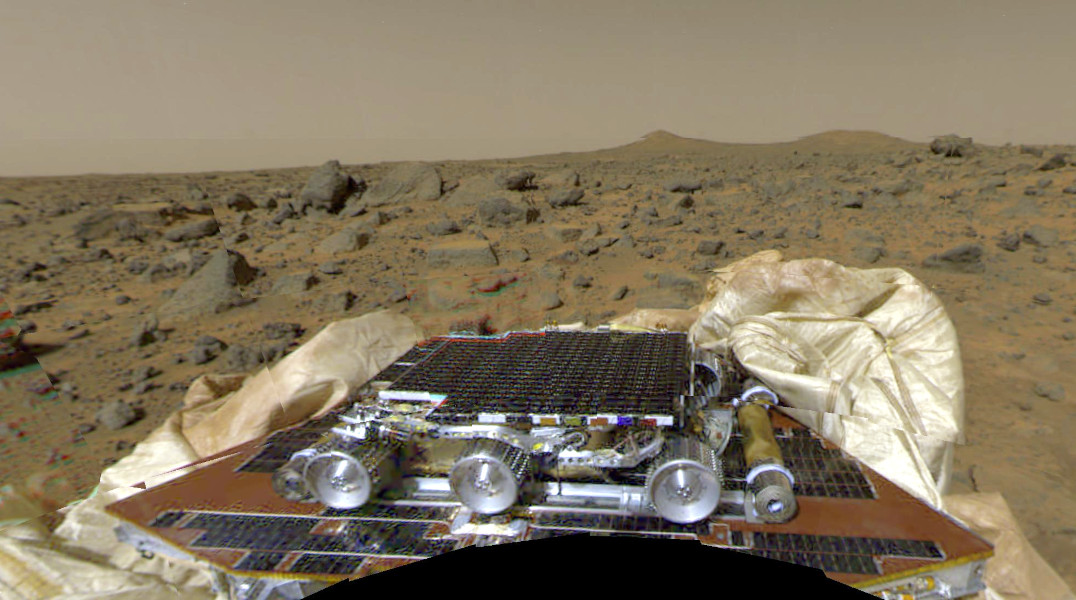
In the scene from another world that followed, the Mars Sojourner rover peered into the frame, its six wheels tucked under a chassis that looked like a tiny moon buggy with big ambitions. Sojourner crouched atop the unfolded Pathfinder, a compact explorer about the size of a large house cat, surveying the lay of the land with a veteran’s patience. The little solar-powered wanderer, powered by curiosity as much as sunlight, would soon prove to be the first successful Martian rover. It wasn’t merely a proof of concept; it was a demonstration that a small, determined vehicle could do serious science on a planet where big plans can be a matter of life and dust.
Pathfinder’s surroundings told a story as dramatic as any sci‑fi plot: deflated airbags, cast-off from the entry sequence, lay strewn about, like the crumpled remnants of a spacefaring bubble wrap party. The terrain of the Ares Vallis floodplain stretched rock-strewn and honest, a landscape that demanded respect and a steady hand. In the distance, Martian hills rose against a dusty brownish sky, painting a horizon both eerily silent and full of possibilities. It was a panorama that whispered: “Here is a world you can study, measure, and perhaps understand a little better with every data packet you beam back home.”
And what a homecoming it was. The Pathfinder lander, historically generous with both spectacle and science, would later be renamed the Carl Sagan Memorial Station, a fitting tribute to one of the brightest voices in astronomy and science communication. The renaming carried not just celestial homage but a reminder that exploration is as much about naming what we discover as it is about discovering what we name.
If you’ve ever daydreamed about robots and rockets dancing across the solar system, this chapter of Mars is where the music began. Pathfinder and Sojourner didn’t just arrive on July 4, 1997; they arrived with a message: that curiosity is contagious, that perseverance can take the form of a conquering bounce, and that sometimes the smallest explorers can yield the largest demonstrations of what we’re capable of when we look up and ask questions. It’s a red-tinged reminder that the frontier isn’t merely a line on a map—it’s a place we cross with ingenuity, humor, and a stubborn faith in the next discovery just over the horizon.
Image via NASA https://ift.tt/jpol2Jg
Copyright Notice: The image and referenced source material remain the property of their respective creators and rights holders. They are used here solely for commentary, discussion, and informational purposes. Please visit the original source links for attribution and additional information.
© 2026 ways4eu.wordpress.com – Herbert Johann Sablotny. All rights reserved. The text content of this article is the intellectual property of Herbert Johann Sablotny. Images remain subject to their respective copyright holders and are used here for commentary, discussion, and informational purposes only.