Ways4eu WordPress.com Blog
SPA View of ways4eu.wordpress.com
The Devil’s Mask: A Three-Galaxy Waltz Across 190 Million Light-Years
By Kinda Cool
on Wed Jul 15 2026
Quick Links:NASA APOD source | NGC 6769 | interacting galaxies | tidal forces in galaxies | star formation in galaxies
The Devil’s Mask: A Three-Galaxy Waltz Across 190 Million Light-Years
Some 190 million light-years away, far beyond the bright stars and nebulae of the Milky Way, three galaxies drift toward each other in a gravity-fed pas de deux that makes the night sky feel like a cosmic ballroom. If you tilt your head just so and squint through a telescope, you can almost hear the faint velvet thrum of dark matter keeping time as these giants choreograph their next dramatic move.
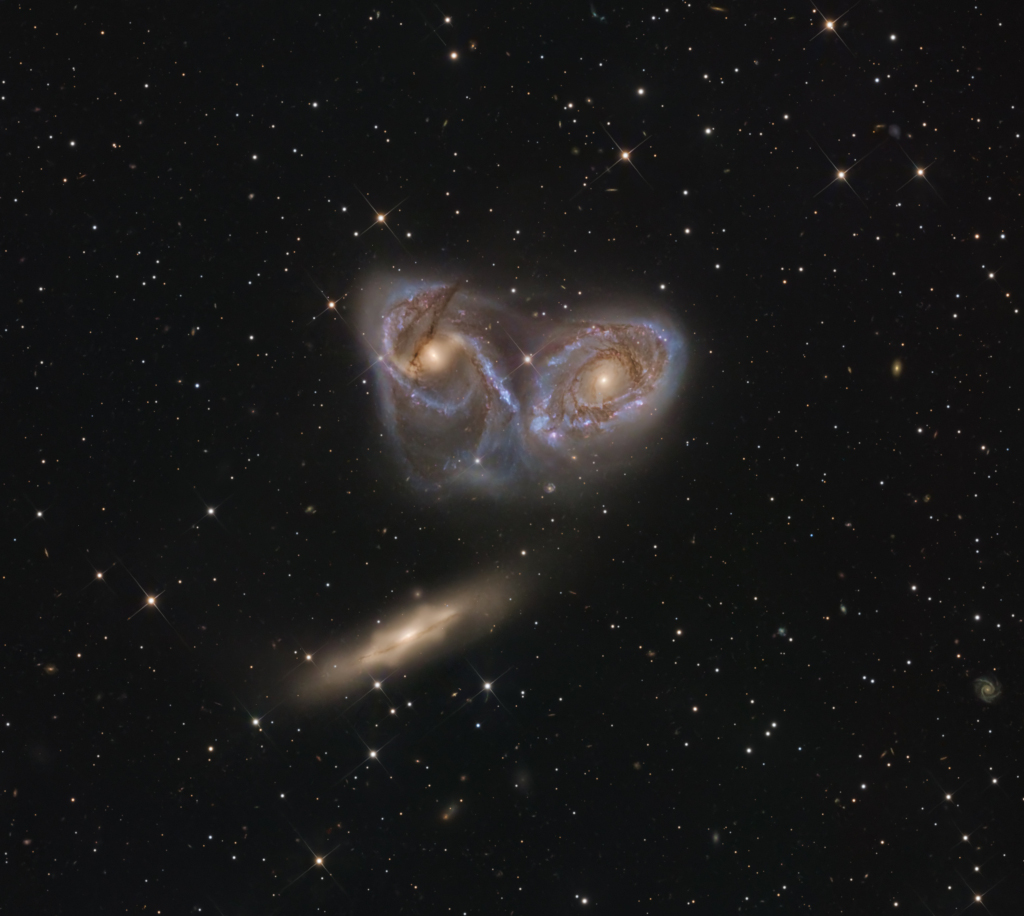
The show opens with two grand spiral galaxies, NGC 6769 and NGC 6770, dancing in a harmonious face-on view. Their luminous disks glow with the quiet confidence of familiar friends, yet a closer look reveals the fingerprints of gravitational sparring: dust lanes, like ink-painted trails, carve dramatic patterns across their spirals. These interstellar scarifications aren’t scars of injury but records of a lively history—tidal forces tugging at clouds of gas and dust, compressing them into star-forming cradles. And in those bright blue clumps along the arms, you can glimpse the youngest of stars—stellar adolescents born from the rough-and-tumble collisions of massive molecular clouds. It’s a reminder that even in the vastness of space, gravity is a patient matchmaker, coaxing cradles of gas into glittering new neighborhoods of stars.
Below this luminous duet, a third partner joins the stage: spiral NGC 6771. This galaxy presents a more edge-on silhouette, offering a contrasting drama to its companions. From our vantage, its central bulge appears boxier, a shape earned from the tangled web of tidal streams and star flows that braid through the core. It’s as if NGC 6771 is wearing an architectural compass on its chest, hinting at the unsettled gravity that will inevitably reshape it in the near cosmic future. The frenzy of interactions has a way of redistributing stars and gas, rewriting the internal choreography and peppering the disk with new lines of star formation.
And yet, the story isn’t merely about what these galaxies look like right now. It’s a prologue to a far more dramatic finale: a future merger in which the three will dissolve their separate identities and fuse into a single, monumental galaxy. The cosmos doesn’t rush these unions; it sedately composes them. The available time for such a transformation is measured not in human lifetimes but in tens to hundreds of millions of years—long, patient strokes on the universal canvas. For now, the three sisters—often nicknamed the Devil’s Mask by those who enjoy a little myth on their science—continue their intricate dance, bound by gravity, their motions a study in orbital grace and galactic reconfiguration.
At the estimated distance of this trio, the sharp telescopic frame spans more than 300,000 light-years, a colossal span that stretches across the southern skies in the faint, far southern constellation Pavo. From Earth, we’re looking through the veil of time as well as space, catching a glimpse of a forebodingly beautiful mask formed by intertwined spirals, gas, dust, and starlight. The Devil’s Mask isn’t a single face but a composite of three—each with its own temperament and history—yet destined to become one, a unified silhouette told in the language of gravity rather than speech.
In the end, what makes this intergalactic performance so arresting isn’t just its size or distance. It’s the way the scene embodies a universal truth: the universe is a patient, stubborn artist, forever sketching out new shapes from old materials, and inviting observers to marvel at the slow, inexorable artistry of cosmic evolution. When the final act comes, the Devil’s Mask will fade into a singular galaxy, its history stitched into a larger tapestry of gravitational artistry that spans the night sky and the imagination alike. For now, we watch, we wonder, and we watch again, as three distant spirals remind us that even in the void, there is movement—and meaning—in every bend of the dance.
Image via NASA https://ift.tt/weRsGcO
Copyright Notice: The image and referenced source material remain the property of their respective creators and rights holders. They are used here solely for commentary, discussion, and informational purposes. Please visit the original source links for attribution and additional information.
© 2026 ways4eu.wordpress.com – Herbert Johann Sablotny. All rights reserved. The text content of this article is the intellectual property of Herbert Johann Sablotny. Images remain subject to their respective copyright holders and are used here for commentary, discussion, and informational purposes only.