Ways4eu WordPress.com Blog
SPA View of ways4eu.wordpress.com
When Binary Stars Throw Supernovae: A Celestial Double Feature
By Kinda Cool
on Thu Jul 16 2026
Quick Links:NASA APOD source | supernova remnants | binary star systems | stellar evolution | shockwaves in space
When Binary Stars Throw Supernovae: A Celestial Double Feature
If you thought reusable drama only lived in soap operas, think again. The cosmos has its own blockbuster: two stars in a binary system, one after another, exploding in a cosmic duet that leaves us with a spectacular, superimposed pair of supernova remnants. Meet the Sibling Supernova Remnants, a mesmerizing story stitched together across light, energy, and time.
What happens when a binary goes supernova?
In a binary star system, two stars dance around a common center of gravity. It sounds elegant, until one star reaches the end of its life and erupts as a supernova. That blast is not just a cataclysm; it’s a celestial kick. The surviving companion is flung outward with a newfound velocity, its life course shaken but not necessarily ended. If the system’s geometry and timing align just right, tens of thousands of years later, the second star also goes supernova. The result is a layered, overlapping structure—two remnants that tell a shared, sequential story rather than two unrelated fireworks.
A composite portrait across wavelengths
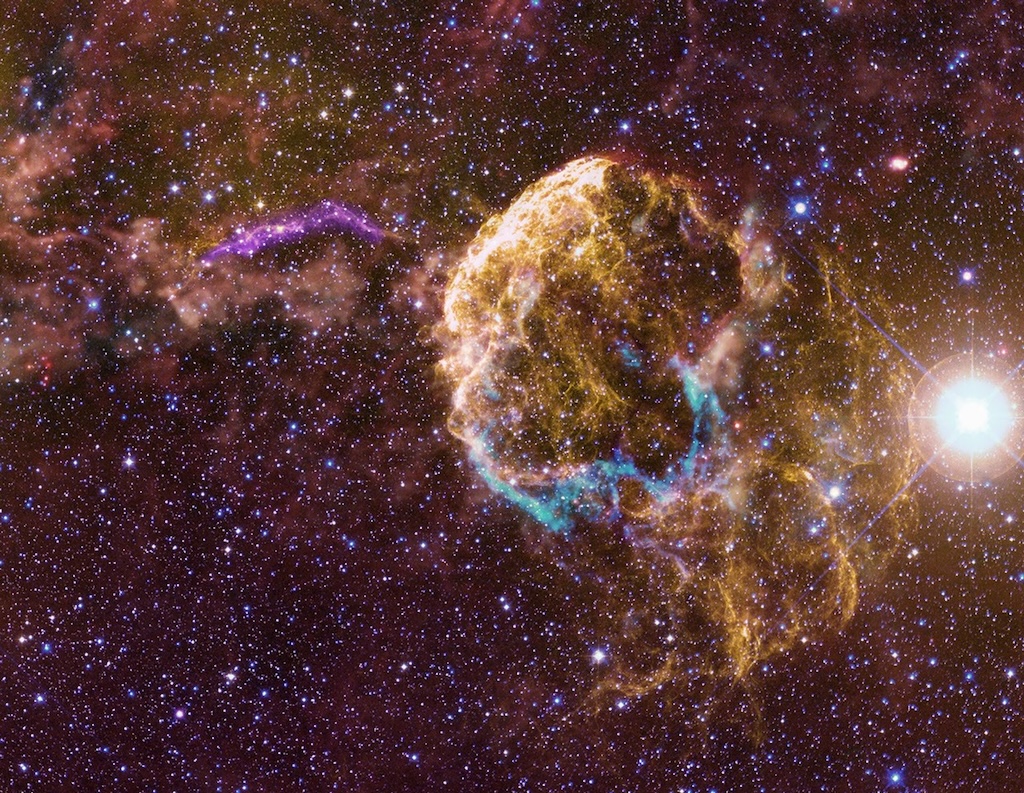
The image that brings this tale to life is a vivid fusion of visible, ultraviolet, and infrared light. In this composite:
- Yellow highlights the visible light that anchors our sense of the scene.
- Purple marks ultraviolet light, hinting at hot, energetic processes in the nebulae’s filaments.
- Cyan, red, and orange reveal the infrared landscape, which maps cooler dust and complex chemistry woven into the remnants’ outskirts.
Nestled at the center of this cosmic gallery is the younger remnant, the Jellyfish Nebula. If our eyes could inhabit this region, the Jellyfish would look larger than the full Moon in our sky—a colossal, ethereal jellyfish of filaments and glow, swimming through the interstellar medium.
A filament in purple tells a parallel tale
Drifting across the frame is a delicate purple filament, part of an older, overlapping supernova remnant known as G189.6+3.3. This older remnant is not just a dusty silhouette; it’s a fossil record, a glowing breadcrumb trail that helps astronomers reconstruct the sequence of events that produced the current double feature.
The science behind the story
A recent study stitched this narrative together using data from NASA’s Fermi Gamma-ray Space Telescope. Gamma-ray observations are the key to spotting high-energy processes that accompany supernova remnants. By comparing gamma-ray emissions with optical, ultraviolet, and infrared data, researchers pieced together the timeline:
- The first star detonated, sending shock waves racing through the binary’s neighborhood and imparting velocity to its companion.
- Tens of thousands of years later, the second star exploded, laying down a second, overlapping remnant.
- The combined shell structures, filamentary networks, and energy signatures reveal a shared origin and a sequential demise—a cosmic duet rather than two isolated fireworks.
The bright star on the right: Propus
Anchoring this stellar drama is a bright star that, at first glance, steals the spotlight. In truth, that “star” is a triple star system named Propus. Its proximity and dynamics add another layer of richness to the scene, reminding us that star systems are often not solitary performers but bustling clusters of gravitational choreography.
Why this matters for our understanding of the universe
Sibling supernova remnants aren’t just pretty to look at; they’re laboratories for astrophysics. They offer a rare, real-world example of how binary interactions shape the life cycles of stars, how supernovae propagate through space, and how remnants evolve over tens of thousands of years. The layered structure helps scientists test models of shock propagation, particle acceleration, and the gravitational dynamics that govern multiple-star systems.
A note for the curious observer
If you’re imagining a telescope tour through this part of the sky, remember that the most striking impressions come from combining data across the spectrum. Visible light shows us the glow of ionized gas; ultraviolet highlights the hottest, most energetic regions; infrared unveils dust and cooler pockets that infrared-bright stars avoid. Together, they tell a story as dramatic as any fictional saga—but written in light that travels across the cosmos for thousands of years to reach us.
Bottom line
The Jellyfish Nebula and its older companion G189.6+3.3 offer a compelling narrative of cosmic consequence: a binary system where one star’s death tremors set the stage for the next, leaving behind a layered, luminous memory of two explosive lives. With Propus watching over the scene, this celestial duet invites us to marvel at how even in death, stars can choreograph an unexpected unity—two remnants bound by a shared origin, dancing through the galaxy as a single, spectacular tale.
Image via NASA https://ift.tt/aT62bry
Copyright Notice: The image and referenced source material remain the property of their respective creators and rights holders. They are used here solely for commentary, discussion, and informational purposes. Please visit the original source links for attribution and additional information.
© 2026 ways4eu.wordpress.com – Herbert Johann Sablotny. All rights reserved. The text content of this article is the intellectual property of Herbert Johann Sablotny. Images remain subject to their respective copyright holders and are used here for commentary, discussion, and informational purposes only.