Ways4eu WordPress.com Blog
SPA View of ways4eu.wordpress.com
Cotton-Candy Clouds? Not Quite: A Kaleidoscopic Look at Rho Ophiuchi from Cádiz
By Kinda Cool
on Sat Jul 18 2026
Quick Links:NASA APOD source | Rho Ophiuchi complex | reflection nebula | T Tauri stars | star-forming regions
Cotton-Candy Clouds? Not Quite: A Kaleidoscopic Look at Rho Ophiuchi from Cádiz
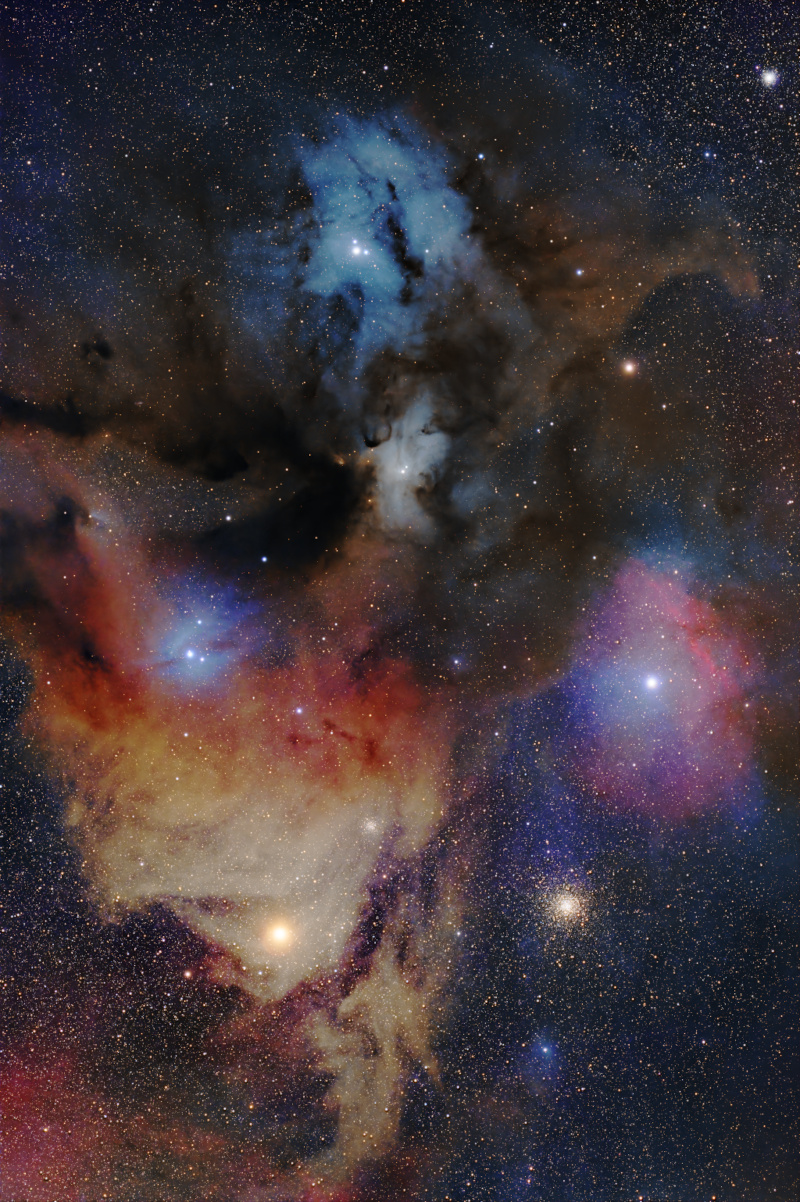
Although they look like cotton candy, you cannot eat these clouds! Taken in Cádiz, Spain, today’s image features the Rho Ophiuchi complex, a rich tapestry of young and old astronomical phenomena. It’s a nearby star-forming region where hundreds of young stellar objects—protostars and T Tauri stars—huddle together like cosmic teenagers at a stellar pep rally.
Let’s start with the blue: the light from a central triple star system dances off of tiny dust grains, painting a delicate blue reflection nebula. It’s a reminder that not all light is born in a single color; some of it is borrowed, reflected, and refracted by the very dust that will someday cradle new worlds.
Then comes the red, a glow born of ultraviolet photons exciting hydrogen gas. This emission nebula isn’t shy about its chemistry: it’s the glow of hydrogen atoms shedding light as they shed electrons, a luminous signal that star formation is happening in real-time, even if we’re watching from millions of years away.
And let’s not overlook Antares—the red supergiant that looms large in this celestial tapestry. The star is big enough to swallow the Solar System’s asteroid belt whole (in a hypothetical cosmic bite), and its warm, ruby-red glow casts a luminous yellow halo across the scene. It’s a grand contrast against the cooler blues and the fiery reds, a reminder that the cosmos loves a good color show.
Of course, not all of the Rho Ophiuchi complex shines with starlight. Dark interstellar dust blocks some of the color, like a theater curtain partially drawn, hinting at hidden drama behind the “on-stage” gas clouds. Where there’s dust, there’s possibility: pockets where light can’t reach now may soon become cradles for future planets.
Recent JWST observations add a fresh twist to the story: shadows cast by hidden circumstellar disks, the nascent silhouettes of planet formation. These are the first murmurs of worlds taking shape, long before we’ll ever catch a planet in the act. It’s science fiction turned science fact, written in the dust and light scattered across the dark.
If you look toward the bottom right corner, you’ll spot Messier 4—the globular cluster that seems almost ancient enough to blink at the age of the universe. And yet, here it sits as part of a broader Milky Way portrait that’s perpetually youthful at heart. While M4 itself is a venerable elder in the galactic family, its presence in this image serves as a counterpoint to the frenetic, newborn activity in Rho Ophiuchi, a reminder that the Milky Way is an eternal ecosystem of birth, evolution, and a little chaos.
This image from Cádiz isn’t just a pretty picture; it’s a narrative mosaic. It tells of star birth and death, of disks circling proto-planets, of dust and light interplaying to sculpt the cosmos. It’s a reminder that the universe isn’t a static backdrop but a dynamic, colorful workshop where the future is being drafted in starlight and shadow.
So next time you find yourself contemplating cotton candy, spare a thought for these clouds that aren’t edible but are endlessly fascinating. They’re not just pretty; they’re a living laboratory of cosmic evolution—a spicy, sweet, ultraviolet-laced reminder that the skies above Cádiz aren’t just a view, but a doorway to tomorrow’s worlds.
Image via NASA https://ift.tt/jhbNm2z
Copyright Notice: The image and referenced source material remain the property of their respective creators and rights holders. They are used here solely for commentary, discussion, and informational purposes. Please visit the original source links for attribution and additional information.
© 2026 ways4eu.wordpress.com – Herbert Johann Sablotny. All rights reserved. The text content of this article is the intellectual property of Herbert Johann Sablotny. Images remain subject to their respective copyright holders and are used here for commentary, discussion, and informational purposes only.