Ways4eu WordPress.com Blog
SPA View of ways4eu.wordpress.com
NGC 300: A Cosmic Gemstone with Stars and Gas Clouds
By JohnTheWordWhirlwind
on Mon Jul 20 2026
Quick Links:NASA APOD source | NGC 300 | Sculptor Group | H II regions | spiral galaxies
NGC 300: A Cosmic Gemstone with Stars and Gas Clouds
NGC 300: A Cosmic Gemstone with Stars and Gas Clouds
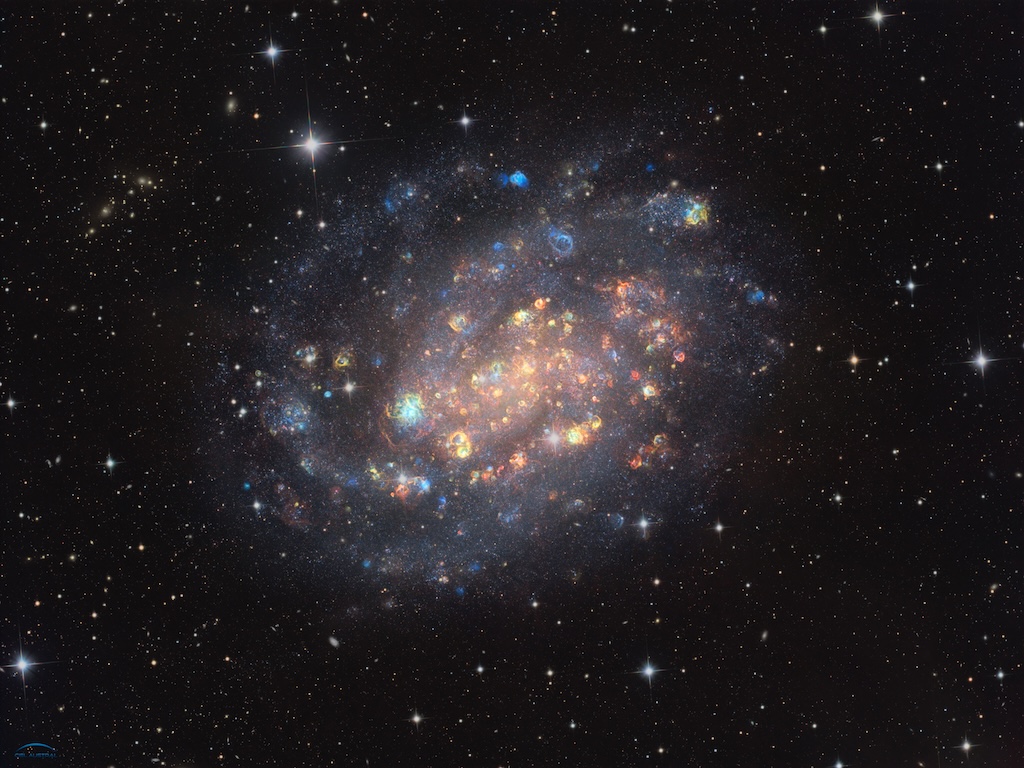
Picture a gemstone so dazzling that it makes the night sky blink with envy. That’s NGC 300, a sparkling spiral galaxy whispering stories from 6 million light-years away. It’s one of our closest grand spirals, a neighbor in the cosmic neighborhood that invites both awe and curiosity. But does it really look like the glossy, jewel-toned portrait you’ve probably seen? Let’s peel back the curtain and stroll through its subtler, starlit truth.
A closer look at a cosmic gemstone
NGC 300 gleams with the same jewel-like charm we prize in earthly gems: a spiral structure, a bright core, and sweeping arms that cradle countless stars. The galaxy is part of the Sculptor Group, a cluster of galaxies dancing in a gravitational wuzzle with each other. From Earth, we catch a face-on or near-face-on view that reveals a graceful, pinwheel-like form. Its beauty isn’t just a matter of pretty shapes; it’s a snapshot of galactic life in motion.
The multi-wavelength portrait: light from stars, dust, and ionized gas
The most arresting photos of NGC 300 come alive when we combine different kinds of light. In a standard, more “scientific” portrait, you’re seeing three key players:
– Starlight: The steady glow of countless stars contributes the warm, diffuse light that sculpts the galaxy’s overall brightness and helps define its spiral arms.
– Dust: Tiny cosmic grains scatter and absorb light, shaping the texture of the galaxy and lending depth to the image.
– Ionized gas clouds: Red, green, and blue hues highlight excited gas in specific emission lines. Red often marks ionized sulfur (S II), green indicates hydrogen (H II) regions where new stars are forming, and blue traces ionized oxygen (O III). When you mix red and green light in varying proportions, you get yellow or orange tones, which are especially noticeable in star-forming regions.
What those colors tell us about the galaxy
That color-coded glow isn’t just pretty; it’s a diagnostic toolkit. The bright red pockets signal areas where hot, young stars radiate ultraviolet photons that ionize surrounding gas. The greenish-green zones trace bustling H II regions—stellar nurseries where newborn stars ignite and heat their environs. The blue highlights mark younger, hotter stars and more energetic ionization. Together, these signals sketch a living, breathing tapestry of ongoing star formation, stellar evolution, and the interplay between stars and their gaseous cradle.
Stars, gas, and the life cycle of a galaxy
A galaxy like NGC 300 is a bustling workshop of creation and destruction. Massive young stars feed the nebulae around them with ultraviolet radiation, exciting gas and lighting up the spiral arms. These same massive stars are short-lived in astronomical terms; they burn bright and fast and often end their lives in cataclysmic supernova explosions. Those explosions do more than light up the night—they seed the surrounding interstellar medium with heavier elements, trigger new rounds of star formation, and compress or disperse gas clouds in a cyclical dance that spans millions of years.
Some clouds’ hidden stories
In the glow of NGC 300’s colorful clouds, there are likely remnants of past supernovae—fossilized echoes of stars that once reached their dramatic finales. These regions can still beam with energy, even as they fade, offering clues about the galaxy’s past and its future. If you’re scanning an image and notice pockets that seem to glow with a slightly different texture or hue, you might be catching a supernova remnant in an advanced stage of dispersal, a celestial fossil mushrooming with history.
A note on perspective: does it look like the image?
Images of galaxies are often the product of careful color mapping and data from multiple telescopes. The “unusual” image common in popular science communication blends light from stars, dust, and ionized gas into a composite that emphasizes the rich tapestry of nebulae and star-forming regions. In other words, the galaxy is real, but the palette is a carefully constructed representation designed to highlight different physical processes. The true beauty of NGC 300 emerges when you understand that the colors are telling you about chemistry, radiation, and dynamics, not just about pretty hues.
Why NGC 300 matters to stargazers and science lovers
– Proximity and accessibility: Being one of the nearer spiral galaxies to Earth makes NGC 300 a favorite target for amateur astronomers and professional observers alike. Its relatively gentle orientation offers a clean view of spiral structure and star-forming regions.
– A laboratory for star formation: The galaxy provides a natural laboratory to study how new stars form in different environments, how they impact their surroundings, and how the spiral arms channel gas into star-birthing nurseries.
– Clues to galactic evolution: By comparing NGC 300 to our Milky Way and other spirals, scientists piece together how galaxies acquire gas, ignite new stars, and grow over cosmic time.
A closing thought: beauty and science intertwined
NGC 300 is more than a pretty image or a cartographic line on a galaxy map. It’s a dynamic system where light from stars, dust, and ionized gas converge to tell a story of creation, transformation, and the ongoing dialogue between stars and their galactic home. The next time you glimpse the jeweled sweep of this spiral in a photo or a telescope eyepiece, remember: every color is a hint, every glow a clue, and every spiral arm a chapter in a grand, celestial saga.
Copyright Notice: The image and referenced source material remain the property of their respective creators and rights holders. They are used here solely for commentary, discussion, and informational purposes. Please visit the original source links for attribution and additional information.
© 2026 ways4eu.wordpress.com – Herbert Johann Sablotny. All rights reserved. The text content of this article is the intellectual property of Herbert Johann Sablotny. Images remain subject to their respective copyright holders and are used here for commentary, discussion, and informational purposes only.