Ways4eu WordPress.com Blog
SPA View of ways4eu.wordpress.com
A Year Under One Sky: The Keogram that Makes Time Blink
By Kinda Cool
on Thu Jul 23 2026
Quick Links
- Turning a year into a single strip
- Reading the moonlit bands
- Solstices, equinoxes, and the hourglass
- Why the sky feels like a diary
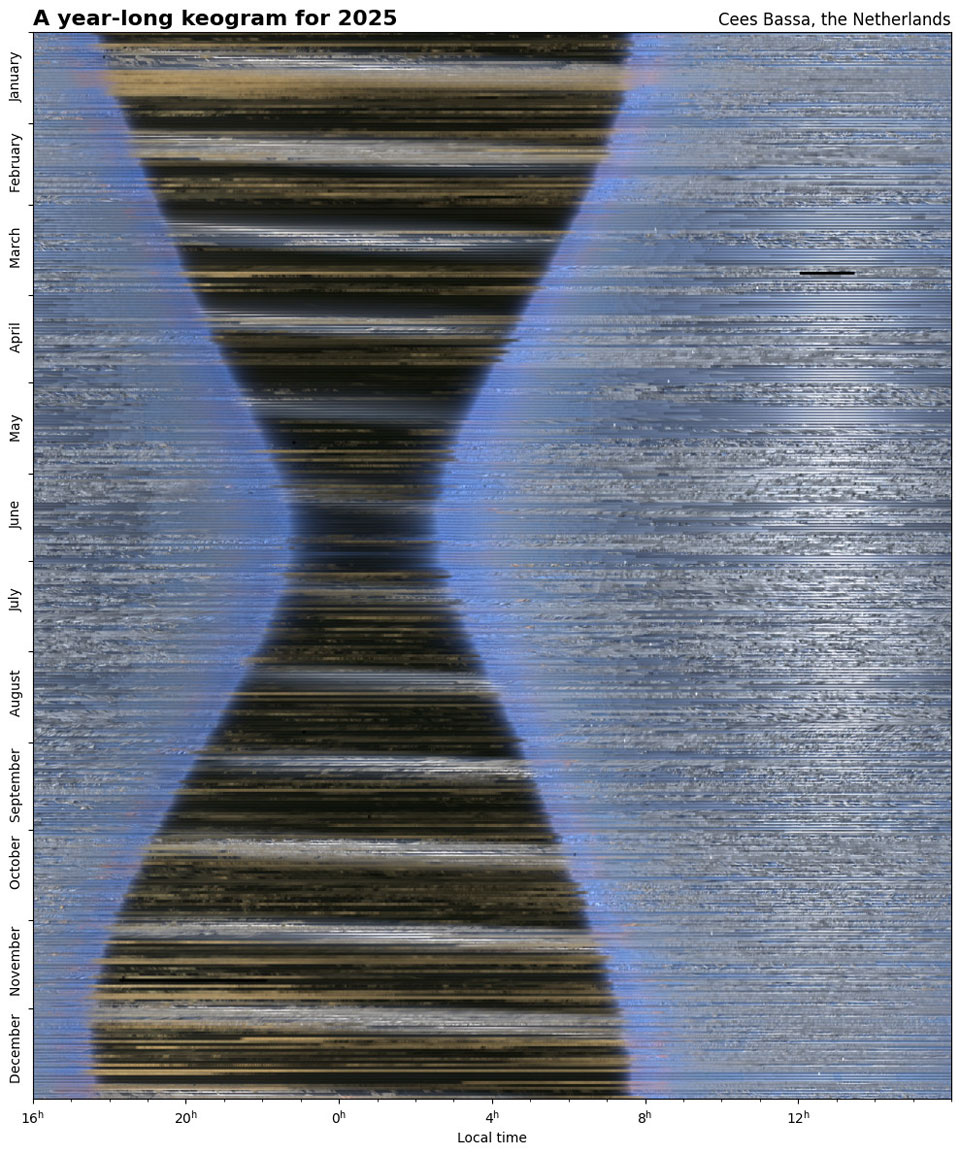
NASA’s keogram of the sky over the Netherlands compresses every 15-second view from 2025 into a single vertical strip, turning day, night, moonlight, solstices, and equinoxes into one patient visual diary.
Turning a year into a single strip
What if you could see the entire sky — all at once — for an entire year? That, very nearly, is what is pictured here. In 2025, an all-sky camera perched over the Netherlands captured a strobe-lit chronicle of the heavens, firing off an image every 15 seconds. Do the math and you’ve got a year’s worth of sky, condensed into a single, sprawling photograph: a keogram that reads like a cosmic diary.
The method is almost delightful in its simplicity. Central columns from every 2025 sky-shot were lined up and fused into one long vertical strip. January flanks the top, December lingers at the bottom, and the middle of the night lies just to the left of center, a steady observer in a world of drift and glare. The result is not merely a map of weather and light but a narrative told in shades of blue, black, and the pale, patient glow of the Moon.
Reading the moonlit bands
What do we see when we tilt our heads and read this sky-chronicle? The daytime sky is, unsurprisingly, mostly blue—a reminder that the sun, unburdened by starry tailwinds, paints the day with a broad, cheerful spectrum. The nighttime sky, meanwhile, is mostly black, a velvet canvas punctured by the patient pinpricks of distant suns and the occasional wandering satellite.
The most arresting feature, beyond the obvious day/night dichotomy, are the twelve light bands that cross the night sky. These are the ghostly trails of the Moon’s glow, a lunar procession etched into the fabric of time. Each band marks a moment in the Moon’s luminous arc, a rhythm that repeats with the months but feels forever unique when you trace it across a year’s worth of nights.
Solstices, equinoxes, and the hourglass
There’s a poetic physics in the keogram, too. The black “hourglass” shape—an hourglass you’d never want to turn over—thins to its slimmest point during the summer solstice, the longest day of the year. The days stretch out like a musical crescendo, and the night narrows to a whisper. Then, as winter creeps in, the hourglass fills again, the night thickens, and the sky wears its deepest cloak for the longest hours.
Equinoxes are not hidden in the margins here; they stand out, almost as plot twists in a well-woven story. The northern-spring equinox from a year ago sits about three-quarters of the way up, a bright hinge where day and night touch in a delicate equilibrium. It’s a subtle reminder that our planet’s tilt is a clockwork we glimpse only when we step back and let the calendar speak in symbols.
Why the sky feels like a diary
This keogram invites a curious kind of reflection. It’s not just a record of weather and space phenomena; it’s a reminder that time itself has a geography. The sky—vast, ephemeral, and indifferent to our hurried lives—maps itself in light and shadow, in the rhythm of the Moon’s wash over the horizon, in the way day surrenders to night, season after season.
If you’re tempted to read it like a diary, you’re not alone. The images tell you when the Moon was bright enough to cast its own glow across the night and when the Earth’s own tilt made the night stretch or snap shut like a drawstring. They whisper about solstices with a wink and nod to equinoxes with a quiet, almost mathematical humility.
So here’s to a year under one sky—an accidental atlas stitched together from seconds and skies. It’s a reminder that science can be a story, that data can be art, and that the heavens sometimes offer their most generous portraits when we pull back the curtain of time and let the lunar light write the page for us. If you listen closely, the Keogram of 2025 might just tell you where wonder lives: right there, in the steady glow and the patient night, above our everyday plans and pursuits.
© 2026 ways4eu.wordpress.com H.J.Sablotny — All rights reserved. The text content of this post is the intellectual property of H.J.Sablotny. Images are subject to their respective copyright holders and are used for illustration purposes only.