Ways4eu WordPress.com Blog
SPA View of ways4eu.wordpress.com
Is This What Will Become of Our Sun? Quite Possibly.
By Kinda Cool
on Thu Jul 23 2026
Quick Links
- Messier’s bright anti-comet entry
- What the colors are telling us
- Why it matters for the Sun
- Why planetary nebulae stay mysterious
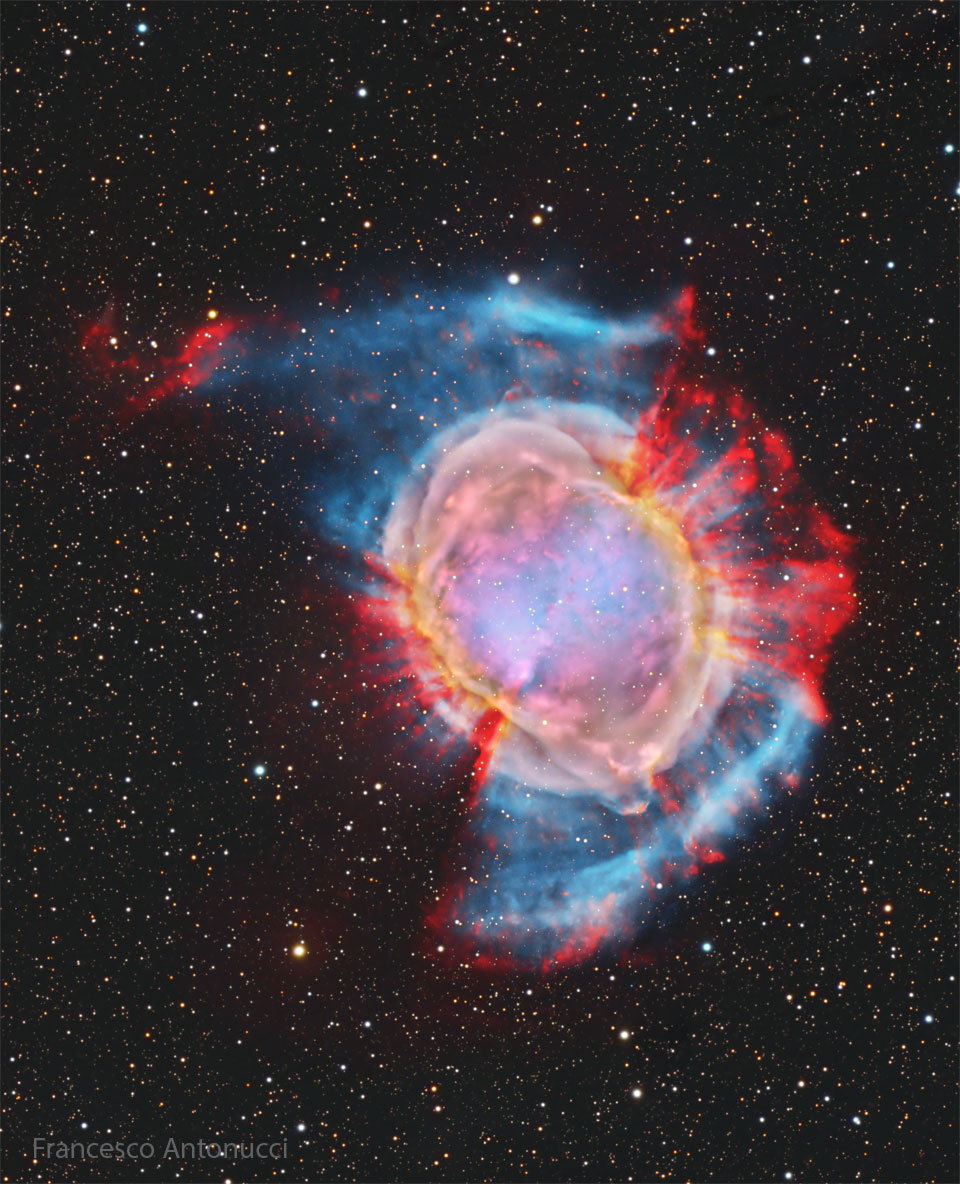
NASA’s view of M27, the Dumbbell Nebula, shows a bright planetary nebula that offers one of the clearest visual hints of what may happen to our Sun billions of years from now.
Messier’s bright anti-comet entry
A long, bright blink in the night sky once whispered a grim forecast about our own solar superstar. The first hint of the Sun’s far-off fate slipped into human view not as a scientific model or a mathematical riddle, but as a casual sidelong glance at the heavens in 1764. Enter Charles Messier, a discerning observer who spent his nights hunting down “fuzzy things” to keep his telescope from the mistaken identity of a wandering comet. He was compiling a catalog of objects not to be confused with comets—an anti-confusion manual for future skywatchers.
Among the 110 entries, the 27th item on Messier’s list—M27, better known today as the Dumbbell Nebula—stood out not for its brightness alone, but for what it hinted at about stellar life cycles. M27 isn’t a comet; it’s a planetary nebula, one of the brighter beacons in the planetary nebula family, visible with binoculars in the vicinity of Vulpecula, the Fox. If you’ve ever stared up with a pair of modest lenses and found a faint, lantern-like glow, you’ve met the sort of object Messier cataloged with a wink and a nod to celestial mislabeling: “planetary,” not “planet,” and certainly not a planet’s idea of a party.
What the colors are telling us
Light from M27 has traveled about 1,000 years to arrive at our doorstep. That’s roughly the equivalent of someone telling you a story from the 11th century—made more vivid by the fact that the colors in modern depictions are often enhanced to tell the tale more clearly. In this image, red highlights hydrogen, the universe’s most faithful hairdresser, while blue emphasizes oxygen’s cool notes. The result is a spectrum-driven portrait of a dying star in the act of shedding its outer layers in a spectacular, if not magical, finale.
Why it matters for the Sun
So what does M27 have to do with our Sun? Everything—and nothing, depending on how you look at it. In about six billion years, our Sun will reach a similar crossroads: it will swell and puff out its outer envelopes, casting off a brilliant shroud of gas, and what remains at the center will settle into an X-ray hot white dwarf. The Sun won’t explode in a blaze of cosmic fireworks like a supernova; instead, it will gracefully bow out, becoming a planetary nebula of its own design. It’s a transformation that turns a life-sustaining solar furnace into a fading star’s last, luminous act.
The physics behind this narrative is a reminder that even the most majestic bodies in the cosmos follow a script as old as time—gravity, fusion, and the gentle, inexorable thinning of stellar fuel. As the Sun swells, its outer layers drift away into the surrounding space, painting the universe with the colors we’ve come to associate with planetary nebulas, a kind of celestial confetti that says, “Good job, star; you did your part.” In the center, what’s left is a searingly hot white dwarf, a fungal-like ember of a former giant that will cool and dim over eons, but not before leaving a lasting halo of light for future cosmic viewers.
Why planetary nebulae stay mysterious
Understanding M27’s exact shapes—the intricacies of its lobes, rings, and filaments—remains a puzzle that even 18th-century science wouldn’t have recognized as a puzzle. The human brain loves a neat, tidy explanation, but planetary nebulas keep their most elegant secrets tucked behind tapestries of gas and dust that interact in ways we’re still learning to model. The more we observe, the more we realize: the universe enjoys a few curveballs when it comes to how these wispy, glowing shells form their intricate silhouettes.
And there’s a playful irony here. The Dumbbell Nebula isn’t dumb at all—it’s a brilliant, shapeshifting reminder of a star’s life after the main act ends. Our Sun’s future is tucked inside that same grand, cyclical arc: a star’s final bow, a noble shedding, and a radiant remnant that will continue to illuminate the cosmos long after its day-to-day energy production has ceased. If you’ve ever wondered whether our Sun might have a dramatic passport stamp—or at least a glamorous cosmic retirement—M27 answers with a confident, twinkling nod.
So, what should we take away from this celestial parable? First, the universe loves to innovate on the fly. The life story of a sun is not a straight line but a loop-de-loop of expansion, shedding, and remnant-waiting. Second, our knowledge, though vast, still has edges and gaps: every planetary nebula invites new questions about formation, structure, and the forces sculpting their shapes. And third, the cosmos is patient—light from distant, ancient events still reaches us, letting us observe, learn, and imagine how our own sun will someday advertise its final act to a curious, observing humanity.
In the end, the tale of M27 isn’t a grim warning so much as a grand backstage pass: a peek behind the curtain at the life cycle of stars, and a hopeful reminder that endings can be spectacular, even luminous. The next time you gaze at the night sky, imagine the Dumbbell Nebula’s ghostly glow as a distant cousin of our Sun’s far-off transformation—a reminder that, if we’re lucky, our own star will finish its days with the same quiet, radiant dignity that has guided countless generations of stargazers before us.
© 2026 ways4eu.wordpress.com H.J.Sablotny — All rights reserved. The text content of this post is the intellectual property of H.J.Sablotny. Images are subject to their respective copyright holders and are used for illustration purposes only.