Ways4eu WordPress.com Blog
SPA View of ways4eu.wordpress.com
The Suit that Says “Hold My Snack”: Chris Williams Prepares for a Spacewalk with a Very Serious Sidekick
By Kinda Cool
on Mon Jul 27 2026
Quick Links
Inside the airlock
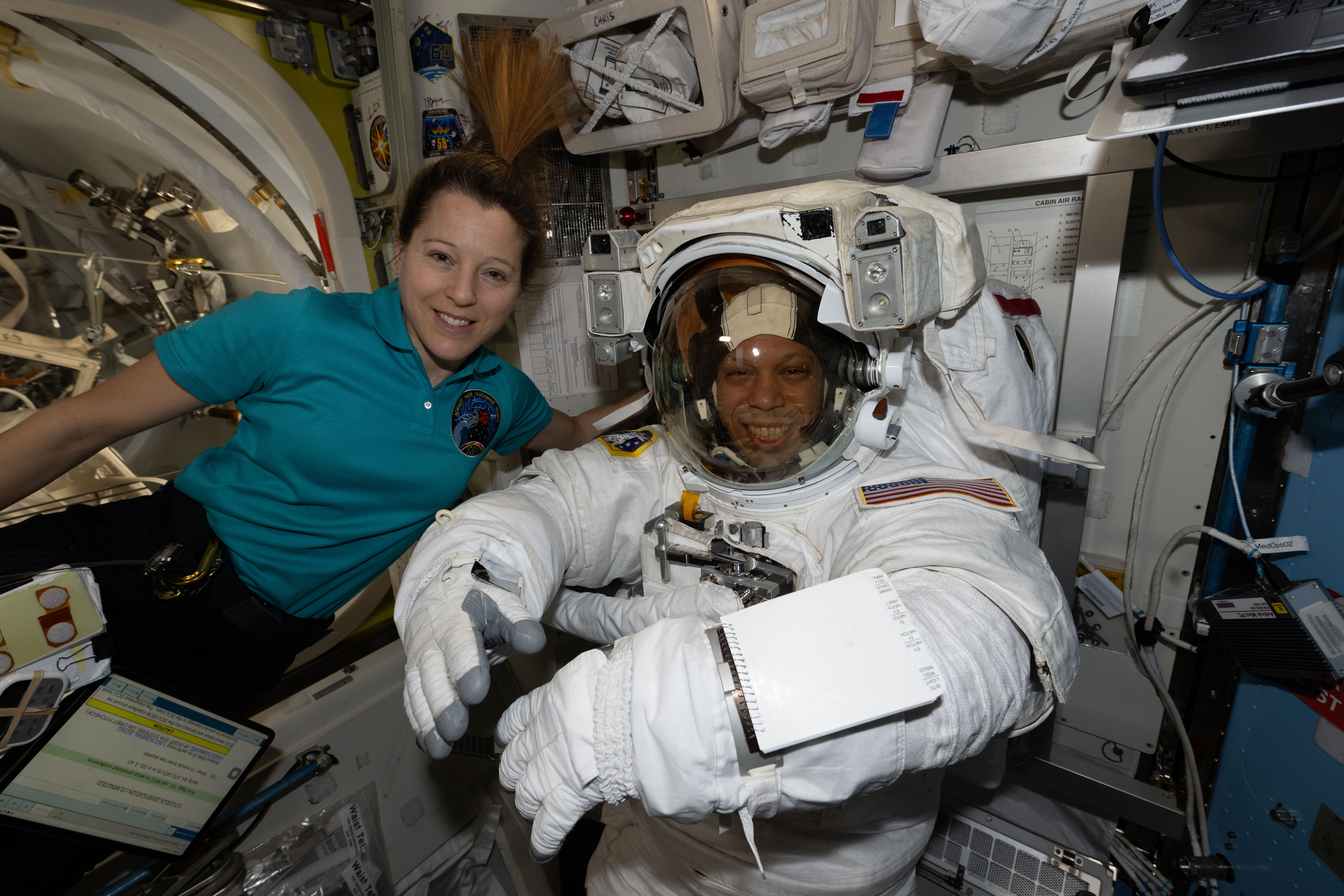
Once upon a microgravity morning aboard the ISS, two spaceflight veterans decided to take a stroll through the most literal locker room in the solar system: the Quest airlock. In the left corner, wearing a grin that could power a small galaxy, was NASA astronaut Chris Williams. In the right corner, offering a steadying hand and a dash of European flair, was ESA flight engineer Sophie Adenot. Their mission: test a spacesuit that has to juggle comfort, mobility, communications, and life support—while making sure no one accidentally sends a distress signal because the helmet squeaked.
The scene was less “floor routine” and more “fit-for-flight fashion show,” with Adenot playing stylist-in-chief and Williams the eager model. The process began with the timeless ritual of suit donning, where every buckle, strap, and tether must be aligned as if orchestrated by a very particular orchestra conductor: one with an excellent sense of humor and a tolerance for the sound of Velcro.
Fit, comms, and motion
Sophie stepped in with the poise of a seasoned test driver and the warmth of someone who’s definitely seen an espresso pull in zero gravity. Her first move: test the suit’s fit. In the weightless world, fit isn’t just about comfort—it’s about not turning a routine spacewalk into a slippery slapstick routine. Williams moved, shifted, and adjusted, while Adenot watched for range of motion in the hips and shoulders, ensuring he could reach, bend, and, crucially, keep a handle on the control panels and the safety tethers that keep a spacewalker from drifting off to explore the moon or, at the very least, the snack bar.
Next up: communications and life support systems. In a place where a wrong word can echo through the void and a dead battery means a hollow silence, the spacelike chorus of beeps, voice comms, and ambient life support hum became the background score. Williams tested mic clarity and headset comfort, making sure his voice could cut through the ambient ISS white-noise like a radio DJ in zero-G. Adenot, ever the practical coach, queried him about helmet fog, visor clarity, and the bracing reality that even in space, a misstep can turn a smooth ascent into a televised dance move—one where the parachute is really just a parachute for a life-preserving suit.
As they tugged, adjusted, and mic’d up, the suit revealed its own personality. It whispered in the language of zippers and seals: a stubborn yet loyal companion that promises protection from the chill of space and the occasional rogue coffee spill (a hazard even in microgravity, if one counts the gravity of gravity’s absence as a cosmic joke). Williams moved with the confidence of someone who knows that the first spacewalk is as much about rhythm as it is about reach. He demonstrated the range of motion needed to perform tasks—scrub brushes, tool exchanges, and those delicate maneuvers that require the precision of a surgeon and the patience of a saint wearing a hat full of batteries.
Crewwork in action
Adenot offered real-time feedback, mixing technical insight with the kind of light-hearted humor that keeps a long EVA day from feeling like an endless sprint on a treadmill in space. “Okay,” she might have said with a nod, “your shoulders have more poise than a planet orbiting a star. Let’s test the comms again.” Her guidance ensured that every test was not just about whether he could physically move, but whether he could do so while staying connected to his crew, mission control, and that cheeky sense of cosmic timing that only spaceflight can conjure.
The Quest airlock provided the stage, but the real star of the session was the teamwork. It’s a reminder that in space, there’s no such thing as a lone astronaut. It’s a duet: the pilot and the partner, the life support and the laugh track, the suit and the human inside it who knows how to lean into gravity’s absence without tipping into the wacky world of space pratfalls. The test didn’t just check the suit’s integrity; it checked the harmony between human and machine—the art of converting a suit into a second skin that breathes, moves, and communicates as if it’s part of the crew.
So what did we learn from Chris Williams’s suit fitting? We learned that a well-fitted spacesuit is not just a device for survival; it’s a confidence booster with a built-in heater for your heart rate, a microphone that never rude-remarks the person wearing it, and a life support system that sounds like a calm heartbeat in a very, very quiet ocean of space. We learned that Sophie Adenot’s expertise isn’t just technical prowess; it’s the human touch that turns a standard test into a meaningful step toward safer, smoother, and arguably more stylish spacewalks.
What the test prepares
As the session wrapped, Williams shed the weight of the suit—figuratively, then literally, in the zero-G sense—and looked ready for the dawn of his spacewalk adventure. The data gathered here will ripple through mission preparations, informing future suits and the precise choreography of movement, comfort, and clear comms. And if nothing else, it gave us a reminder that when humans push the boundaries of exploration, we do so with a crew around us who can measure a glove’s grip, troubleshoot a hiccup in the life-support whisper, and share a laugh that travels through the vacuum of space and lands with a gentle thud back on the ISS floor.
Stay tuned for the next update from the ISS, where Chris Williams will likely don the suit again, polish the helmet, and remind us that exploration isn’t just about reaching out to the stars—it’s about making sure we can do it with a wink, a grin, and a suit that’s nearly as excited as we are to see what we discover next.
© 2026 ways4eu.wordpress.com H.J.Sablotny — All rights reserved. The text content of this post is the intellectual property of H.J.Sablotny. Images are subject to their respective copyright holders and are used for illustration purposes only.