Ways4eu WordPress.com Blog
SPA View of ways4eu.wordpress.com
Why Is the Cigar Galaxy Billowing Red Smoke?
By Kinda Cool
on Mon Jul 27 2026
Quick Links
The starburst trigger
If you’ve ever looked up at the night sky and wondered what a cosmic cigarette puff would look like, you’re not far off. The Cigar Galaxy, better known to astronomers as M82, is puffing out some seriously dramatic red wisps that look for all the world like it’s exhaling a long, glowing plume. So what’s going on in this starburst of a galaxy, 12 million light-years away, that makes it look like it’s been hitting the cosmic incense?
A starburst that didn’t come with a push from the right wing
M82 didn’t earn its nickname by accident. It’s a starburst galaxy, meaning it’s making stars at a furious rate compared to typical galaxies like our Milky Way. This especially intense activity was sparked by a close encounter with its larger neighbor, the spiral galaxy M81. The gravitational nudge from that near pass didn’t just distort M82’s shape; it set off a cascade of star formation that fired off new stars at a blinding clip. But that dramatic spark isn’t the whole story.
What powers the red plume
What’s driving the red glow outward?
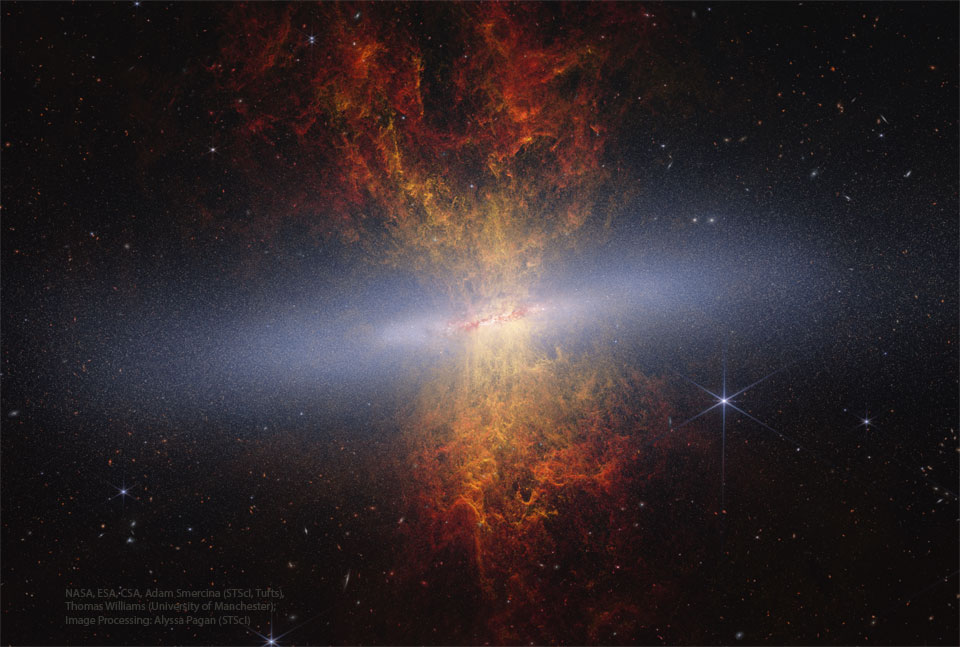
The red, outwardly expanding gas and dust aren’t simply the leftover smears of a galactic collision. They’re the result of a collective wind—no single star or supernova alone, but a chorus of stellar winds and explosive deaths feeding into a single, galactic-scale outflow. As massive young stars pump out energy and as supernovae explode in rapid succession, their winds collide and combine, creating a galactic superwind that blasts material away from the galaxy’s central regions. The result is a spectacular, multi-parsec-scale plume, glowing in orange-red hues as the gas is heated to extreme temperatures and illuminated by stars and the galaxy’s own energetic processes.
Dust that looks suspiciously familiar
The dust particles doing the glowing aren’t exotic moon-dusts from a sci-fi epic. They’re ordinary interstellar dust grains resident in M82’s own medium—think particles roughly the size you’d associate with the dusty haze in a cigar—moved and dragged aloft by the galaxy’s powerhouse winds. In the context of a starburst, these grains get heated and illuminated, producing the distinctive red glow we observe when peering through the right wavelengths.
How we see it
A mosaic that’s part optical, part infrared poetry
What you’re seeing in the best images of M82 is a layered portrait. The mosaic blends visible-light data from the Hubble Space Telescope with infrared data from the James Webb Space Telescope. The visible light reveals the central, light-colored core of the galaxy, viewed almost edge-on across the center. The infrared data, meanwhile, teases out the hidden warmth and structure in the dust and gas, highlighting the dramatic filaments that radiate in orange and red.
A cosmic megaphone: filaments that stretch far
From that central bustle, the filaments fan outward in two great swaths, upward and downward from the disk. These aren’t small features; they extend for more than 10,000 light-years. They’re the visible signs of the winds at work, carving channels through the galactic medium and carrying gas and dust far beyond the galactic plane. It’s a colossal reminder that in a starburst galaxy, energy isn’t just inside the bright core—it’s exploding outward, sculpting the galaxy’s surroundings on a truly galactic scale.
Why the image matters
Infrared brightness that outshines the night sky
If you’re measuring light by who can glow the brightest in infrared, M82 is hard to beat. It’s the brightest galaxy in the sky in infrared light, a fact that makes it a darling for infrared astronomers and a striking subject for any telescope that can see beyond visible dawn. Yet in visible light, with a modest telescope, it remains a mighty sight in Ursa Major, the Great Bear, offering a reminder that some of the universe’s most dramatic stories play out in wavelengths our eyes can rarely perceive unaided.
Image via NASA https://ift.tt/w2gcfWR
© 2026 ways4eu.wordpress.com H.J.Sablotny — All rights reserved. The text content of this post is the intellectual property of H.J.Sablotny. Images are subject to their respective copyright holders and are used for illustration purposes only.