Ways4eu WordPress.com Blog
SPA View of ways4eu.wordpress.com
What Are These Two Bands in the Sky?
By Kinda Cool
on Thu Jul 30 2026
Quick Links
Opening glimpse
If you’ve ever looked up on a clear night and spotted two celestial ribbons staking their claim across the darkness, you weren’t imagining things. The sky sometimes wears two distinct, glowing bands that are bold enough to rival the Milky Way’s own drama—each with its own story, its own sparkle, and a hint of cosmic mischief.
The Milky Way’s central glow
Our Milky Way’s Central Glow
The more commonly seen band, sweeping across the sky like a cosmic rail, is the central band of our Milky Way galaxy. Picture the Milky Way as a grand spiral galaxy, twirling a vast disk of stars, gas, and dust. From inside that disk, our vantage point in the Solar System makes the Milky Way appear as a broad, bright ribbon that arcs across the heavens. It’s a uniform glow of comparable brightness all the way around the sky because we’re nestled within the disk itself—looking through millions of stars that lie along that flat, rotating plane of our galactic home.
In practice, this band is why star maps look so “galactic” whenever you tilt your head back and scan the night. It’s not just a line; it’s the dense starry spine of a spiral galaxy we call home. The light you see is a blend of countless distant stars, nebulae, and the soft touch of interstellar dust that scatters and reddens the glow. It’s a reminder that we’re not looking at the edge of the universe from a lofty cliff, but rather living inside a swirling cosmic city, where the main avenue is the Milky Way itself.
The zodiacal light
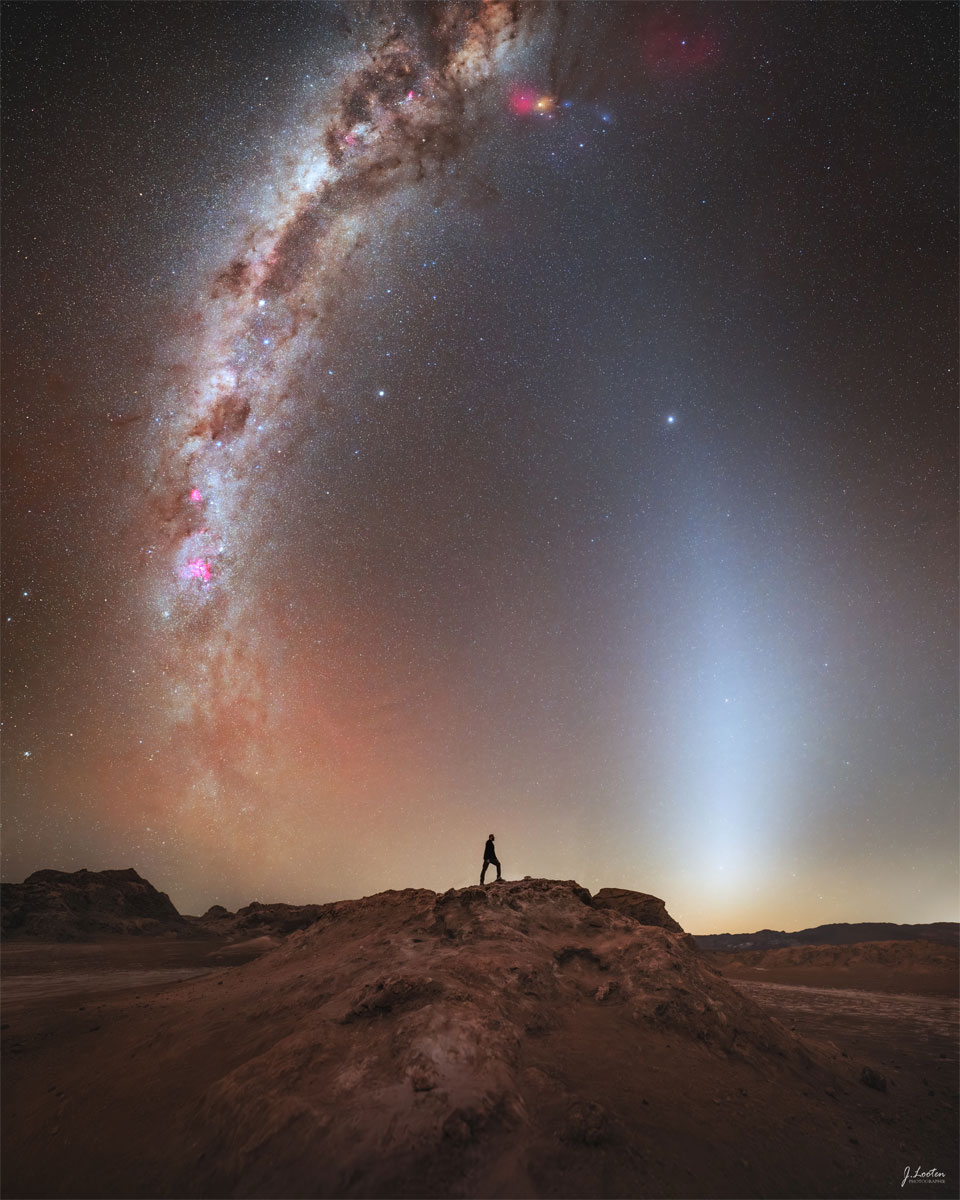
On the right, you’ll often encounter a more delicate, ethereal ribbon—the zodiacal light. This is sunlight reflected off dust that orbits the Sun within our own Solar System. The dust is a steady stream of tiny fragments from comets, asteroid collisions, and the debris of cosmic anniversaries that circle the Sun in roughly the same plane as the planets. When the Sun is just below the horizon, the sunlight that bounces off this dust creates a faint, triangular glow that rises toward the ecliptic—the path the Sun and planets follow across the sky.
Zodiacal light is strongest when the Sun is near the horizon, so it tends to shine best just before sunrise or just after sunset. In the right conditions, and with a good, dark sky, this ribbon can look surprisingly prominent—like a ghostly, forward-curving smile stretching along the east or west, depending on the season and your latitude. It’s a gentle reminder that the space between planets is not empty but filled with tiny particles orbiting the Sun, quietly catching and reflecting the solar glow.
Why the double band matters
An especially neat bit of trivia about the zodiacal dust is its history—and its origin story. It wasn’t until this century that scientists recognized that most of the zodiacal dust is expelled by comets that have flown near Jupiter. These planetary visitors shed material as they slingshot around the giant planet, and that debris settles into the plane of the Solar System, where it keeps circling the Sun in a cosmic dust belt. So the zodiacal light is, in a sense, a dusty souvenir from the era of comets and planetary wanderers.
The featured image—captured about a year ago from the Atacama Desert in Chile—shows both bands in a single frame, a rare alignment that invites awe. The Atacama’s dry, high desert skies provide an ideal stage: minimal moisture, minimal light pollution, and a horizon that seems to fade into infinity. When conditions cooperate, the Milky Way’s central band and the zodiacal light’s delicate ribbon can share the same canvas, offering a double feature that highlights both the majesty of our galaxy and the quieter, dust-stitched glow of our own solar neighborhood.
A Quick Guide for Stargazers
- Look for the Milky Way’s central band: a broad, bright arc that feels like the backbone of our galaxy.
- Watch for zodiacal light: a fainter, forward-curving ribbon near sunrise or sunset, strongest near the Sun’s direction.
Best viewing tips: dark, moonless nights, high-altitude sites, and patience. The more you look, the more you’ll notice how these two bands tell different tales with the same sky as their stage.
So next time you step outside and glimpse a shimmering left-hand glow and a subtler right-hand lane of light, you’ll know you’re seeing two different kinds of cosmic sculpture: one born from the Milky Way’s grand spiral and the other from the tiny dust grains that keep the solar neighborhood sparkling in sunlight. The sky isn’t just a ceiling—it’s a living gallery of our galaxy and our solar system, side by side in the velvet black.
Image via NASA https://ift.tt/NpkuCc1
© 2026 ways4eu.wordpress.com H.J.Sablotny — All rights reserved. The text content of this post is the intellectual property of H.J.Sablotny. Images are subject to their respective copyright holders and are used for illustration purposes only.