Ways4eu WordPress.com Blog
SPA View of ways4eu.wordpress.com
The Large Magellanic Cloud: A Neighbor Galaxy With Busy Star Factories and Zero Interest in Staying Quiet
By JohnTheWordWhirlwind
on Mon Aug 10 2026
Quick Links
- A galaxy you can actually spot
- Smallish neighbor, big personality
- Why it keeps making stars
- What the future might bring
A Galaxy You Can Actually Spot
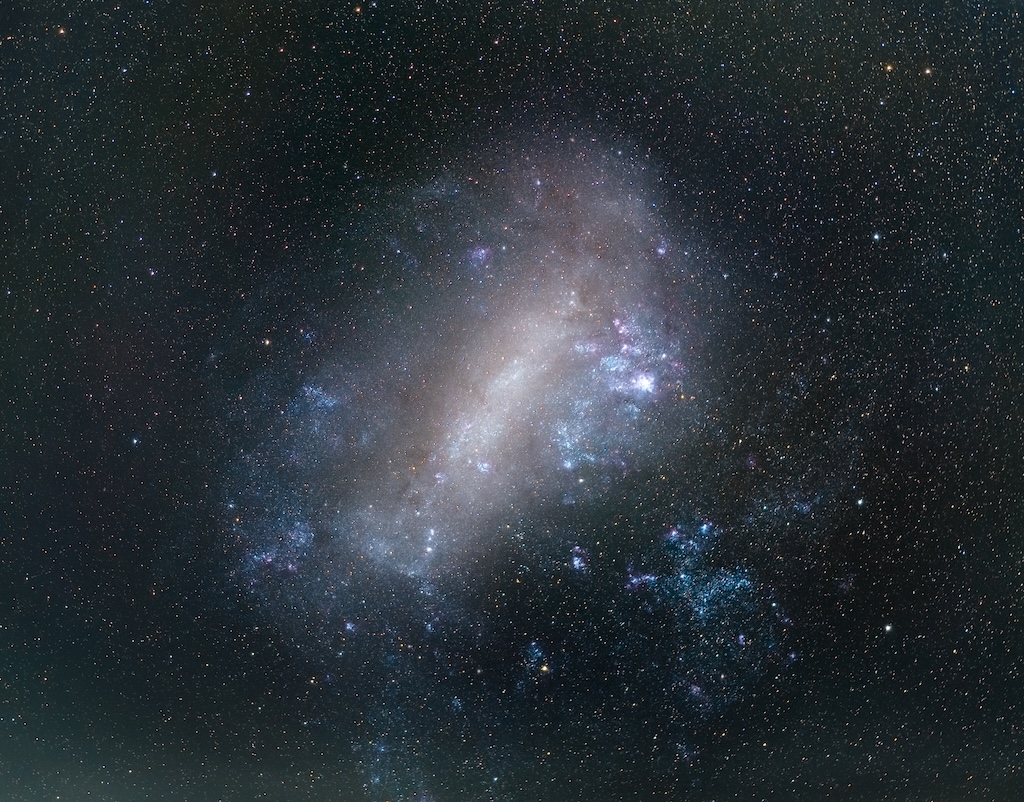
The featured image shows the Large Magellanic Cloud (LMC), one of the closest neighbors of our Milky Way. If you are anywhere south of latitude 20° N, and the further south you go, the better, you can glimpse it with the unaided eye from a dark-sky location, away from the glow of big cities and the sneaky menace of light pollution. It’s a cosmic newcomer you can charm with just your naked eye and a curious gaze.
If you’ve ever seen another galaxy with your own eyes, you know that the feeling lands somewhere between disbelief and pure delight. The LMC offers exactly that kind of thrill: a nearby presence that reminds you space is not only vast, but occasionally generous enough to let us see a neighboring galaxy without industrial-strength machinery.
Smallish Neighbor, Big Personality
The LMC is a dwarf irregular galaxy, sitting about 163,000 light-years away. It’s a proud member of our Local Group, strutting its stuff alongside the Milky Way, Andromeda, and a handful of other celestial companions. Size-wise it’s modest, but don’t let its compact appearance fool you. In mass terms, the LMC clocks in at roughly 10%–20% of the Milky Way’s heft. That’s not tiny to ignore; that mass is enough to fuel a serious star-making spree.
It’s the kind of galaxy that refuses to play the “supporting cast only” role. The Large Magellanic Cloud may be smaller than the Milky Way, but it behaves like a bright, busy neighbor who always seems to have something interesting happening behind the curtains.
Why It Keeps Making Stars
And boy, does it star-pop. The LMC is a bustling factory of star formation. New stars are continually being born in its shimmering clouds, giving rise to brilliant regions of glow and color that punctuate the galaxy’s irregular outline. What stirs this stellar nursery? A dash of gravitational mischief, mostly. The Milky Way’s invisible hand — the tidal pull of our own galaxy — tugs at the LMC, stirring its gas, compressing clouds, and nudging material into ready-made star nurseries.
It’s a cosmic dance: we pull on it, it responds with bursts of stellar activity, and we all get to watch a bit of galactic keyboard-pounding in action. That makes the LMC not just a pretty object in the sky, but a live demonstration of how galaxies shape one another over time.
What the Future Might Bring
If you’re a student of the night sky, you might wonder about the future of this neighbor. Some astronomers predict that the LMC will encounter the Milky Way in a few billion years. The exact timeline is subject to the whims of gravity and the complex ballet of dark matter halos, but the broad idea is this: a future gravitational embrace, a reshaping of nearby halos, and an ongoing reminder that galaxies aren’t solitary, stagnant islands.
So next time you’re gazing up at the Southern Cross or tracing the Milky Way’s own hazy river of stars, tip your hat to the Large Magellanic Cloud. It may be our smaller neighbor, but its busy heart and dynamic dance with the Milky Way make it one of the most intriguing members of our cosmic community.
SourceLink via NASA APOD
Copyright Notice: The image and referenced source content remain the property of their respective creators and rights holders. They are used here solely for commentary, discussion, and informational purposes. Please visit the original source links for attribution and additional information.
© 2026 ways4eu.wordpress.com – H.J. Sablotny. All rights reserved. The text content of this article is the intellectual property of H.J. Sablotny and may not be reproduced, distributed, or republished without permission. Images remain the property of their respective copyright holders and are used for illustrative and commentary purposes only.