Ways4eu WordPress.com Blog
SPA View of ways4eu.wordpress.com
The Night the Sky Breathed Fire: RCW 86 and the Long Echo of an Ancient Supernova
By JohnTheWordWhirlwind
on Wed Aug 19 2026
Quick Links
- The Recorded Blaze of 185 AD
- Reading the Remnant
- Type Ia Versus Core Collapse
- Distance, Time, and Legacy
The Night the Sky Breathed Fire: RCW 86 and the Long Echo of an Ancient Supernova
The Recorded Blaze of 185 AD
In 185 AD, Chinese astronomers watched the heavens with the steady curiosity that only ancient stargazers possess. They noted a new star popping into the Nanmen asterism—the portion of the sky lingering near what we today map to the southern slice of Centaurus. This bright newcomer didn’t flicker and fade in a weekend; it shone for months, a naked-eye beacon that refused to be ignored. Modern scholars now recognize this as the earliest candidate for a recorded supernova, a stellar eruption so luminous it briefly outshone ordinary celestial traffic and left behind a legacy far more durable than any comet’s tail.
Reading the Remnant
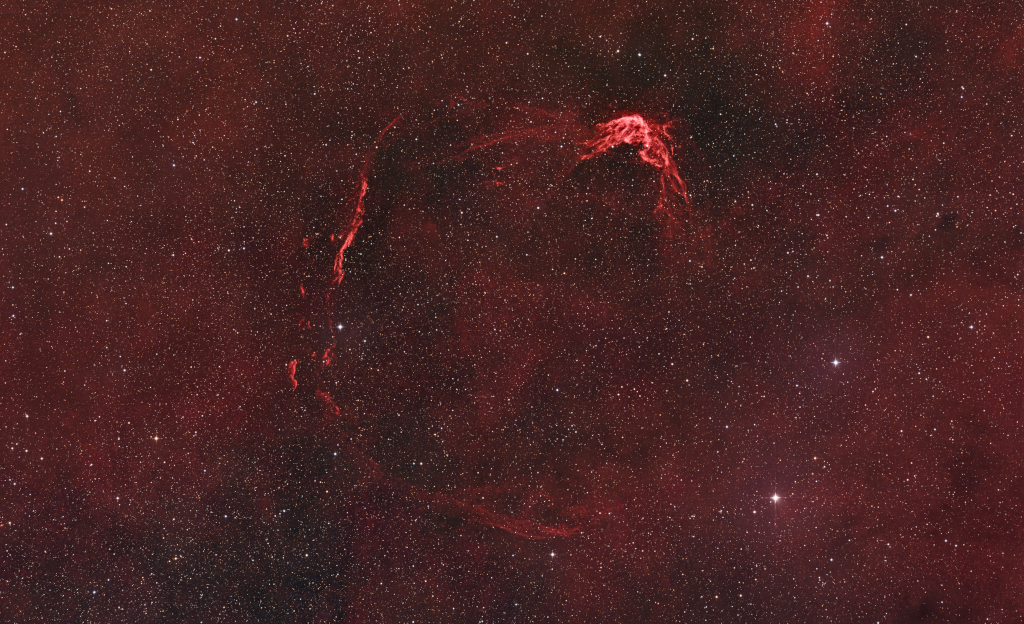
Fast-forward two millennia, and science has perched itself on the shoulders of that ancient observation. In a 21st-century telescope image, the ghostly wisps of a faint emission nebula trace the historical star’s final act against a cluttered tapestry of stars. The nebula, rugged and roughly circular, is cataloged as RCW 86. It is, in truth, the remnant of the explosion—interstellar gas ionized by the supernova’s still-thundering shock wave. If you squint at the right wavelengths, you can almost hear the distant hiss of ionized hydrogen and feel the theater of a cataclysmic finale.
What does RCW 86 tell us? Space-based observations reveal a surprising abundance of iron in this remnant, a chemical signature that points to a Type Ia supernova. And yet, the usual postscript of many supernova stories—a surviving neutron star or pulsar at the center—does not appear in RCW 86. The absence of a compact stellar core helps tilt the verdict toward a Type Ia origin: a thermonuclear detonation on a white dwarf that has siphoned matter from a companion in a binary system until the mass tipped over the edge and the star went off with a bang.
Type Ia Versus Core Collapse
To contrast, a core-collapse supernova is the dramatic finale of a massive star’s life, where the core collapses under gravity and a neutron star or black hole might become the remnant. A Type Ia, in contrast, is more of a stellar arsonist’s trick—one white dwarf, a partner in gravity, a little matter transfer, and a detonation that can outshine an entire galaxy for a fleeting moment. RCW 86 is a quiet, stubborn reminder that cosmic fireworks come in more than one flavor.
As for the setting, RCW 86 lies tucked near the plane of our Milky Way, a position that makes it a bit of a celestial wallflower. It’s far from the bright beacon of a naked-eye supernova; the remnant is too faint for casual stargazing. Yet its size is grand in astronomical terms: roughly 100 light-years across. If you could float above it and zoom out, you’d see a vast, raggedly circular cloud of ionized gas, a fossil halo that once bore the blaze of a brilliant, self-destructive star.
Distance, Time, and Legacy
Distance-wise, RCW 86 sits about 8,000 light-years away—a reminder that the night we marvel at from Earth is already a story told long ago. The photons we catch from RCW 86 today left its fiery birthplace when Rome was still rising and the world’s scientific map was more legend than ledger. Every glimmer we observe is a time capsule, a note in the universe’s grand, slow music.
In many ways, RCW 86 is a stubbornist storyteller: it speaks softly, through iron lines and ionized gas, about a cataclysm whose name we’ve learned to pronounce as Type Ia. It’s a reminder that the sky’s most dramatic events are not always the loudest in the moment they occur; sometimes their voices travel across millennia, arriving in our instruments as iron-rich whispers from a long-vanished blaze.
© 2026 ways4eu.wordpress.com H.J.Sablotny — All rights reserved. The text content of this post is the intellectual property of H.J.Sablotny. Images are subject to their respective copyright holders and are used for illustration purposes only.