Ways4eu WordPress.com Blog
SPA View of ways4eu.wordpress.com
The Dark Doodad Nebula: A Silhouette in the Southern Sky
By Kinda Cool
on Thu Aug 20 2026
Quick Links
- A Shadow Near Musca
- Dust, Distance, and the Musca Cloud
- How the Name Stuck
- How to Spot It
- Why the Darkness Matters
The Dark Doodad Nebula: A Silhouette in the Southern Sky
A Shadow Near Musca
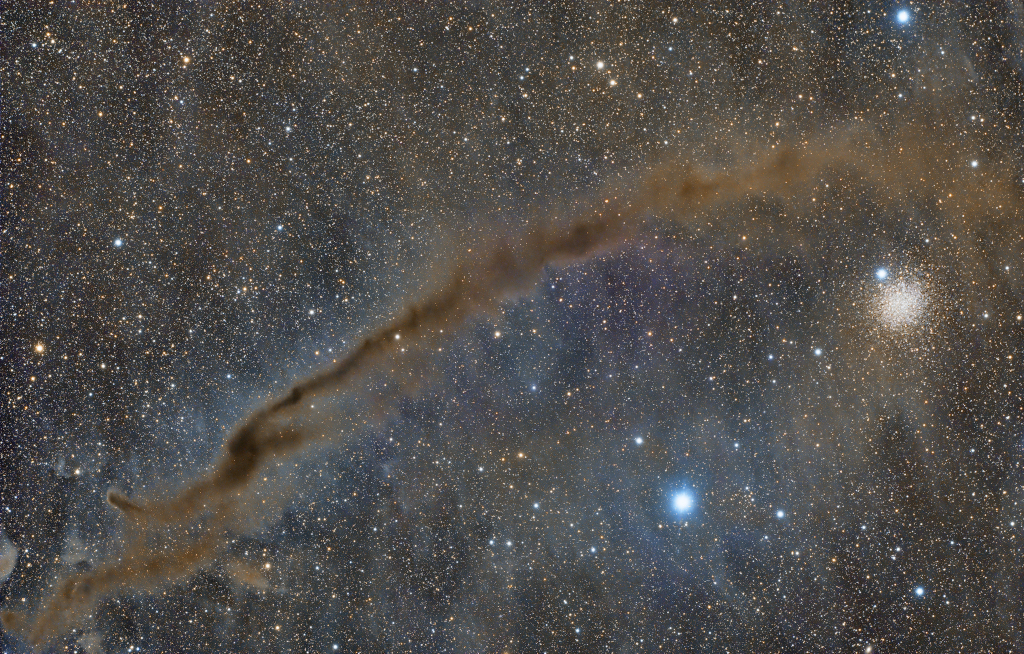
The Dark Doodad Nebula drifts through the southern skies like a cosmic sketch drawn in charcoal, a tantalizing target for binoculars as you sweep toward the modest glow of the constellation Musca—the Fly. This is no ordinary cloud of stardust; it’s a dusty interstellar veil that pops against the rich starfields just south of the Coalsack Nebula and the Southern Cross. If you’re peering through a wide-field setup, the Dark Doodad spans roughly 3 degrees across your view, a generous, ghostly silhouette that invites slow, contemplative scanning rather than a quick, detective-style stare.
Near its southern tip, which in a telescope’s field sits upper right, sits the yellowish globular star cluster NGC 4372. It’s a reminder that what we’re looking at isn’t just a solitary cloud against a starry backdrop, but a complex, layered scene in our Milky Way. NGC 4372 is a halo wanderer of our galaxy, a background object perched about 20,000 light-years away. It’s merely along the line of sight to the Dark Doodad, a reminder of how our celestial vantage point is a kaleidoscope of coincidental alignments rather than strict foreground-background separations.
Dust, Distance, and the Musca Cloud
The Dark Doodad itself sits about 700 light-years from us and stretches over more than 30 light-years in length. Its well-defined silhouette marks it as part of the Musca molecular cloud—a region long suspected of birthing stars, even if its stellar nursery hasn’t spilled its secrets onto our catalogs just yet. The cloud’s darkness—its inky, absorbing dust—contrasts with the glittering starfield behind it, a reminder that in astronomy, absence can be as compelling as presence. The Dark Doodad’s shape has a way of inviting the imagination: a cosmic shade drawing across the cosmos, a celestial doodle that begs to be traced with a pair of trusty binoculars or a modest telescope.
How the Name Stuck
A touch of lore, a dash of whimsy: the Dark Doodad’s name is delightfully alliterative, a moniker born in the 1980s from the keen eye and witty pen of astro-imager and writer Dennis di Cicco. He coined the term in 1986 while observing Halley’s Comet from the rugged outback of Australia. Sometimes the universe gives us not just wonders to observe, but names to savor, and the Dark Doodad is one of those charmingly nerdy, endearing monikers that makes stargazing feel a little more playful.
How to Spot It
If you’ve got a skychart, a pair of binoculars, and a patient gaze, here’s how to spot the Dark Doodad on a clear southern night. Let the Coalsack and the Southern Cross provide your anchors. Scan into the Musca region—no need for expensive gear to appreciate the cloud’s evocative silhouette. Let your eyes relax into the field; the contrast between the dark dust and the sparkling backdrop will reveal the cloud’s softly ragged edges and its graceful, elongated drift across the sky.
Why the Darkness Matters
Why does the Dark Doodad matter to stargazers? Because it’s a vivid reminder that the Milky Way isn’t a flat, glossy ribbon of stars. It’s a layered, dusty tapestry with pockets of possible star formation, where light bends, dust absorbs, and gravity teases matter into motion. The Dark Doodad sits at the intersection of curiosity and observation—a reminder that even in darkness, astronomy offers a silhouette of possibility.
If you’re feeling ambitious, take a longer look with a modest telescope. The tug of the surrounding starfields becomes even more pronounced, and the cloud’s edges may reveal subtle irregularities that hints of internal structure—perhaps clumps of dust or varying densities along its 30-light-year length. It’s not a grand nebula in the fashion of Orion, but it has the charm of a quiet, well-defined shadow that invites longer, more intimate observing sessions.
In the end, the Dark Doodad Nebula is a reminder that sometimes the most captivating features aren’t the brightest beacons in the sky but the rhythm of shadow and light that threads through the night. It’s a celestial doodle worth pausing for, a small but meaningful nook of our galaxy that keeps reminding us: the universe has a sense of humor, and a taste for elegant silhouettes that pay off with just a little patience, and a good pair of binoculars.
<a href="https://ift.tt/Q1Z3EqS
” target=”_blank” rel=”noopener”>Image via NASA
© 2026 ways4eu.wordpress.com H.J.Sablotny — All rights reserved. The text content of this post is the intellectual property of H.J.Sablotny. Images are subject to their respective copyright holders and are used for illustration purposes only.