Ways4eu WordPress.com Blog
SPA View of ways4eu.wordpress.com
The Curious Case of Planetary Nebula Knots: When Gas Gets a Mind of Its Own
By Kinda Cool
on Fri Aug 21 2026
Quick Links
- Cosmic Knots in the Twilight
- A Helix Close-Up from Webb
- How the Knots May Form
- Earth-Mass Clumps on Vast Scales
- Why Helix Matters Nearby
- A Messy Stellar Farewell
The Curious Case of Planetary Nebula Knots: When Gas Gets a Mind of Its Own
Cosmic Knots in the Twilight
If you’ve ever stared at a planetary nebula and whispered, “Is that a cosmic doodle or a rumor from the universe’s dusty archives?” you’re not alone. The universe has a knack for throwing curveballs at the end-of-life stories of stars, and one of its most delightful mischief-makers is the appearance of little gas-and-dust knots—tiny, comet-like clumps that seem to have formed out of nowhere. You’ve seen them in familiar friends like the Ring Nebula, the Dumbbell Nebula, and NGC 2392, but their origin story remains as tangled as the knots themselves.
A Helix Close-Up from Webb
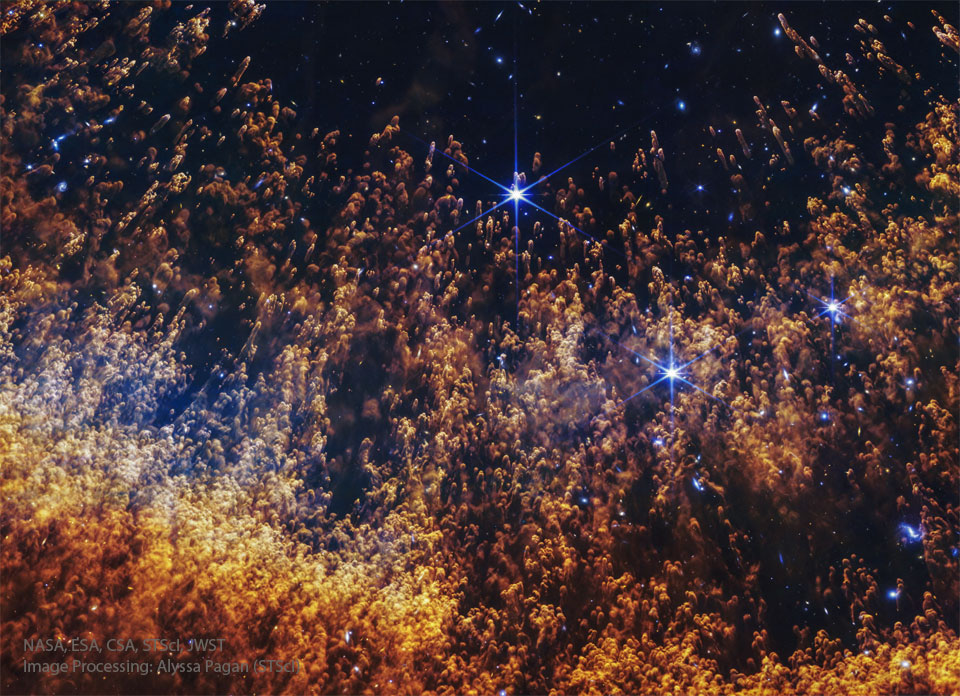
Pictured here is one of the universe’s most dramatic close-ups: a segment of the Helix Nebula, captured by the James Webb Space Telescope in exquisite infrared detail. The image reveals a forest of knots, each with a life of its own, dancing in the glow of a dying star. These cometary knots, collectively, challenge our intuition about how planetary nebulas shed their layers and how small-scale structures can weather a star’s final gusts.
How the Knots May Form
How do these knots form? There isn’t a single, tidy answer—scientists describe a few competing ideas, and the jury is still out. One leading notion involves a kind of cosmic fragmentation: as the central star of the nebula winds down, its dying breath becomes a powerful, energetic flow. This stellar wind – less dense than the surrounding gas, but incredibly energetic – can push and sculpt the existing gas into finger-like protrusions that we see as knots. Over time, these knots evolve, their surfaces sculpted by the wind and radiation from the hot stellar core. The result is a field of little pillars and tails, some with lengths that make Pluto look almost punctual.
Size and mass add another layer of wonder. These cometary knots typically carry masses comparable to Earth, yet their physical size is something more akin to a planetary-scale picnic: their diameters generally stretch to several times the orbit of Pluto. In other words, we’re dealing with Earth-mass clumps that are squeezed into—let’s call it—cosmic popcorn kernels: dense enough to persist, light enough to be swept around by the nebula’s gas flows, and long-lived enough to make future observers marvel at their persistence.
Earth-Mass Clumps on Vast Scales
It’s worth noting that these knots are not solely the domain of Helix. The Ring Nebula, the Dumbbell Nebula, and NGC 2392 display similar knotty features, hinting at a common mechanism at work during the late stages of a sun-like star’s life. The fact that these structures were not predicted in early models is a gentle reminder that the universe loves to surprise us, especially when we’re peering at the moments right before a star sighs its final luminous breath.
Why Helix Matters Nearby
The Helix Nebula, or NGC 7293, occupies a special place in our cosmic neighborhood. It is one of the closest examples of a planetary nebula—the spectacular end stage of a Sun-like star. At roughly 650 light-years away, in the direction of Aquarius (the Water Carrier), it offers astronomers a rare opportunity to study the delicate ballet between stellar wind, ionizing radiation, and the stubborn little knots that refuse to be tidied away by the star’s last hurrah.
So what should we take away from this knotty business? First, planetary nebulas are not just pretty shells of gas fading into the night. They are dynamic laboratories where winds collide, radiation carves, and tiny, Earth-mass knots carve out a local geography that future telescopes will continue to map in ever-increasing detail. Second, the knots remind us that the end of a star’s life is not a simple, clean curtain drop but a messy, intricate, and beautifully chaotic process. And third, the James Webb Space Telescope’s infrared prowess shows us a world we could only imagine before: structures so delicate, so persistent, that they demand new theories and a renewed sense of cosmic curiosity.
A Messy Stellar Farewell
If you’re hunting for a mental image to accompany the science, picture a star shedding its outer layers like a celestial gardener pruning a bushel of delicate, gleaming beads. Each bead—each knot—is a small, stubborn world, held together by gravity, radiation, and the stubborn push of a stellar wind. They drift, they shimmer, and in their quiet persistence they tell a story of stellar aging that’s both humbling and wonderfully strange.
In the end, the knots of gas and dust are more than mere curiosities. They are signposts pointing toward how complex and nuanced stellar death can be. They remind us that even in the twilight of a star’s life, there’s a lively subculture of structure, preference, and motion—one that we are only beginning to map with clarity, one infrared image at a time.
© 2026 ways4eu.wordpress.com H.J.Sablotny — All rights reserved. The text content of this post is the intellectual property of H.J.Sablotny. Images are subject to their respective copyright holders and are used for illustration purposes only.